
This article was first published on TurkishNYR.
The BRICS bloc has moved from a loose economic club to a serious architect of new financial rails. Brazil, Russia, India, China and South Africa are not only reshaping trade and reserves. They are also building a parallel digital asset infrastructure that challenges the dominance of the United States dollar and the existing cross-border payment system.


At the center of this shift sit three pillars. Central bank digital currencies, tighter but clearer crypto regulation, and a gradual push toward de-dollarization in trade and settlement. Together, these trends make BRICS one of the main laboratories for how global crypto adoption will look in the next decade.
BRICS, de-dollarization and the new payment rails
BRICS members hold a large share of global foreign exchange reserves and have signalled that they want a more balanced currency order. Analysts note that BRICS plus countries together control more than 40 percent of global central bank reserves, and the bloc is exploring alternatives that reduce reliance on the dollar in trade and finance.
Projects such as BRICS Pay and the proposed BRICS Bridge payment system illustrate this ambition. These initiatives promote regional payment schemes that bypass traditional networks such as SWIFT, reduce cross border transfer costs and shield members from external sanctions.
In practical terms, that puts blockchain-based rails, CBDCs, and stablecoins right in the spotlight as tools for cheaper, faster settlement across borders.
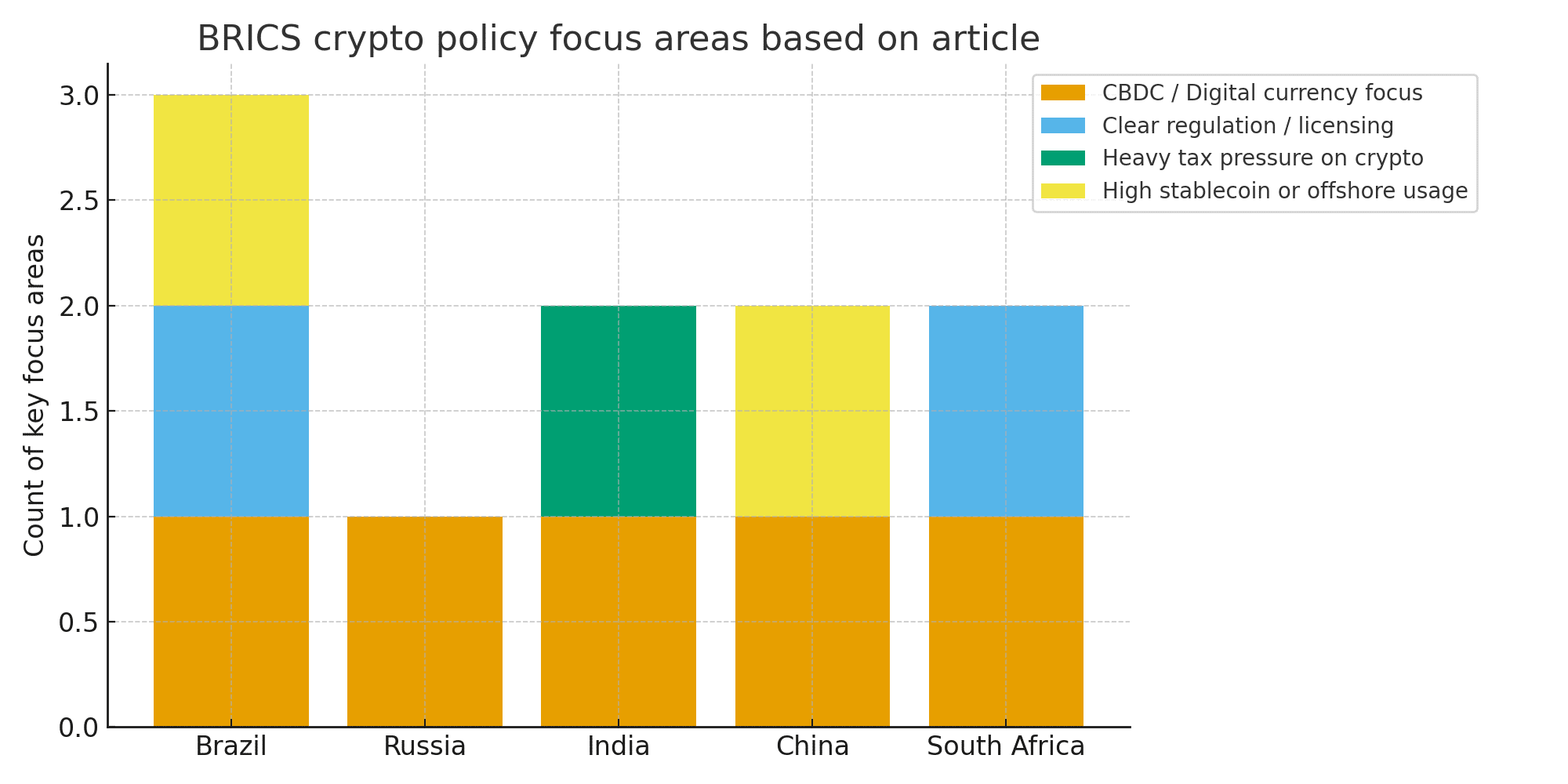
Brazil: Stablecoins, regulation and everyday crypto
Among BRICS members, Brazil currently stands out as one of the most active crypto markets. Recent data shows that in 2024, Brazil received an estimated 318.8 billion dollars in crypto value, nearly one-third of all inflows in Latin America and enough to place the country among the top global adopters.
Central bank officials estimate that around 90 percent of Brazil’s crypto flows are tied to dollar-backed stablecoins. These tokens are widely used for foreign purchases, cross-border payments, and informal access to dollar liquidity, which has started to affect local capital flow volatility.
Regulators are reacting with a firmer framework. Brazil’s central bank has recently published detailed rules for virtual asset service providers, extending anti money laundering and consumer protection standards to exchanges and stablecoin platforms. The rules, which start to apply in 2026, classify many stablecoin transactions as foreign exchange operations and bring them under tighter supervision.
At the same time, Brazil is developing Drex, a wholesale CBDC infrastructure that uses distributed ledger technology to tokenize collateral and improve interbank settlement. The combination of high retail demand, stablecoin intensity and a modernized regulatory and CBDC agenda makes Brazil a reference point for how a large emerging economy can fold crypto into a formal financial system.
Russia: Digital ruble and sanctions-resistant settlement
Russia’s digital ruble project is driven by a different pressure point. After Russian banks were cut off from SWIFT, policymakers started to treat a domestic CBDC and new payment rails as a potential shield against sanctions. The digital ruble was signed into law in 2023, and pilot testing with real users and merchants began the same year with a group of banks and businesses across several cities.
The pilot continues to expand. Large financial institutions such as the country’s biggest bank have joined, and thousands of individuals and companies now test digital ruble payments in day to day scenarios. Authorities have signalled that full scale rollout will come later than originally planned, after more consultation with banks and users, which reflects both ambition and caution.
For global crypto adoption, Russia’s experiment matters in two ways. First, it shows how CBDCs can be used to reroute cross border flows around existing messaging networks. Second, it reminds the market that digital currencies can serve geopolitical aims as much as efficiency goals.
India: Heavy tax, tight rules and a compliance blueprint
India has taken a starkly different stance. The government has not banned crypto, but it has made trading expensive through taxation. Profits from crypto transfers are taxed at a flat 30 percent rate, and most transactions are subject to a 1 percent tax deducted at source. Losses cannot be offset against other income, which makes speculative trading far less attractive.
Tax authorities have followed up with enforcement. Investigations have found widespread non compliance by traders who used arbitrage bots and stablecoins without reporting gains properly. Thousands of notices are being prepared, which sends a clear message that regulators treat crypto as fully taxable virtual digital assets.
At the same time, India is piloting its own CBDC and positions it as a safer state-backed alternative to private cryptocurrencies and stablecoins. The central bank has highlighted the systemic risks of unregulated digital assets while promoting the digital rupee as a controlled innovation.
India’s model is significant for global adoption because it shows how a large market can keep crypto activity within strict tax and reporting walls while still experimenting with public digital money.
China: Digital yuan and the offshore yuan play
China has banned most domestic crypto trading, but it has advanced one of the most sophisticated CBDC projects in the world. The digital yuan, or e CNY, is already in large scale pilot across many cities. Authorities are also testing cross-border use. In 2024, residents in Hong Kong gained the ability to open e CNY wallets linked to their local bank accounts and make retail payments to mainland merchants.
Alongside the CBDC, China is supporting experiments with offshore yuan stablecoins that can be used by foreign partners for Belt and Road trade. A recent example is a regulated yuan-linked stablecoin launched in Kazakhstan, designed to support cross-border settlement and to extend yuan usage in regional finance.
This mix of strict domestic controls and active international pilots sends a clear message. China wants to harness blockchain and digital currency technology to internationalise the yuan and to influence the standards for cross border payment platforms, rather than to promote open crypto markets at home.

South Africa: Licensing, DeFi and regulated innovation
South Africa completes the BRICS picture as a test bed for regulated retail crypto. Authorities there formally recognised crypto assets as financial products in 2022 and began licensing crypto asset service providers in 2023. Since then, regulators have approved hundreds of licences for exchanges and other platforms, creating one of the most structured regulatory environments on the continent.
The country is also rolling out stricter anti money laundering rules, including a Travel Rule regime that requires detailed information sharing for crypto transfers. In parallel, the central bank is extending its CBDC pilot, known as Project Khokha, to explore cross border payments and improved financial inclusion.
Recent developments illustrate growing mainstream acceptance. A local digital bank will soon allow customers to trade popular cryptocurrencies directly in its mobile banking application, under full regulatory oversight. This kind of integration blurs the line between traditional finance and digital assets and sets a useful precedent for other emerging markets.
How BRICS shapes key crypto indicators
For global markets, the role of BRICS in crypto adoption shows up in several key indicators that analysts track.
Market capitalisation and dominance remain anchored in global assets such as Bitcoin and Ethereum, but BRICS policy choices influence where new capital flows. Clearer rules in Brazil and South Africa, for example, encourage local institutions to offer regulated products, which supports deeper liquidity and more stable order books in those markets.
Trading volume and liquidity are heavily affected by stablecoins. In Brazil, the fact that most crypto usage is linked to dollar-pegged tokens reveals how traders and businesses rely on them for cross-border purchases and informal hedging. Large and consistent stablecoin volume often signals high retail adoption, but also raises questions about capital controls and macro stability.
Regulatory clarity and taxation form another crucial indicator. India’s 30 percent tax and 1 percent transaction levy show a path where governments treat crypto as fully taxable but still legal. That approach may reduce speculative volumes, yet it can increase the quality of reported data and push serious investors toward compliant platforms.
Infrastructure progress, including CBDCs and projects such as mBridge, signals how future cross border rails may function. Central banks in BRICS and partner economies are testing shared platforms where multiple CBDCs can interoperate, which could shorten settlement times and cut costs for trade flows.
Together, these indicators suggest that BRICS is not only a consumer of crypto technology. The bloc is helping to define what “regulated adoption” will look like in the next cycle.
What this means for global investors and builders
For global investors, BRICS policies create both entry points and friction. Markets such as Brazil may offer high volume, high stablecoin usage and increasingly robust regulatory protection. India sets a high bar for tax compliance, which may reduce net returns but also lowers legal uncertainty. Russia and China show how digital currencies can serve as strategic tools in parallel financial systems, which affects the risk profile of any asset linked to their rails.
For builders, BRICS countries serve as live test environments. Drex, the digital ruble, the digital yuan, and Project Khokha all provide lessons about interoperability, privacy, offline payments, and the balance between state control and innovation. These lessons will feed back into global standard-setting.
In short, the BRICS story inside crypto is about power, but also about plumbing. Whoever shapes the next generation of settlement layers will quietly influence how value moves across borders.
Conclusion: BRICS will not replace the system, but it will rewrite it
BRICS is unlikely to replace the existing global financial system in the near term. The dollar still dominates reserves, trade invoicing and global capital markets. However, the bloc is clearly reshaping the edges of that system.
By combining CBDC experiments, stricter but clearer crypto regulation, and a deliberate push toward de-dollarized payment rails, BRICS members are building real alternatives. These alternatives affect market structure, capital flows and the daily lives of millions of users who now hold stablecoins, pay with digital wallets or interact with licensed exchanges.
As global crypto adoption moves from a speculative phase to an infrastructure phase, the influence of BRICS will grow. Investors, builders and policy makers who ignore this shift risk misunderstanding where the next chapter of digital finance will actually be written.
Frequently Asked Questions
Question 1: How are BRICS countries influencing global crypto regulation?
Answer: BRICS members are introducing clearer legal frameworks for exchanges, stablecoins and service providers, while also piloting CBDCs. Brazil and South Africa focus on licensing and anti-money laundering rules. India uses heavy taxation and strict reporting, and China and Russia rely more on state-backed digital currencies.
Question 2: Why is Brazil important for global crypto adoption?
Answer: Brazil combines high retail and institutional usage with a fast-evolving regulatory framework. Large inflows, strong demand for dollar-backed stablecoins, and a modern instant payment system make the country a real-time case study for mainstream crypto use in an emerging economy.
Question 3: What role do CBDCs play in BRICS strategy
Answer: CBDCs allow BRICS central banks to modernise payment systems, test cross-border settlement, and reduce dependence on foreign messaging networks. The digital ruble, the digital yuan, Brazil’s Drex and South Africa’s pilot projects all serve this broader goal.
Glossary of key terms
Stablecoin: A crypto asset that aims to keep a stable value by linking to a reference asset, often a fiat currency such as the dollar. Stablecoins are widely used for trading and cross border payments.
Central bank digital currency (CBDC): A digital form of central bank money. It is issued by a central bank and can be used for wholesale settlement between banks or retail payments by the public.
Dollarization: The process in which countries reduce their reliance on the United States dollar in trade, reserves, and cross-border finance, often by increasing the use of local currencies or alternative assets.
Virtual asset service provider (VASP): A business that offers services such as exchanging, transferring, safekeeping or managing crypto assets on behalf of customers.
Market capitalization: The total value of a cryptocurrency, calculated by multiplying its current price by the number of coins or tokens in circulation.
Trading volume: The total amount of a crypto asset traded over a certain period. Higher volume usually indicates greater liquidity and market interest.
Tax deducted at source (TDS): A mechanism in which a portion of the transaction value is withheld and paid directly to the tax authority, as used in India’s crypto tax regime.