
When banks close, currencies collapse, or borders become financial walls, digital assets can offer another way to move money. Yet crypto in sanctioned regions is not simply a matter of financial freedom versus government control. The same payment rails that help a displaced family receive aid may also serve sanctioned businesses, armed groups, or state-linked networks.
That tension has turned cryptocurrency into both a practical financial tool and a serious compliance concern. Stablecoins, self-custody wallets, peer-to-peer markets, and public blockchains now play visible roles wherever traditional banking becomes unreliable or inaccessible.


Why Crypto in Sanctioned Regions Gains Traction
War damages more than buildings and roads as it can close bank branches, interrupt card networks, create cash shortages, and separate workers from relatives living abroad. In such conditions, a digital wallet may remain accessible when conventional payment channels are delayed or completely unavailable.
Crypto in sanctioned regions often gains users because it offers speed, portability, and access to assets that may hold value better than weakening local currencies. Dollar-linked stablecoins are especially attractive because they aim to remain close to $1. Bitcoin can also function as portable savings, although its price swings make it less practical for daily household spending.
Humanitarian organizations have tested blockchain-based cash assistance in conflict-affected areas. A programmed supporting people displaced by the war in Ukraine used digital wallets to distribute funds, while a separate model in Afghanistan connected blockchain-backed payments with prepaid cards and local merchants. These systems can improve traceability, but they still require phones, internet access, safe withdrawal points, and basic digital knowledge.
A Financial Lifeline With Serious Limits
For civilians, crypto in sanctioned regions can support remittances, emergency savings, freelance income, aid payments, and cross-border commerce. A person fleeing violence can carry a wallet recovery phrase more easily than a large amount of physical cash. A merchant may accept stablecoins when local money is rapidly losing purchasing power.
Still, cryptocurrency is never entirely detached from the real economy. Users eventually need rent, food, medicine, fuel, or transport, meaning digital assets must connect with local merchants or cash markets.
High transaction fees, weak internet service, scams, wallet theft, limited liquidity, and lost private keys can leave users unable to reach their funds. Stablecoins also carry issuer risk. Some issuers can freeze tokens linked to sanctioned or suspicious wallet addresses.
Sanctions rules generally apply to virtual currency transactions in the same way they apply to fiat payments. Exchanges and other service providers may be required to screen customers, wallet addresses, locations, and counterparties before processing transactions.
When Civilian Use and Sanctions Evasion Overlap
The most difficult issue is attribution as a transaction from a sanctioned country is not automatically illegal, while a harmless-looking wallet may connect to a restricted network several transfers later.
Crypto in sanctioned regions therefore demands context rather than assumptions about an entire population. Investigators must distinguish ordinary household transfers from coordinated activity involving governments, military bodies, brokers, or commercial networks.

On-chain research estimated that sanctioned entities received $15.8 billion in cryptocurrency during 2024. Later analysis reported a sharp increase in state-driven sanctions evasion during 2025, with sanctioned actors making greater use of exchanges, brokers, stablecoins, and layered wallet structures. Iranian cryptocurrency activity reached about $7.78 billion in 2025, with transaction spikes appearing around periods of geopolitical stress.
These figures do not suggest that most users in affected countries are breaking sanctions. They explain why compliance teams examine transaction behaviour rather than relying only on geography.
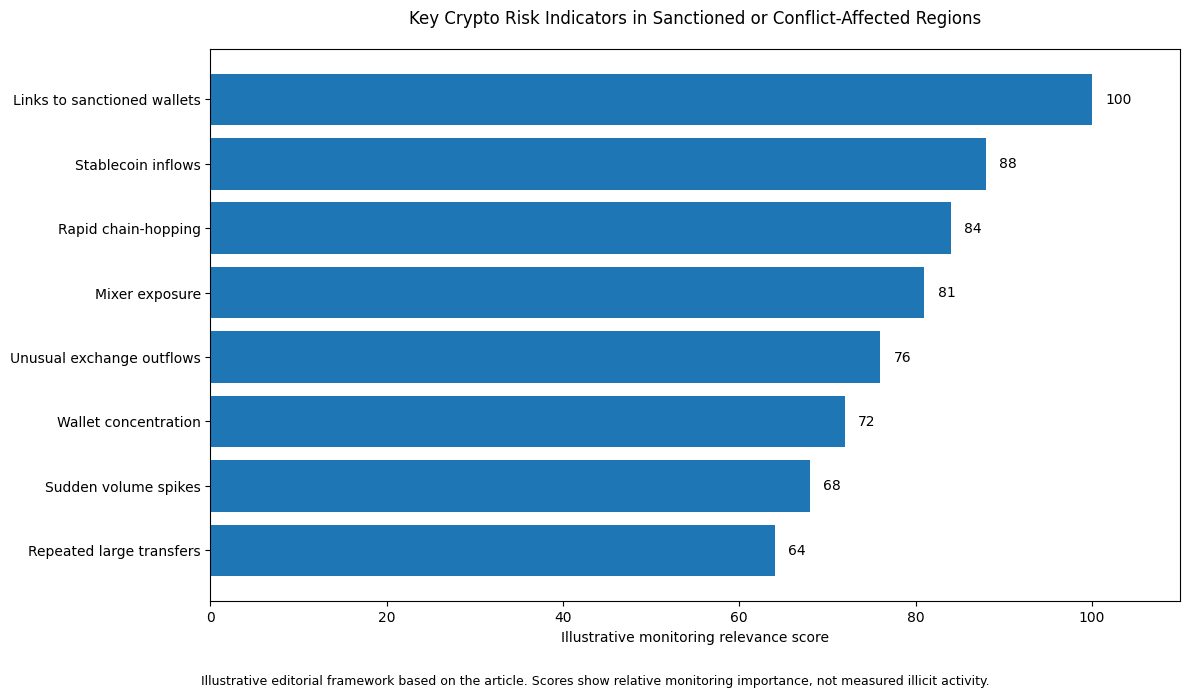
Key Crypto Indicators Analysts Watch
Trading volume is often the first indicator. A sudden rise following an airstrike, banking restriction, currency collapse, or border closure may reflect capital flight, emergency transfers, speculation, or institutional movement.
Stablecoin inflows can signal growing demand for dollar exposure. Exchange outflows may indicate self-custody, fear of seizure, or movement toward peer-to-peer trading. Wallet concentration shows whether funds are widely distributed or controlled by a small group of addresses.
Transaction size also matters. Repeated retail-sized transfers may reflect household use, while large timed movements across connected wallets can suggest organized activity.
Other important indicators include rapid chain-hopping, mixer exposure, newly created wallets, unusual bridge usage, deposits into high-risk exchanges, and direct or indirect contact with sanctioned addresses. International guidance identifies irregular transaction patterns, anonymity tools, geographic risk, unclear sources of funds, and unusual account behavior as warning signs. No single indicator proves misconduct, but several appearing together may justify deeper investigation.
Stablecoins Reshape the Sanctions Debate
Stablecoins have become central to crypto in sanctioned regions because they offer faster settlement with less price volatility than Bitcoin. They can help families preserve purchasing power, yet the same liquidity attracts criminal and state-linked networks.
International monitoring bodies reported that stablecoins represented a substantial share of illicit virtual-asset transaction volume in 2025. They also warned about risks involving self-hosted wallets, layered transfers, and services that obscure the source of funds.
This creates a difficult policy balance. Blocking broad access may punish civilians, while weak controls can leave room for sanctions evasion. A more measured approach uses targeted address screening, transaction monitoring, humanitarian exemptions, licensing rules, and appeal systems for mistaken freezes.
What Responsible Crypto Use Requires
Responsible use of crypto in sanctioned regions begins with a lawful purpose and verified counterparties. Humanitarian organizations need controlled distribution systems, privacy safeguards, reliable redemption options, and backup plans when communication networks fail.
Exchanges should use risk-based reviews instead of treating nationality alone as evidence of wrongdoing. Users must understand wallet security, local regulations, token-freezing powers, counterparty risk, and price volatility before moving funds.
Public blockchains create visible transaction records, but visibility does not automatically reveal who controls an address. Effective analysis combines on-chain data with legal records, exchange information, geographic signals, and verified intelligence.
Conclusion
Crypto in sanctioned regions is neither a complete cure for broken financial systems nor merely a sanctions loophole. It is infrastructure, and its impact depends on who uses it, why it is used, and which services support the transaction.
For civilians, crypto in sanctioned regions can keep remittances, savings, and humanitarian payments moving when ordinary banking fails. For sanctioned actors, the same technology can support more organized attempts to move value outside regulated financial channels.
The practical response is not blanket prohibition or blind acceptance. Targeted enforcement, stronger monitoring, humanitarian safeguards, and clearer regulations can protect legitimate access while making abuse harder and more expensive.
Frequently Asked Questions
Is cryptocurrency legal in sanctioned countries?
Legality depends on the country, user, asset, transaction, service provider, and applicable sanctions programmed.
Can stablecoins be frozen?
Yes. Some stablecoin issuers can block identified wallet addresses or stop certain tokens from moving.
Is Bitcoin anonymous?
No. Bitcoin is pseudonymous, and transactions recorded on its public blockchain can often be traced.
Why is crypto used during war?
People may use it for remittances, emergency savings, humanitarian aid, remote work payments, or cross-border transfers.
Glossary of Key Terms
Stablecoin: A digital token designed to track an asset such as the US dollar.
Self-custody: Direct control of cryptocurrency through private keys.
On-chain data: Transaction information permanently recorded on a blockchain.
Mixer: A service designed to obscure links between sending and receiving wallets.
Sanctions screening: Checks used to identify restricted people, companies, regions, or cryptocurrency addresses.
Disclaimer: This article is provided for educational and informational purposes only. It does not constitute legal, financial, sanctions compliance, or investment advice.