World Cup prediction markets have become one of the strongest early signals of how sports, crypto-style trading, and event contracts are starting to overlap. Before the June 11 kickoff, traders have already pushed the main tournament-winner market to about $2 billion in volume, with Spain and France almost tied at the top. That is not a small side market anymore. It is a live, global pricing board for football expectations, built around money, probability, and fast-moving public opinion.
World Cup Prediction Markets Show a Tight Race at the Top
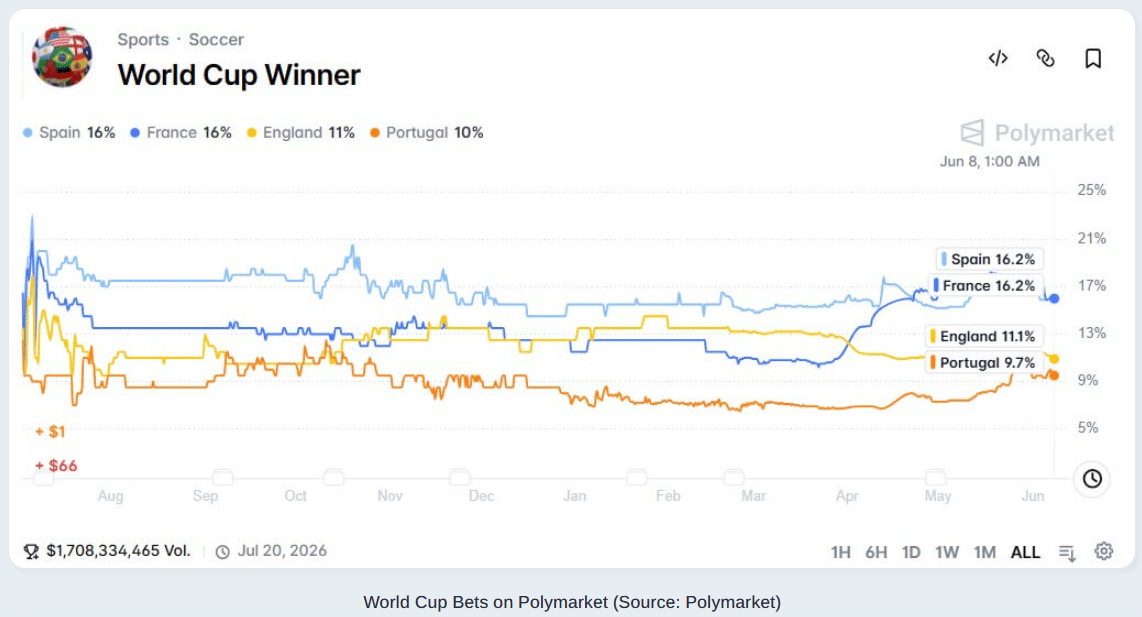
World Cup prediction markets currently price Spain and France near 16% implied odds to win the tournament. England follows around 11%, Portugal sits close to 10%, and defending champion Argentina trades near 9%. These figures do not mean Spain or France will win. They show where traders are placing capital today.


In simple terms, a contract priced at $0.16 suggests a 16% market-implied chance. If that team wins, the contract pays $1. If the team loses, it becomes worthless. That structure turns football debate into a tradable market, much like how investors price stocks before earnings or Bitcoin before a major macro report.
Why the $2B Volume Matters
World Cup prediction markets are drawing attention because liquidity is arriving before the first whistle. High volume usually matters because it can make prices harder to distort, while also showing broader trader interest. Still, volume is not the same as truth. A market can be liquid and still wrong, especially in sports, where one red card, injury, or penalty shootout can flip the entire bracket.
The 2026 World Cup also has a larger format, with 48 teams and 104 matches. That gives traders more information to react to and more chances to misprice emotion. A group-stage upset can move odds in minutes. A star player injury can do the same. This is where World Cup prediction markets may face their first true stress test at scale.
Crypto Trading Habits Move Into Sports
World Cup prediction markets feel familiar to crypto traders because the mechanics are similar. Prices move in real time, sentiment matters, liquidity can shift fast, and traders often chase momentum. The difference is that the underlying asset is not Bitcoin, Ethereum, or XRP. It is an outcome.

That makes the product both powerful and risky. A trader can express a view without using a sportsbook. At the same time, these markets may attract users who do not fully understand probability, payout structures, liquidity depth, or jurisdictional restrictions. For crypto readers, the lesson is clear. A clean interface does not remove market risk.
Regulation Remains the Biggest Test
World Cup prediction markets are also testing legal boundaries. Some venues operate under financial-market rules, while others face restrictions in certain jurisdictions. Regulators are asking whether sports event contracts are legitimate derivatives, gambling products, or something in between.
That question matters because classification affects consumer protection, marketing rules, age checks, tax treatment, and surveillance requirements. If regulators tighten oversight, platforms may need stronger identity checks, clearer risk warnings, and better systems to detect manipulation or insider-style trading.
What Traders Should Watch Next
World Cup prediction markets will likely become more active once matches begin. The most important indicators are trading volume, bid-ask spreads, price swings after injuries, and whether favorites hold their odds after early games. Thin liquidity can create sharp moves, while deep liquidity may help prices settle faster.
Spain and France may lead now, but knockout football rarely rewards straight-line thinking. Tournament paths matter. So does fatigue, squad depth, and luck. Markets can help measure expectations, but they cannot remove uncertainty.
Conclusion
World Cup prediction markets have crossed into serious territory with $2 billion in pre-kickoff volume and a tight race between Spain and France. The rise shows how event contracts are moving from niche crypto circles into mainstream sports conversation. Yet the bigger question is not only who wins the World Cup. It is whether these markets can handle pressure, regulation, and retail demand without losing trust.
Frequently Asked Questions
What are World Cup prediction markets?
They are tradable markets where users buy and sell contracts based on World Cup outcomes, such as which team will win the tournament.
Why are Spain and France leading?
Traders currently price both teams near 16% implied odds, reflecting strong squads, market confidence, and early tournament expectations.
Are these markets risk-free?
No. Prices can move quickly, and traders can lose the full amount paid for a contract if the outcome does not happen.
Glossary of Key Terms
Implied Odds: The probability suggested by a market price.
Liquidity: The ease of buying or selling without sharply moving the price.
Event Contract: A contract that pays based on whether a specific event happens.
Settlement: The final payout process after the event result is confirmed.
Sources
Disclaimer: This article is for informational purposes only and is not financial, betting, legal, or investment advice.