This article was first published on TurkishNYR.
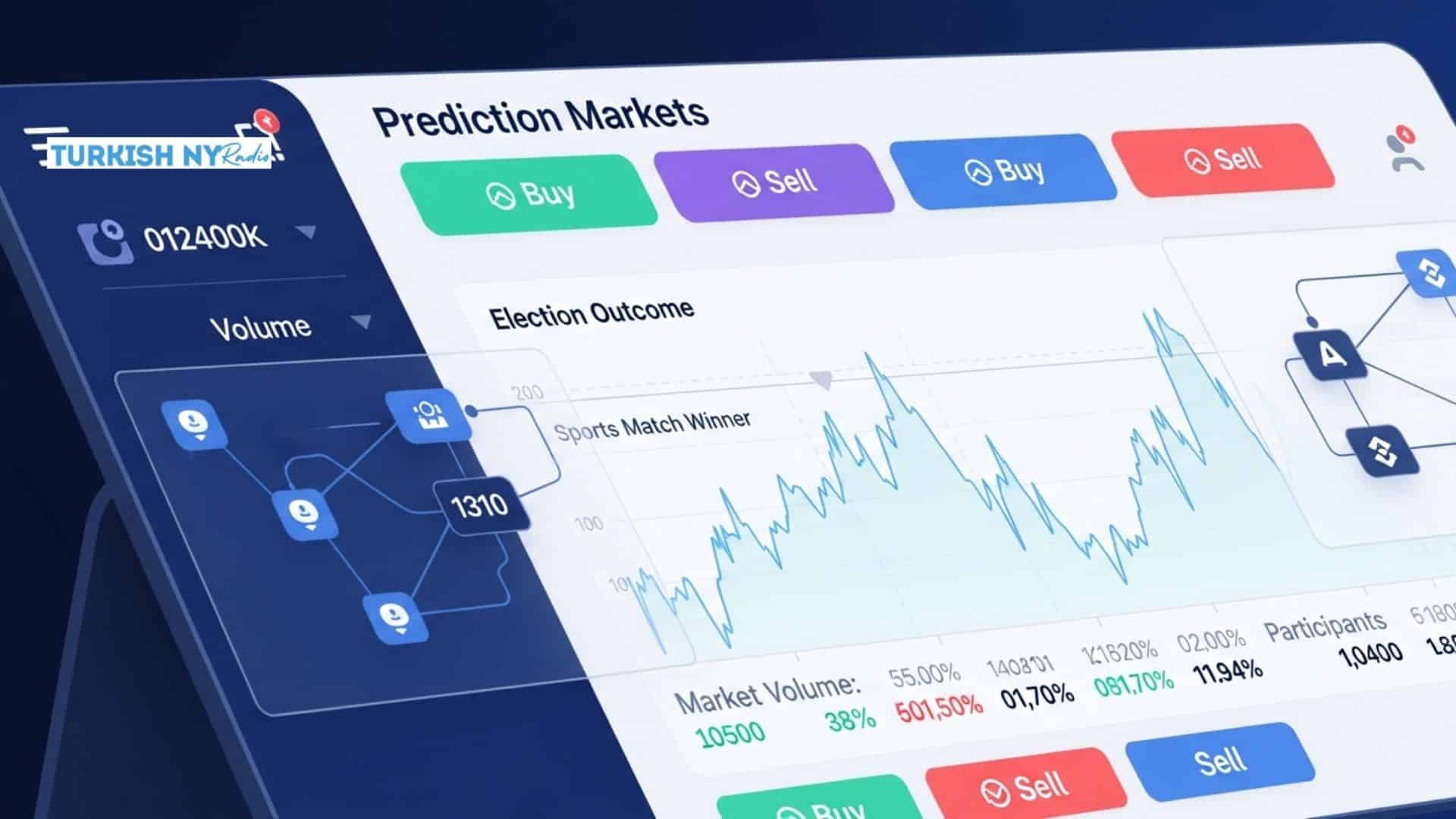
Blockchain-powered crypto prediction markets have gained popularity and it’s no surprise. Unlike the way traditional stock or commodity exchanges work, these markets let anyone bet on the outcome of real-world events (elections, sports results, economic data etc).


Sources note that crypto prediction markets use blockchain technology to create liquid platforms for forecasting and hedging real-world events by using drawing in both retail users and Wall Street firms.
Polymarket, one of the leading DeFi prediction platforms, saw $25.7 billion in trading volume in March 2026 alone and major exchanges like ICE have pumped in over $600 million into Polymarket in the hopes of getting a foothold.
What Are Crypto Prediction Markets?
Crypto prediction markets are blockchain-based platforms where users trade on future events, just using contracts. They let users buy and sell shares on outcomes. Each market usually comes in one of two forms: binary (yes/no) or a multiple-choice question, with a fixed $1 payout if the chosen outcome happens.
For instance, a contract like “Will X win the election?” will trade at $0.70 if the crowd thinks there’s a 70% shot X is going to win. If X does happen to win, those who said yes get $1; otherwise they get nothing.
Because they’re based on blockchain, everything gets automated through smart contracts. Users deposit stablecoins (like USDC) into the contract and it locks them up in escrow till the event outcome is finalized.
This on-chain setup eliminates the middlemen and counterparty risks. Winners get paid instantly and automatically once the results have been verified.
Decentralized oracles (like Chainlink) or community dispute resolution systems (like Kleros and UMA) feed the event outcomes to the chain, and that solves the “oracle problem” of getting real-world data on the blockchain.
In short, crypto prediction markets are just a way to trade event-driven “bets” using public smart contracts, and they take advantage of blockchain’s transparency and security.
Use Cases of Crypto Prediction Markets
Crypto prediction markets have diverse applications. Some of the key use cases include:
Election and Political Forecasting: Markets aggregate public sentiment on elections, legislative actions or geopolitical events. Research shows that liquid prediction markets can often do better than opinion polls when it comes to forecasting election outcomes.
In effect, they turn the opinions of a lot of people into something you can put a price on. For example, Polymarket’s U.S. election markets (built on Polygon) have become some of the most widely-cited ways of measuring campaign probabilities. Here’s a summary of the major use cases below:
| Use Case | Example / Platform | Impact & Benefit |
| Election & Politics | Polymarket, PredictIt, Kalshi | Transforms polls into real-time probabilities. Often more accurate than surveys. |
| Sports & Entertainment | Polymarket (NFL, March Madness) | Massive volume (e.g. $10.1B in Q1 2026 on sports). Engages fans by enabling peer-to-peer betting without intermediaries. |
| Financial & Crypto Markets | Polymarket crypto-price markets, Augur | Speculation/hedging on asset prices or economic indicators. E.g. users bet on Bitcoin price moves or Fed rate changes. |
| Weather & Natural Events | (Conceptual – e.g. weather futures) | CFTC notes farmers can hedge crop risks via weather event contracts. On-chain markets could similarly trade insurance-like contracts. |
| DeFi & Yield Strategies | Polymarket, Syndicate-style venues | Prediction positions are now used as DeFi collateral and yield assets. As Bitget reports, “prediction market positions are now used as loan collateral” and merged with yield farming strategies. |
These examples show that crypto prediction markets serve as a true wisdom-of-the-crowd tool, working across all sorts of domains. They let individuals and institutions hedge their bets on niche risks and tap into the collective insights of the crowd.
It is worth noting that institutional interest is on the rise: the ICE (NYSE) has come out with analytics tools and invested heavily, and even the CME Group is now offering event-linked derivatives and in doing so has increased market depth.
How Blockchain Powers Prediction Markets
Putting prediction markets on the blockchain offers clear advantages. With blockchain, these markets become open and global to anyone (all you need is a wallet to participate).
Every bid and outcome is recorded in a public ledger, giving auditability that traditional bookmarkers can’t compete with. And with Automated Market Makers (AMMs) or pooled funds, liquidity can be automated so users can trade even illiquid events without needing a centralized market maker.
Crypto markets cut out the middleman because smart contracts deal with trade execution and settlement. This means payouts happen the moment the outcome is resolved and there’s no central counterparty that could put one’s trade at risk.
Platforms usually use stablecoins like USDC for settlement. Decentralized oracles then crowdsource the event results. For example, multiple nodes might report the outcome of an election, or a dispute process like Augur’s can sort out any conflicts that come up.
As a result, crypto prediction platforms combine crowd wisdom with blockchain integrity so they can give truth-seeking forecasts while keeping track of every action that takes place.
Major Platforms and Infrastructure
There are some main platforms driving the crypto prediction market space. The most well-known blockchain-based platforms include:
Polymarket: A web3 market (built on Ethereum/Polygon) known for its deep liquidity and user-friendly interface. It supports a wide range of categories (politics, finance, sports) and reached a monthly trading volume of $25.7 billion in March 2026. Polymarket’s transparent order books and early-exit features make it a favourite among active traders.
Augur: One of the first decentralized markets (it went live back in 2018). Augur is Ethereum-based with a permissionless protocol. Anyone can create their own custom market. Trades use P2P orderbooks and the REP token incentivizes accurate outcome reporting. Augur uses smart contracts to facilitate trades and settle outcomes, offering truly open and trustless markets.
Omen (Gnosis): A conditional-token market on the Ethereum/Gnosis chain. Omen focuses on permissionless market creation. It lets users launch new markets without needing to get central approval, essentially tapping into community input on event probabilities.
Kalshi: (Not blockchain-based) A licensed U.S. exchange offering event contracts (elections, economy, etc.). Kalshi requires full KYC and US dollar settlement, illustrating the regulated side of prediction markets.
Syndicate/Diversion (DeFi tools): Emerging DeFi protocols allow pooled betting and cross-chain prediction markets. For example, newer platforms are integrating AI and social features (like Pariflow) to make participation a whole lot easier.
The table below gives a breakdown of some key blockchain-based platforms:
| Platform | Launch Year | Blockchain | Mechanism | Notable Features |
| Polymarket | 2020 | Ethereum / Polygon | Orderbook/AMM | Largest trading volume ($25.7B in Mar ’26); deep markets in politics, sports, crypto. |
| Augur | 2018 | Ethereum | Orderbook | Fully permissionless: users can create any market; uses REP token for resolution. |
| Omen | 2020 | Gnosis / Ethereum | AMM (Conditional Tokens) | Open market creation; emphasizes community-driven, censorship-resistant markets. |
| Manifold | 2020 | Web (virtual $) | Centralized | Social forecasting with play-money (no real funds); user-friendly (listed for context). |
| Kalshi | 2021 | Fiat / Regulated | Centralized | CFTC-regulated events; full KYC; cash-settled; contrasts with DeFi-native markets. |
Advantages of On-Chain Prediction Markets
Bringing prediction markets on-chain comes with some benefits:
Global Access: Anyone, no matter where they are, can join in and trade, expanding the influx of liquidity beyond any one place. There’s no need to be in a specific region or even have a bank account (although some platforms may voluntarily do ID checks).
Total Transparency: Every trade and order is on open display. Experts can check for real volume and spot people scamming the system. This openness also helps when it comes to regulations and law enforcement if they ever need to get involved.
Instant Settlements and Automation: Smart contracts make payouts happen the second an event is done. You don’t have to worry about trusting the other person; the code does the maths and you get paid in real-time.
Always Tradable: A lot of on-chain prediction markets use automated market makers so one can trade at any time. Liquidity providers can just stake their money in pools so users can enter/exit positions at any time.
Data Richness: The on-chain records create a wealth of data for experts to dig into. For example, analysts can study charts to see what’s influencing the market.
These advantages turn on-chain prediction markets into seriously useful tools for forecasting. In fact, studies have shown that the crowd’s aggregated bets can be a much better truth finder than more traditional methods.
Challenges and Risks
On-chain prediction markets still have a few major hurdles to overcome:
Regulatory Grey Area: The biggest problem is legality. A lot of jurisdictions think they’re on the line between licensed derivatives and banned gambling. In the US, the CFTC says Prediction Market contracts are derivatives, while some states call them illegal betting.
Laws like the 2026 DEATH BETS Act prohibits bets on wars or terrorism. Even globally, dozens of countries have shut down or restricted prediction markets under gambling or finance laws. This means operators and users have to tread carefully.
Oracle and Data Integrity: The ‘oracle problem’ is still a major challenge. Prediction markets rely on oracles to report back the outcomes of events – but these oracles themselves often need to be trusted or decentralized enough to prevent manipulation . Ensuring accurate, tamper-proof data for politically sensitive events or corporate decisions is non-trivial. If oracles fail, markets can settle incorrectly, reducing confidence.
Liquidity and Market Quality: A lot of markets don’t really have enough people trading to make them reliable. Without deep liquidity, a huge whale can skew the odds. Polymarket and a few others have had huge volumes, but many niche events still see really sparse trading.
Often professional market makers need to step in to keep things stable. If users are worried that a few trades can swing prices all over, they might lose faith in the whole system.
Market Manipulation & Insider Trading: Even with transparency, risks exist. A recent high-profile example hit Polymarket: a U.S. soldier allegedly used classified intel to place a bet on a foreign conflict and netted $410K. It was caught through blockchain tracking, but still raises concerns about the potential for prediction markets to encourage insider trading.
Then there’s the issue of wash trading where fake volume is artificially created by traders buying and selling at the same time. On the plus side, because all trades are on-chain, it’s easy for analytics tools to spot suspicious patterns. It is up to the platforms to build strong anti-money laundering and market surveillance processes as they grow.
Usability and Access: A lot of crypto prediction markets require some level of familiarity with crypto (setting up wallets, swapping tokens etc.) which can make things tough for the average user. This limits mainstream adoption.
That said, a lot of new entrants (Pariflow) are really focused on building interfaces that are easy to use, and some of the bigger crypto players (like Coinbase, Crypto.com) are taking a serious look at incorporating prediction market features into their apps.
Regulatory Terrain
In the US, recent events have really created a tense outlook:
- The CFTC has been pushing for event contracts to be considered under federal derivatives law. If accepted by courts, the CFTC could clear the way for national regulation, overriding state bans.
- States like New York and Illinois are treating these as forms of gambling, and there are ongoing lawsuits as of May 2026 about whether states can shut down prediction market platforms that operate within their borders.
- Congress has proposed laws: e.g. bills banning certain war/terrorism bets and restricting federal officials from trading on PMs.
- The SEC is also keeping an eye on things, and might step in if any market starts to look like a security.
Outside the U.S., a lot of countries have banned prediction markets outright. Over 30 nations have taken action to shut down major platforms (via gambling laws or crypto bans). For example, in early 2026 Brazil closed more than 25 prediction sites, while Argentina blocked access nationwide. The EU and UK haven’t clarified much but draft regulations like the EU’s MiCA bill are suggesting a requirement for licenses by late 2026.
In the Asia-Pacific region, markets in Singapore, Australia, India and others treat prediction markets as illegal betting so operators have to navigate this really complex and varied regulatory landscape with care.
Conclusion
Despite all the obstacles, the outlook is still good. The major financial giants players are really betting on this market’s future and some of the bigger consumer crypto apps (Coinbase, Robinhood) are starting to explore adding PM features, while firms like Bitwise have filed for prediction-market ETFs which would give investors exposure to the market without having to take on the risks of individual contracts.
Innovation is still happening, cross-chain prediction market platforms are emerging that can aggregate liquidity from around the world, and some are even exploring AI-driven forecasting interfaces.
If regulatory clarity improves, the market could see really explosive growth.
Crypto Prediction Markets are rapidly maturing into powerful forecasting tools with a ton of potential applications, but also a lot of legal and technical hurdles to get over first.
Glossary
Prediction Market: a platform where users trade contracts that pay out based on the outcome of future events.
Smart Contract: These are self-executing code on a blockchain that enforce the rules of trades.
Oracle: This is a service that brings real-world data (like who won an election) onto the blockchain, so that smart contracts can use it to make decisions.
AMM (Automated Market Maker): This is a decentralized mechanism (often a smart contract) that keeps markets liquid by pricing trades automatically. AMMs let people trade continuously without the need for order books.
Liquidity: This just means how easy it is to buy or sell assets.
CFTC (Commodity Futures Trading Commission): This is the U.S. regulator that oversees commodity and derivatives markets.
Frequently Asked Questions About Crypto Prediction Markets
What are crypto prediction markets?
They are blockchain-based platforms where users trade contracts on future events and each contract pays out if the event actually occurs. Smart contracts and stablecoin settlement sort out the trades automatically.
How do prediction markets differ from polls or betting?
Unlike polls, prediction markets attach real money which creates financial incentives. Studies show that prediction markets regularly do a better job of forecasting than polls. Compared to traditional bookmaking, crypto prediction markets run on transparent smart contracts (no middleman), and settle quickly.
Are crypto prediction markets legal?
That depends on jurisdiction. Some countries view them as derivatives (legal if regulated) while others are outrightly banning them as gambling.
How does the outcome of an event get determined securely?
Most platforms use decentralized oracles or peer-driven reporting to make sure outcomes get verified properly.
References
Disclaimer: This article is for informational purposes only and does not constitute financial or legal advice. Prediction markets are speculative and involve financial risk; always do your own research before participating.