
The Tether Georgia stablecoin plan has pushed Georgia into one of the most watched corners of digital finance, where national currency, private stablecoin infrastructure, and state-backed regulation are beginning to overlap. Tether and the Government of Georgia plan to launch GEL₮, a stablecoin representing the Georgian lari, with details on structure, rollout, and regulatory implementation still expected later.
The move is being framed as a payment-focused initiative, not merely another crypto market product, because it aims to support faster settlement, lower costs, programmable payments, fintech development, and cross-border commerce.


Tether Georgia Stablecoin Moves the Lari Into Crypto Payments
The Tether Georgia stablecoin initiative centers on GEL₮, described as a digital representation of the Georgian lari. In plain terms, it would allow the local currency to move across blockchain-based rails while keeping its link to a sovereign fiat currency. That matters because stablecoins are increasingly used for transfers, trading, remittances, and settlement, even though they are still not widely accepted as day-to-day payment tools in many economies.

For Georgia, the timing is not random as the country has spent years building a clearer digital asset framework, and the National Bank of Georgia has already worked on rules covering reserve management, issuer oversight, redemption rights, and AML compliance. That regulatory base gives the Tether Georgia stablecoin plan a more serious foundation than a simple token launch.
Why GEL₮ Could Matter Beyond Georgia
Georgia is a small economy, but small markets often test ideas faster than larger ones. The Tether Georgia stablecoin model could become a live case study for countries that want digital currency infrastructure without building a full central bank digital currency from scratch. It may also help local fintech firms experiment with payment flows that settle faster than bank transfers and cost less than traditional cross-border rails.
Prime Minister Irakli Kobakhidze said, “Together with visionary partners like Tether, Georgia is laying the foundations for a more connected, transparent, and digitally empowered financial world.” Tether CEO Paolo Ardoino added, “Stablecoins are no longer a niche financial instrument. They are becoming part of the infrastructure layer for global finance.”
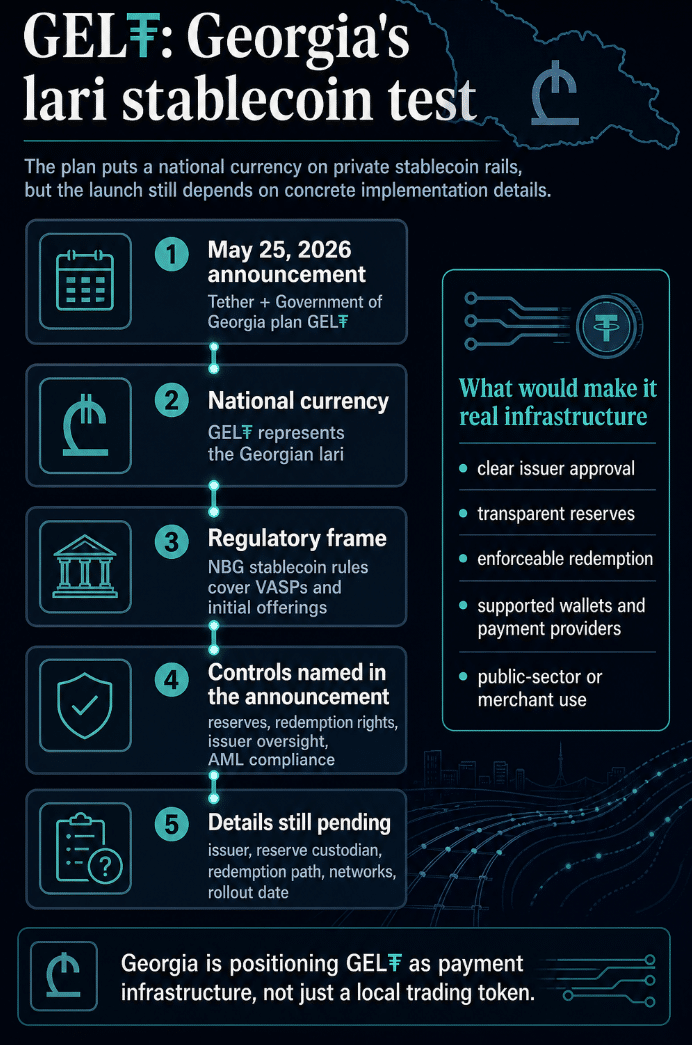
Still, this is where the fine print matters. The issuer, reserve location, redemption process, supported blockchains, and regulatory control model have not yet been fully explained. That leaves the Tether Georgia stablecoin proposal promising, but not complete.
Key Crypto Indicators to Watch
The first indicator is adoption. If businesses, payment firms, and remittance users do not use GEL₮, the token may stay limited, much like other non-dollar stablecoins that struggled to gain traction. The second indicator is liquidity, because a stablecoin needs deep and reliable conversion channels to hold user confidence. The third is reserve transparency, as users must know whether every token is backed by safe, accessible assets.
Another key signal is regulatory clarity. The Tether Georgia stablecoin plan sits in a sensitive area between private money and public currency policy, so Georgia will need strong rules around audits, consumer protection, and redemption. The final indicator is market trust. In crypto, trust is not built by branding alone. It comes from stable pricing, clear disclosures, and clean execution over time.
Regulatory Questions Remain Open
The plan is unusual because it involves a private stablecoin issuer working with government support around a national currency. That makes the Tether Georgia stablecoin development important, but it also raises questions about monetary control. Global financial authorities have warned that privately issued stablecoins can create risks for financial stability and monetary sovereignty when they grow too large or operate without enough oversight.
Conclusion
The Tether Georgia stablecoin plan shows how digital money is moving from crypto exchanges into national payment strategy. GEL₮ could help Georgia modernize settlement, remittances, and fintech services, but the real test will come after the technical and regulatory details are public. If reserves, redemption, compliance, and access are handled well, the Tether Georgia stablecoin model could become a reference point for other smaller economies watching the stablecoin race from the sidelines.
Frequently Asked Questions
What is GEL₮?
GEL₮ is a planned stablecoin representing the Georgian lari.
Is GEL₮ live now?
No. Rollout and technical details are still pending.
Is this a CBDC?
It has not been clearly defined as a central bank digital currency.
Why does it matter?
It may show how national currencies can move on private stablecoin rails.
Glossary of Key Terms
Stablecoin: A crypto token designed to track the value of a fiat currency.
Lari: The official currency of Georgia.
Redemption rights: The right to exchange a token back into fiat money.
AML: Anti-money laundering rules used to fight illicit finance.
Sources