
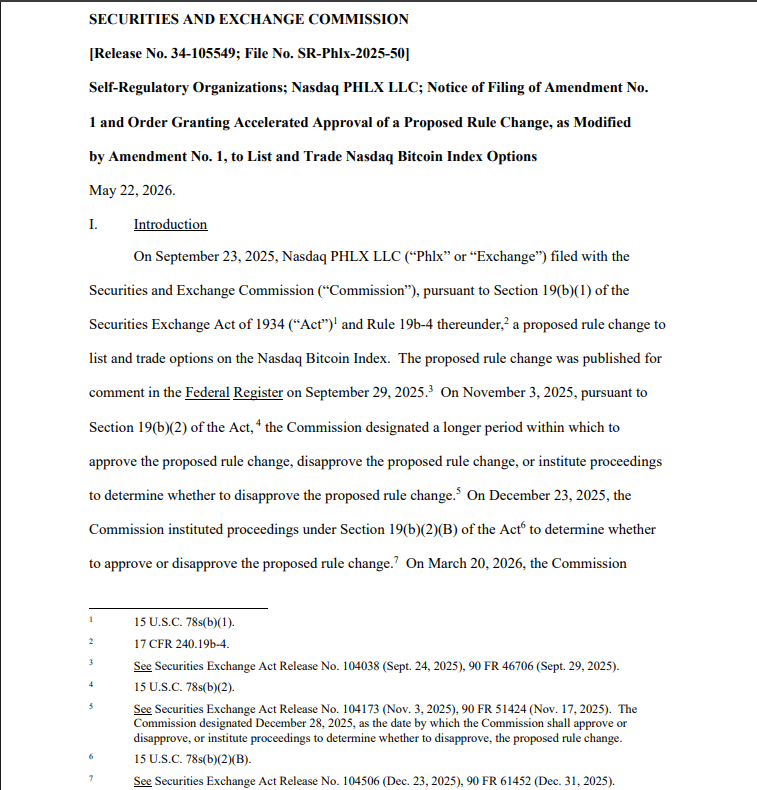
Nasdaq has moved closer to launching a Bitcoin derivatives product after securing conditional approval from the U.S. Securities and Exchange Commission. Nasdaq Bitcoin options would give traders a cash-settled way to manage Bitcoin exposure through a regulated exchange.
The product still needs clearance from the Commodity Futures Trading Commission. If approved, the contracts would trade on Nasdaq PHLX under the ticker QBTC.


Nasdaq Bitcoin Options Move Closer After SEC Approval
The SEC approved Nasdaq PHLX to list European-style Bitcoin index options. The contracts will track the CME CF Bitcoin Real Time Index, also known as BRTT.
Nasdaq Bitcoin options will settle in U.S. dollars. No actual Bitcoin will be delivered when contracts expire.
Each QBTC contract will provide exposure equal to 1 BTC. CME’s standard Bitcoin option is sized at 5 BTC.
Nasdaq Bitcoin options are designed to reduce friction for traders seeking Bitcoin exposure. The structure removes direct crypto custody and may avoid the need for a separate futures account.
The contracts would trade on the same Nasdaq system used for listed securities. That could allow eligible users to place hedges or volatility trades through brokerage access. Trading cannot begin without CFTC approval.
What QBTC Tracks
The QBTC contracts will follow the CME CF Bitcoin Real Time Index. The benchmark reflects real-time Bitcoin price movement.
The contract uses a 1/100th index scaling factor and a standard $100 multiplier. This gives each contract exposure equal to exactly 1 BTC. That smaller structure may help traders manage risk with more precision.
Cash Settlement Removes Delivery Risk
Cash settlement means the contract closes in U.S. dollars. At expiration, the exchange credits or debits the difference between the strike price and final index value.
No Bitcoin changes hands. This removes custody, wallet, and transfer issues. The design may help users who want Bitcoin exposure without direct digital asset handling.
Smaller Contract Size May Widen Access
Nasdaq Bitcoin options could be more accessible than larger Bitcoin derivatives. CME’s standard Bitcoin option is tied to 5 BTC, which can create large notional exposure.
QBTC’s 1 BTC exposure may help smaller institutions hedge more accurately. It may also give retail participants a lower entry point. This does not remove trading risk. Options can lose value quickly.
How Bitcoin Options Work
Options give buyers the right, but not the obligation, to buy or sell an asset at a set price on a later date. A call option can benefit when the market rises. A put option can help protect against price declines. The buyer pays a premium. If the trade fails, the buyer can lose that premium.
Regulatory Questions Remain
CME argued that the contracts belong under the CFTC’s exclusive jurisdiction. The SEC addressed that concern in its order.
The agency said Section 717 of the Dodd-Frank Act is not limited to new derivative products. It also said shared oversight may apply when the CFTC grants exemptive relief.
The SEC cited mixed swaps and security futures as examples of shared jurisdiction. Nasdaq Bitcoin options still need CFTC approval.
Market Impact
Demand for crypto risk management tools has grown as institutions enter the market. Bitcoin options have expanded as traders seek hedging and yield strategies.
Nasdaq’s product could add another regulated venue for Bitcoin-linked exposure. It could also reduce operational steps for some users. The final impact will depend on liquidity, brokerage support, fees, and CFTC clearance.

Conclusion
Nasdaq Bitcoin options could bring Bitcoin index exposure closer to mainstream brokerage platforms. The cash-settled structure removes custody barriers and may support more precise risk management. The product is not live yet. Its launch still depends on CFTC approval.
Appendix: Glossary of Key Terms
QBTC: The ticker for Nasdaq’s proposed cash-settled Bitcoin index options.
Cash settlement: A process where contracts settle in U.S. dollars instead of delivering actual Bitcoin.
European-style options: Options that can only be exercised at expiration, not before.
CME CF Bitcoin Real Time Index: A benchmark that tracks real-time Bitcoin price movement.
CFTC clearance: Final regulatory approval needed before the contracts can begin trading.
Strike price: The fixed price at which an option can be exercised at expiration.
Call option: A contract that can benefit when the Bitcoin-linked index rises.
Put option: A contract that can help protect against Bitcoin-linked price declines.
Frequently Asked Questions About Nasdaq Bitcoin options
1- What are Nasdaq Bitcoin options?
They are proposed cash-settled Bitcoin index options that would trade on Nasdaq PHLX.
2- Will traders receive Bitcoin at expiration?
No. The contracts settle in U.S. dollars.
3- How large is each QBTC contract?
Each contract provides exposure equal to 1 BTC.
4- Are the contracts approved for trading?
Not yet. The SEC granted conditional approval, but CFTC clearance is still required.