
CLARITY passed after a 15-9 vote by the Senate Banking Committee, which cleared the digital asset market structure bill. According to the National Cryptocurrency Association, Washington is moving closer to rules that will be clearer for crypto markets after such a vote.
The full Senate still has to vote on the CLARITY Act. It has many disagreements ahead of it as well.


Concerns raised by Democrats over potential political conflicts had summoned up anti-money-laundering rules. There is also no common approach among banks and crypto firms regarding stablecoin rewards.
The National Cryptocurrency Association said the committee vote is an important signal to consumers. It said that explicit rules could render crypto safer and more predictable for consumers and businesses alike.
CLARITY Act Marks Key Step Toward US Crypto Rules
The role that it plays is to improve consumer confidence and almost give consumers a boost of confidence, said NCA vice president of external affairs Ali Tager. Consumers require knowledge on when, where and how digital assets can be utilized securely, she said.
The Senate Banking Committee vote marked a key step for the bill. It did not make the proposal law, but it showed that a federal crypto framework is moving forward.
The CLARITY Act aims to define rules for digital asset markets in the United States. The bill could affect exchanges, custodians, crypto firms, banks, and consumers.
The vote also matters because the U.S. crypto industry has faced years of unclear rules. Many firms have called for defined agency roles and a clearer compliance path.
NCA Says Clear Rules Could Build Trust
The NCA linked clearer rules to consumer trust. Tager said crypto can feel less new when legal uncertainty is replaced with clear protections.
The group pointed to its 2026 State of Crypto Holders Report. The report was based on a Harris Poll survey of 10,000 U.S. crypto holders from February 12 to March 3.
The report found that more than 67 million American adults now own crypto. It also said 12 million new holders entered the market in the past year.

Crypto Use Expands Across Consumers
The survey showed that 87% of holders actively used crypto in 2026. That was up from 80% in the previous year.
The report also found that 41% send crypto to friends and family. That figure was up from 31%.
Another 40% said they use crypto for shopping or payments. Financial independence through crypto was cited by 54%.
The report also placed crypto in workplace payment discussions. It found that 37% of holders plan to send crypto to employees in the next year.
Regulation Is Not the Only Driver
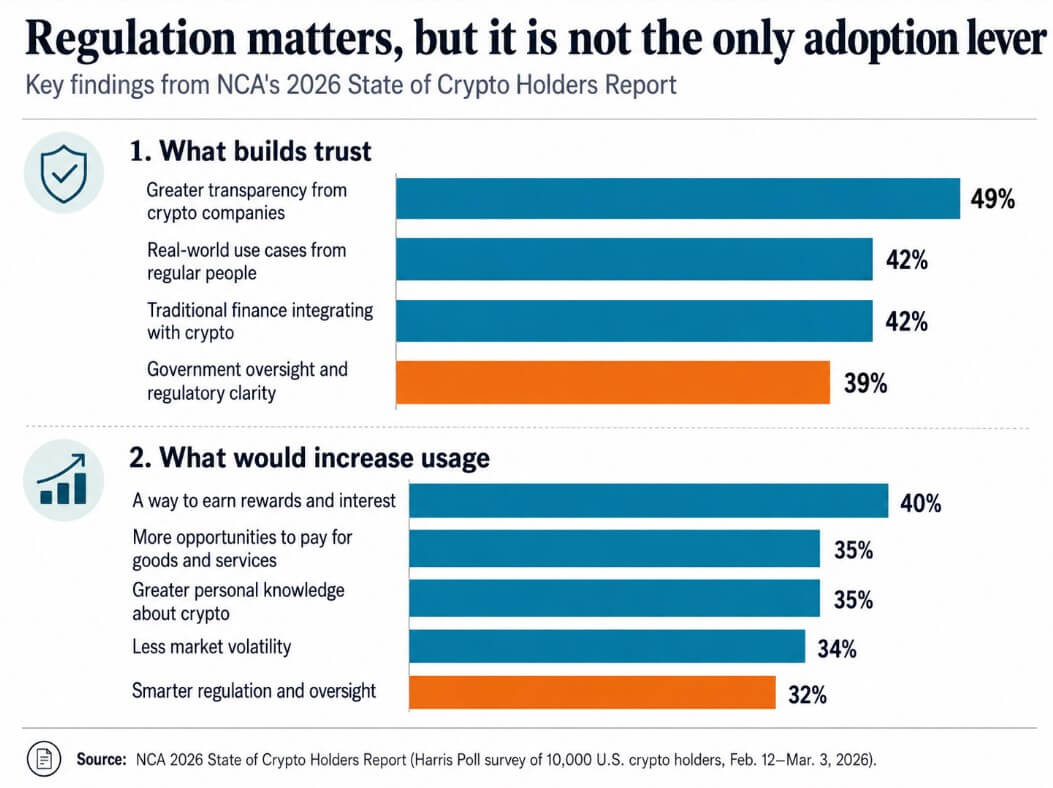
The CLARITY Act could help adoption, but regulation is only one factor. NCA data showed that 39% of holders see government oversight and clear rules as trust builders.
That figure ranked behind company transparency at 49%. It also ranked behind real-world use cases from regular people at 42%.
The report found other adoption drivers as well. Rewards and interest ranked first at 40%.
Greater payment acceptance and personal knowledge both stood at 35%. Reduced volatility came at 34%, while smarter regulation stood at 32%.
Crypto Ownership Broadens in the US
The NCA report showed that crypto ownership is spreading across more groups. More than one-third of crypto holders are women, up 10 percentage points in one year.
Older buyers also became more visible. The 55-and-older group now outnumbers the 18-to-24 group among recent buyers.
The report also found that more holders work in construction than in finance. The South accounts for 38% of holders, while the West accounts for 27%.
The Northeast and Midwest each account for 18%. The data suggests that crypto ownership now looks closer to the wider U.S. population.
Global Rules Raise Pressure on Washington
Other regions have already moved ahead with crypto regulation. The European Union’s Markets in Crypto-Assets framework entered into force in June 2023 and is now fully implemented.
The United Kingdom’s cryptoasset regulatory regime is expected to take effect in October 2027. These timelines matter for U.S. policymakers.
Tager said the CLARITY Act could help protect American leadership. She said it could also reduce the risk of innovation and capital moving offshore.
Senate Path Could Shape Adoption
If the bill passes the Senate with its main framework intact, it could give consumers and firms clearer legal ground. Exchanges and custodians could also receive better compliance direction.
That outcome could support holders who want banks to offer crypto access with regular accounts. It could also give future buyers more confidence.
If Senate disputes weaken support, the vote may remain only a signal. Adoption would then depend more on payments, rewards, bank access, and consumer familiarity.
Conclusion
The CLARITY Act committee vote proves that a domestic U.S. crypto framework has legs. But it goes a long way and still needs to clear several hurdles before it becomes law.
Next could be a vote in the Senate, negotiations to pass a House version of Biden’s plan, agency rulemaking and implementation. So the vote provides a clearer signal on this, but not final certainty, ahead of it.
Appendix Glossary of Key Terms
Digital Assets: Financial goods associated with crypto on blockchain or other distinctive digital networks.
Regulatory clarity: Specific legal rules that provide you a better understanding of how crypto firms and users should function.
Market structure: Refers to the rules that govern how a financial or crypto market operates.
Anti-money-laundering legislation: Laws meant to stop or slow down the illegal movement of money.
Rewards in stablecoin: rewards or returns are linked to your use or holding of a stablecoin.
Frequently Asked Questions About CLARITY Act
1- What did the Senate Banking Committee approve?
The committee approved the Digital Asset Market Clarity Act by a 15-9 vote.
2- What is the main goal of the bill?
The bill aims to create clearer market structure rules for U.S. digital asset markets.
3- Why does the NCA support clearer rules?
The NCA says clear rules can improve trust and make crypto use more predictable.
4- What issues still need debate?
Lawmakers still need to address anti-money-laundering rules, political conflicts, and stablecoin rewards.
Reference