

This article was first published on TurkishNY Radio.
The Senate Banking Committee is moving closer to a key markup session for the CLARITY Act, but the legislation is entering the debate with growing political pressure from banks, crypto firms, and lawmakers on both sides of the aisle.


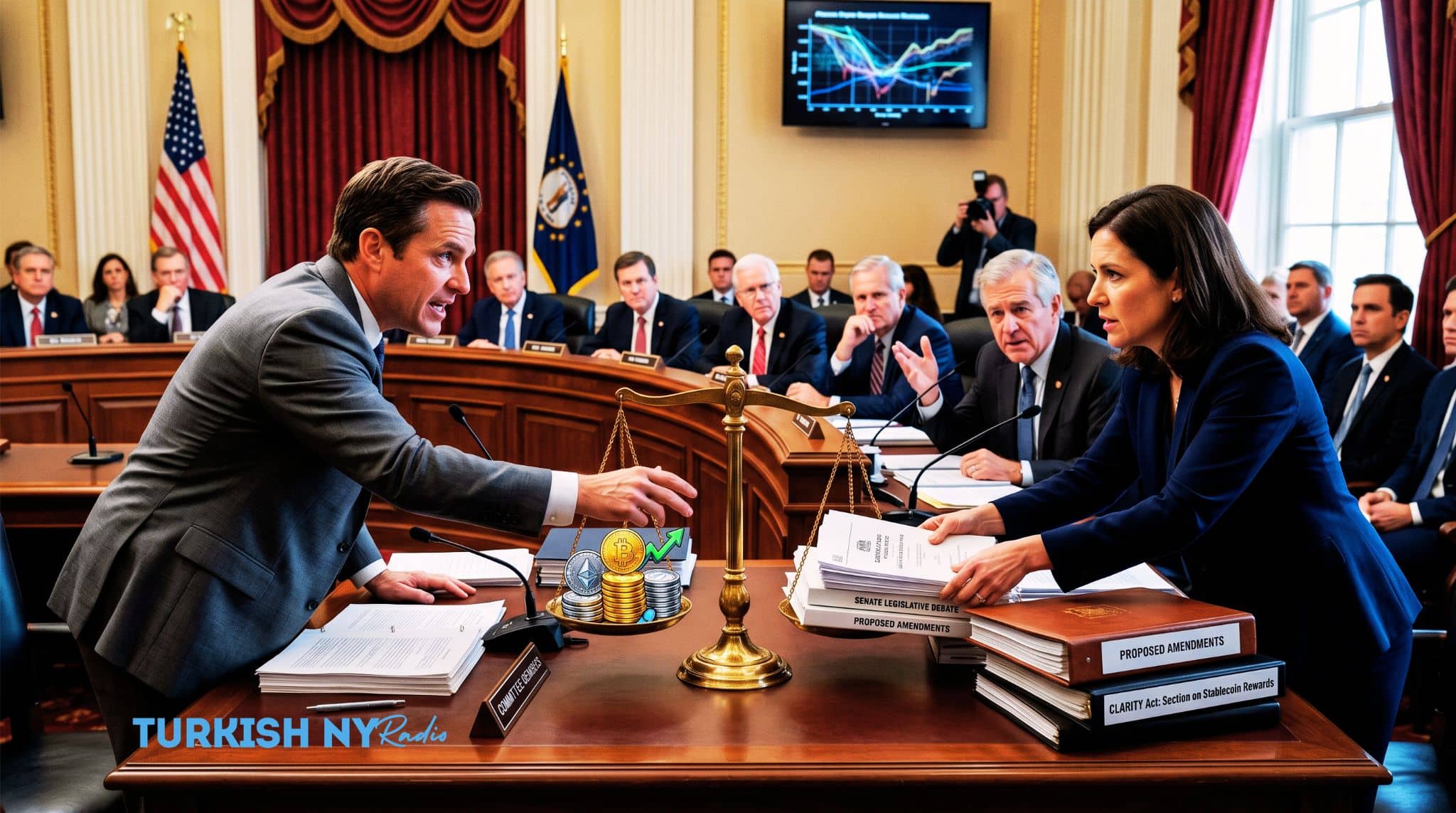
More than 100 proposed amendments have reportedly been attached to the bill ahead of the committee review, showing that major disagreements around stablecoins, decentralized finance, and crypto oversight remain unresolved.
At the center of the fight is one issue that continues to divide Washington and the digital asset industry: stablecoin rewards.
CLARITY Act Stablecoin Fight Deepens in Senate
The latest version of the CLARITY Act attempts to draw a line between payment-based incentives and products that resemble traditional bank interest.
Under the current Senate compromise, crypto companies would still be allowed to offer rewards connected to activities such as transactions or platform usage.
However, the bill would prohibit passive returns on idle stablecoin balances if those rewards function similarly to interest paid by banks.
Supporters of the proposal say the language was carefully designed to stop stablecoins from replacing insured bank deposits while still allowing payment-related incentives that support blockchain-based financial activity.
Banks are not convinced.
Several banking organizations have argued that the existing wording leaves room for crypto exchanges and intermediaries to create programs that effectively mimic savings account yields.
Their concern is that customers could gradually move deposits away from traditional banks toward digital dollar products operating outside the same regulatory structure.
That pressure has now reached the Senate markup process.
Senators Jack Reed and Tina Smith reportedly introduced an amendment that would tighten the restrictions further by targeting rewards considered “substantially similar” to deposit interest. If approved, regulators could gain wider authority to block crypto incentive models that resemble banking products.
The vote on that amendment may become one of the most closely watched moments of the CLARITY Act debate.
CLARITY Act Sparks Major Crypto Lobbying Push
Crypto advocacy groups are now pushing back publicly against the banking industry campaign.
Stand With Crypto, a Coinbase-backed organization, stated that banking lobbyists sent roughly 8,000 letters to lawmakers seeking stricter stablecoin reward restrictions.
In response, the group said crypto supporters made thousands of calls and delivered around 300,000 emails supporting the CLARITY Act.
The organization also claimed lawmakers have received nearly 1.5 million contacts from crypto supporters tied to the broader legislation effort.
The unusually public lobbying battle highlights how important stablecoin payments have become to both industries.
For banks, stablecoins raise concerns about future deposit flows and payment control. For crypto firms, reward programs are viewed as part of a larger push to build blockchain-based financial systems that compete with traditional infrastructure.
The Blockchain Association and Crypto Council for Innovation have also urged senators to preserve the compromise language already included in the bill.
Their position is that the CLARITY Act could finally replace years of regulation-by-enforcement with clearer legal standards for crypto companies operating inside the United States.
Elizabeth Warren Expands Debate Beyond Stablecoins
While stablecoin rewards remain the headline issue, Democrats are also widening the debate into ethics and banking access.
Senator Elizabeth Warren reportedly filed more than 40 amendments ahead of the markup session. One proposal would prevent crypto firms from receiving Federal Reserve master accounts, which provide direct access to the central bank’s payment rails.
Crypto companies have spent years trying to secure clearer access to the banking system. Traditional financial groups, however, continue warning that direct Federal Reserve access for digital asset firms could introduce new financial stability risks.
The Independent Community Bankers of America previously criticized the Federal Reserve’s approval of a master account tied to crypto exchange Kraken, arguing that nonbank crypto entities create supervisory concerns for the banking system.
Warren is also continuing to push ethics concerns connected to President Donald Trump’s family-linked crypto ventures.
She argues Congress should not advance major crypto legislation without stronger safeguards addressing potential conflicts of interest tied to political figures and digital asset businesses.
That argument is giving Democrats a broader political framework beyond investor protection alone.
DeFi and Legal Tender Proposals Add More Complexity
The CLARITY Act debate is also expanding into decentralized finance.
Senator Mark Warner reportedly introduced amendments focused on how the bill defines decentralized protocols and whether certain DeFi platforms should face anti-money laundering and compliance requirements similar to traditional financial firms.
That section of the legislation remains highly sensitive because it determines whether some blockchain protocols can operate without centralized intermediaries while avoiding bank-style oversight obligations.
Crypto developers argue that forcing traditional compliance systems onto open-source protocols could push development outside the United States. Critics counter that weak oversight standards may create regulatory gaps that allow firms to avoid accountability.

Another amendment introduced by Senator Jack Reed would prohibit cryptocurrencies from being treated as legal tender for public payments, including taxes.
Together, the proposals show that the CLARITY Act has evolved far beyond a narrow stablecoin bill. Senators are now debating how much authority regulators should hold over DeFi systems, payment infrastructure, and digital dollar activity across the broader crypto market.
Why the CLARITY Act Matters
The CLARITY Act is becoming one of the most important crypto legislation efforts currently moving through Congress because it could establish the first large-scale federal framework governing digital assets in the United States.
Supporters believe the bill could reduce regulatory uncertainty that has slowed institutional adoption and forced crypto firms into years of legal disputes with federal agencies.
Critics argue the legislation still lacks strong enough safeguards around stablecoins, ethics oversight, and decentralized finance risks.
The Senate Banking Committee’s markup session may now determine whether lawmakers can preserve a workable compromise or reopen divisions that delay US crypto legislation once again.
Summary
- The CLARITY Act is heading into a tense Senate review as lawmakers debate more than 100 amendments tied to stablecoins, DeFi rules, and crypto oversight.
- Banks want stricter limits on stablecoin reward programs, arguing they could pull money away from traditional savings accounts.
- Crypto groups are fighting back with large lobbying campaigns supporting the bill.
- Senator Elizabeth Warren is also pushing tougher rules on ethics and Federal Reserve access for crypto firms.
- The outcome could heavily influence the future of crypto regulation in the US.
Glossary of Key Terms
- CLARITY Act
A proposed US crypto law that aims to create clearer rules for digital assets, stablecoins, and crypto companies operating across the financial system. - Stablecoin
A cryptocurrency designed to maintain a steady value by being linked to assets like the US dollar, unlike highly volatile coins such as Bitcoin. - Stablecoin Rewards
Special incentives crypto platforms offer for using or holding stablecoins are similar to earning cashback points or rewards from traditional payment apps. - Senate Banking Committee
A group of US lawmakers responsible for reviewing financial laws, including rules related to banks, cryptocurrencies, and the broader digital asset market. - DeFi (Decentralized Finance)
Financial services built on blockchain technology that let people trade, borrow, or send money without depending on traditional banks or intermediaries. - Federal Reserve Master Account
A direct account with the US central bank that gives financial institutions access to the country’s core payment and money transfer system. - Crypto Regulation
Rules created by governments to manage how cryptocurrency companies operate, protect consumers, reduce financial risks, and improve market transparency. - Lobbying
When companies or organizations try to influence lawmakers by sharing opinions, running campaigns, or encouraging public support around important policy decisions.
FAQs About CLARITY Act
What is the CLARITY Act?
The CLARITY Act is a proposed US crypto bill that aims to create clearer rules for stablecoins, digital assets, DeFi platforms, and overall crypto market regulation.
Why are banks worried about stablecoin rewards?
Banks believe stablecoin rewards could encourage people to move money out of savings accounts and into crypto-based payment platforms offering similar financial incentives instead.
How could the CLARITY Act impact crypto companies?
The bill could give crypto firms clearer legal guidance, reduce regulatory uncertainty, and help companies operate in the US under more defined compliance standards.
What happens next with the CLARITY Act?
The Senate Banking Committee will review proposed amendments before lawmakers decide whether the bill can advance further through the broader legislative approval process.