
A senior White House official accused major banking trade leaders of avoiding earlier talks on stablecoin rewards, adding new pressure before the Senate Banking Committee reviews the CLARITY Act. The dispute has become a key flashpoint between banks, crypto firms, and lawmakers.
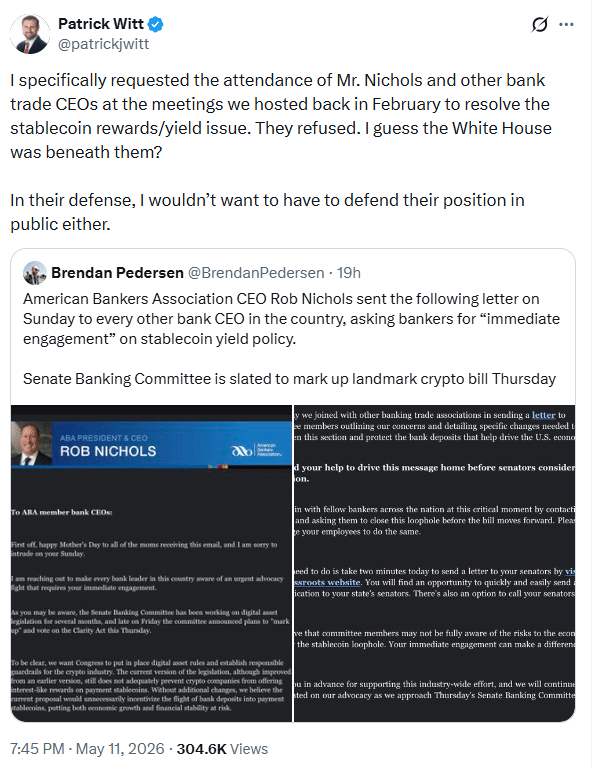
Patrick Witt, executive director of the White House Presidential Advisory Committee on Digital Assets, made the accusation in a May 11 post on X. He said American Bankers Association President Rob Nichols and other bank trade CEOs were asked to attend February meetings.


White House Enters Stablecoin Rewards Dispute
Witt said those talks were meant to address stablecoin rewards and yield. He argued that banking leaders refused to join the meetings. His comments placed the White House more directly inside the policy dispute.
The CLARITY Act is designed to create a broader market structure framework for digital assets. However, stablecoin rewards have become one of the final pressure points before the scheduled May 14 committee markup.
The issue centers on whether crypto companies should be allowed to offer rewards tied to stablecoin use. Banks say such products could compete with traditional deposits. Crypto firms argue that the matter involves consumer choice and fair competition.
White House Official Challenges Bank Timing
Witt’s comments reframed the banking industry’s latest objections. He suggested the concern was not a new technical issue that appeared before a committee vote.
Instead, he portrayed it as an unresolved dispute that bank leaders had a chance to address earlier. His criticism also suggested frustration over the industry’s decision to push lawmakers late in the process.
ABA Pushes for Tighter Bill Language
The American Bankers Association urged bank executives and employees to contact senators before the vote. The group warned that the current CLARITY Act language may still allow crypto firms to offer reward structures similar to interest.
ABA leaders want tighter restrictions covering issuers, exchanges, brokers, and related crypto platforms. Their concern is that affiliates could offer rewards, rebates, or incentives even if issuers are barred from paying yield directly.
Deposit Competition Drives Banking Concerns
Banks rely on deposits to fund loans to households, farms, small businesses, and corporations. They argue that stablecoin rewards could pull customer funds away from banks and raise funding costs.
The banking industry says this could pressure margins and reduce lending capacity. It also says the current compromise leaves a loophole if non-issuer platforms can deliver similar economic benefits to users.
Senate Compromise Faces Industry Pressure
The Senate compromise tries to separate passive yield from activity-based rewards. That distinction is meant to stop stablecoins from becoming direct substitutes for interest-bearing deposits.
At the same time, the language leaves room for crypto platforms to reward users for payments, participation, or services. That balance has become harder to defend as banks increase pressure before the markup.
White House Analysis Weakens Lending Claim
The Council of Economic Advisers challenged part of the banking sector’s warning in an April report. It said banning stablecoin yield would only slightly increase bank lending under baseline assumptions.
The CEA estimated the increase at about $2.1 billion. That would equal roughly 0.02% of total lending in the base case. The finding gave the administration a counterargument against claims that stablecoin rewards would severely damage credit creation.
The report also said most stablecoin reserves would not leave the financial system permanently. Instead, reserves held in cash, bank deposits, or Treasury instruments would keep moving through markets.
Galaxy Research Highlights Offshore Demand
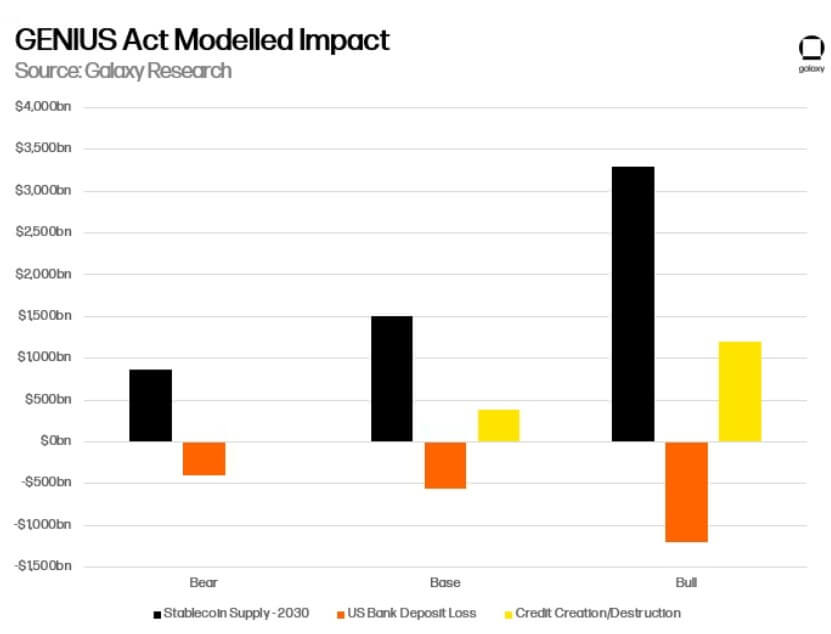
Galaxy Research also questioned the idea that stablecoin growth would mainly drain domestic deposits. The firm said much of the growth under a regulated framework could come from offshore users seeking dollar-denominated assets.
Galaxy estimated that 60% to 70% of stablecoin growth under the GENIUS Act framework could originate outside the United States. It also projected that foreign demand could exceed domestic deposit migration by about 2:1.
The firm did not dismiss bank pressure. It said some low-cost deposits could migrate. It also said funding costs may rise and net interest margins could narrow in some business lines.
Crypto Groups Accuse Banks of Blocking Competition
Crypto advocacy groups have used the ABA campaign to accuse banks of protecting their margins. Stand With Crypto urged supporters to contact senators, saying bank lobbyists were trying to weaken stablecoin rewards language before the markup.
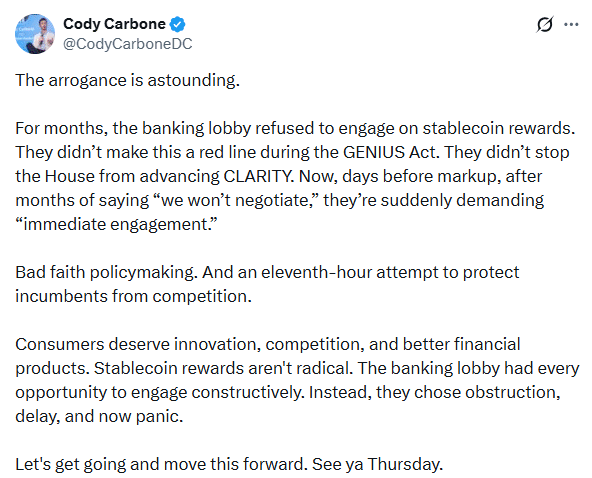
Cody Carbone, CEO of The Digital Chamber, said banks had months to negotiate. He described the latest push as an attempt to protect incumbents after earlier chances to engage had passed.
Senator Bernie Moreno also criticized the banking industry’s opposition. His comments showed that the dispute has moved beyond drafting details and into a broader political debate about competition and consumer returns.
Markup Will Test the Compromise
The May 14 markup will test whether the current CLARITY Act compromise can survive coordinated bank opposition. If the bill advances with the language intact, crypto firms may claim policy momentum.
If lawmakers tighten the provisions, banks will have reopened one of the bill’s most contested sections. That result could shift the next stage of digital-asset legislation in the Senate.
Conclusion
The fight over stablecoin rewards now touches bank deposits, consumer yield, Treasury demand, offshore dollar use, and crypto payment rules. It has become a major test for the CLARITY Act.
The Senate Banking Committee’s markup will show whether lawmakers keep the current compromise or respond to banking industry pressure. The decision could shape how dollar-backed digital assets develop under U.S. regulation.
Appendix Glossary of Key Terms
CLARITY Act: A proposed U.S. bill for digital-asset market structure rules.
Stablecoin yield: Income that may come from assets backing stablecoins.
Bank deposits: Customer funds held by banks and used to support lending.
Market structure: Rules that define how digital assets are issued, traded, and supervised.
Senate markup: A committee session where lawmakers review and amend a bill.
Treasury bills: Short-term U.S. government debt often used in stablecoin reserves.
Offshore demand: Interest from users outside the U.S. seeking dollar-based assets.
Crypto advocacy: Efforts by crypto groups to influence policy and public debate.
Frequently Asked Questions Stablecoin Rewards
1- Why are banks concerned about this issue?
Banks say crypto reward products could pull customer funds away from traditional deposits.
2- What did Patrick Witt claim?
He said major bank trade leaders refused to attend earlier February talks on the issue.
3- What did the CEA report find?
It said a yield ban would have only a small baseline effect on bank lending.
4- Why does the CLARITY Act markup matter?
It will show whether lawmakers keep or tighten the current stablecoin compromise.
Reference