
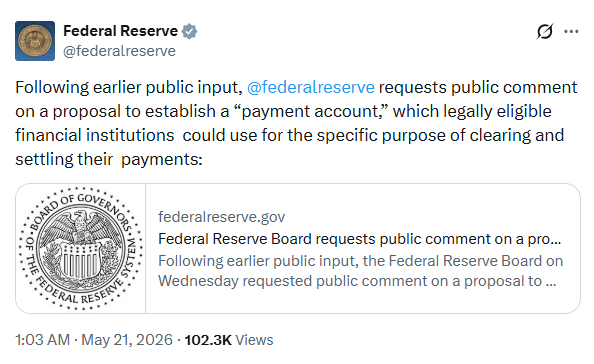
Fed payment account proposal has entered public comment at the Federal Reserve Board. It would create a limited-purpose account for legally eligible financial institutions.
The account would allow approved firms to clear and settle payments directly. They would use selected Federal Reserve services for these transactions.


The proposal could affect crypto, fintech, and payment-focused firms. Many non-traditional institutions have long sought direct access to Fed payment rails.
These firms want faster settlement and fewer delays. They also want to reduce dependence on intermediary banks.
Fed Payment Account Plan Limits Master Account Benefits
The Fed said many requests have come from institutions that are not federally insured. However, the proposal does not grant broad master account access.
The proposed Fed payment account would offer a restricted path into Federal Reserve payment services. Account holders would not receive all benefits linked to a traditional master account.
They would not get intraday credit. They would not have discount window access. They also would not earn interest on balances kept at a Reserve Bank.
Transactions that could create an overdraft would be blocked automatically. This condition is central to the Fed’s risk-control design.
The Fed payment account plan aims to balance access with safeguards. It would support direct clearing and settlement for eligible firms. At the same time, it would limit credit, liquidity, and balance-sheet risks for Reserve Banks.
The account would only be available to institutions already legally eligible for Federal Reserve accounts or services. The Fed said the proposal would not expand legal eligibility.
That point is important for digital asset firms. Some may still fail to qualify under current law, even if the new account type is approved.
Fed Limits Master Account Benefits
The limited-purpose structure is different from a full master account. A master account can give banks broader access to Federal Reserve services.
The proposed structure would be narrower. It would focus on payment clearing and settlement.
This means the Fed payment account could help approved firms move payments more directly. Yet it would not give them the same financial tools available to traditional banks. The Fed appears to be drawing a line between payment access and banking privileges.
Services Included and Excluded
The Fed’s staff memo said eligible account holders could access services where overdrafts can be blocked. These include Fedwire Funds Service, FedNow Service, National Settlement Service, and free-of-payment Fedwire Securities transfers.
FedACH would not be available under the proposal. That exclusion keeps the account limited to specific payment functions.
The structure shows the Fed is focused on operational control. It also shows caution around services that may create broader risk.
Balance Cap and Review Timeline
The proposal includes a closing balance limit. The limit would be based on expected payment activity.
The balance cap would be set at up to $1 billion. This could prevent firms from using the account as a large reserve storage tool.
The Fed’s staff memo also gave a review timeline. Payment account requests would generally be reviewed within 90 calendar days after all requested documents are received.
That timeline may offer more clarity to applicants. Many firms have faced uncertainty around account access decisions.
Political Pressure Adds Weight
The timing gives the proposal added political importance. On May 19, President Donald Trump signed an executive order asking the Fed to evaluate access to Reserve Bank payment accounts and services.
The order covered uninsured depository institutions and non-bank financial companies. It also mentioned firms involved in digital assets and other novel financial activities.
The Fed payment account proposal arrived as policymakers review how modern payment firms should connect with central bank infrastructure.
Board Vote Shows Risk Concerns
The proposal passed with support from Chair Pro Tempore Jerome Powell, Vice Chair Philip Jefferson, Vice Chair for Supervision Michelle Bowman, Governor Lisa Cook, Governor Stephen Miran, and Governor Christopher Waller.
Governor Michael Barr voted against it. Barr said the proposal lacked strong safeguards against money laundering and terrorist financing risks for firms outside Fed supervision.

Cook supported public comment. However, she asked for feedback on systemic risks linked to giving clearing and settlement abilities to eligible firms without deposit insurance or full federal oversight.
Conclusion
The Fed payment account proposal could create a narrow access route for eligible financial institutions seeking direct settlement through Federal Reserve services. It may help some payment and fintech firms reduce delays and reliance on banks.
Still, the plan remains restricted. It does not expand legal eligibility. It blocks overdrafts and excludes major benefits tied to master accounts.
The public comment period will close 60 days after publication in the Federal Register. The final rule could shape how non-traditional financial firms interact with Fed payment infrastructure.
Frequently Asked Questions About Fed Payment Account
1. What is a Fed payment account?
A Fed payment account is a proposed limited-purpose account. It would let eligible firms clear and settle payments through selected Federal Reserve services.
2. Who could use the Fed payment account?
Only legally eligible financial institutions could apply. The proposal does not expand legal access to Fed accounts or services.
3. How is it different from a master account?
It would not offer full master account benefits. Holders would not get intraday credit, discount window access, or interest on balances.
4. Why does it matter for crypto and fintech firms?
Many crypto, fintech, and payment firms want direct access to Fed payment rails. They seek faster settlement and less reliance on intermediary banks.