The next major crypto security failure may not begin with a broken smart contract. It may begin earlier, inside a developer’s machine, a package manager, a build script, or an AI coding file that nobody checks twice. A recent software supply-chain campaign called TrapDoor has sharpened that concern across crypto and Web3 engineering circles. The campaign targeted developers through malicious packages across npm, PyPI, and Crates.io, raising a hard question for decentralized finance: what happens when the road to deployment is already compromised before the code goes live?
Why the Next DeFi Exploit May Begin Before Deployment
For years, the phrase DeFi exploit usually pointed to smart contract bugs, oracle manipulation, flash loan attacks, or poor access controls. Those risks still matter, but the attack surface has widened. In the latest case, security researchers found more than 34 malicious packages tied to TrapDoor, with hundreds of related versions or artifacts distributed across major developer ecosystems. The packages were designed to steal sensitive data from developer environments, not just attack live protocols.


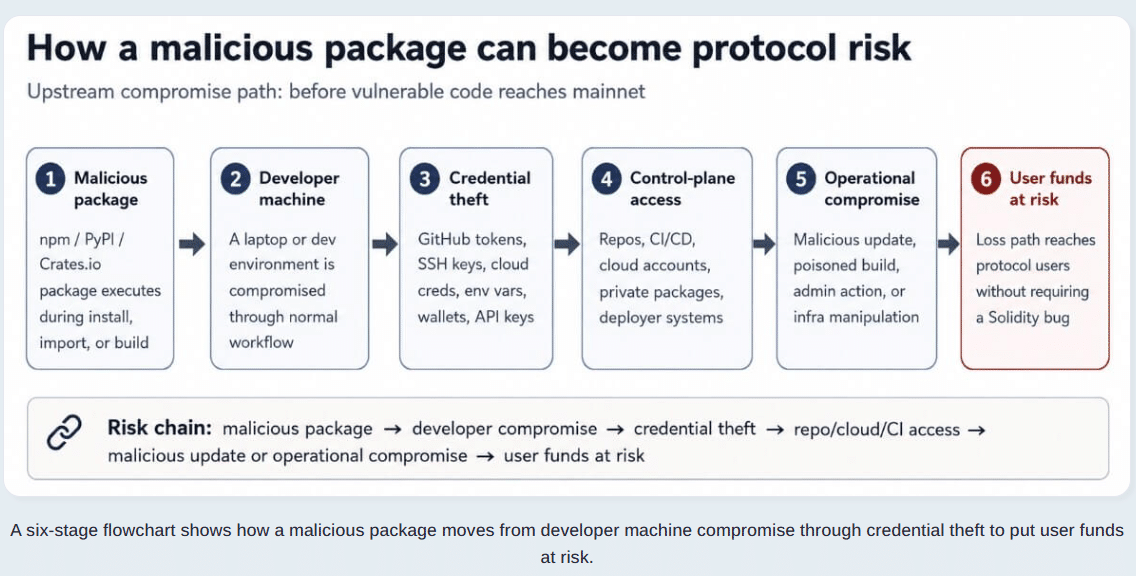
That detail changes the security conversation. If attackers steal GitHub tokens, SSH keys, cloud credentials, wallet files, API keys, or environment variables, they may not need to break a deployed contract at all. They can move upstream, where a single compromised developer account can touch repositories, deployment pipelines, infrastructure dashboards, and private signing material.
In plain English, the danger is not only bad code. It is trusted code built inside a bad environment.
The New Weak Point Is the Build Pipeline
A modern DeFi protocol is not just a smart contract. It is a chain of tools, people, scripts, keys, servers, dashboards, bots, and permissions. The contract may pass an audit, but if the developer workstation is infected, the project can still walk into mainnet carrying hidden risk.
This is why the DeFi exploit model is shifting. Attackers no longer need to wait for liquidity to arrive on-chain. They can target the software supply chain days or weeks earlier, then sit quietly until the right moment. That is similar to someone copying the keys to a bank vault before the vault is filled with cash.
TrapDoor reportedly focused on crypto, DeFi, AI, and security developers, which makes the campaign especially relevant for Web3 teams. The malware was built to collect secrets and persistence signals from local machines, browsers, configuration files, and developer workflows.
AI Coding Tools Add Another Layer of Risk
One of the most unusual parts of this campaign was its reported use of hidden instructions aimed at AI coding assistants. Researchers said the malware attempted to place concealed guidance inside files such as .cursorrules and CLAUDE.md, which some AI-assisted development environments may read as project instructions.

That matters because AI tools are now part of everyday engineering. Developers ask them to review code, generate tests, explain errors, or adjust files. If an attacker can influence the assistant’s context, the tool could become an unwitting helper inside a compromised workflow.
A DeFi exploit built this way would not look like the classic “one bad function” failure. It could look like a clean repository, a familiar dependency, a helpful automation step, and a quiet leak of credentials behind the curtain.
Why Audits Alone Are No Longer Enough
Smart contract audits remain important, but they are not a full shield. An audit reviews the code that is presented. It may not catch a stolen deployment key, a poisoned dependency, a compromised CI/CD token, or a malicious package installed by a developer before the final build.
That gap is now a serious governance issue. A DeFi exploit can damage users, liquidity providers, treasuries, token holders, and market confidence in a matter of minutes. When the weakness sits outside the contract, the post-mortem becomes harder. The protocol may say the code was audited, and that may be true. The real failure may have been access hygiene, package verification, secret storage, or deployment controls.
The open-source malware trend adds pressure. One software supply-chain report identified more than 454,600 new malicious packages in 2025, showing how industrialized this threat category has become across public repositories.
Key Indicators Crypto Teams Should Watch
The first indicator is dependency risk. Teams should pay close attention to newly published packages, lookalike names, unusual version jumps, unexpected install scripts, and dependencies maintained by unknown accounts.
The second indicator is credential exposure. A future DeFi exploit may start with secrets stored in local files, unprotected environment variables, browser profiles, or cloud tools that were never meant to be part of the protocol’s security perimeter.
The third indicator is permission spread. If one developer account can push code, update packages, trigger deployments, and access admin systems, the project has a concentration risk. In finance, that would be poor internal control. In DeFi, it can become an on-chain loss.
The fourth indicator is AI context integrity. Teams using coding assistants need to review project instruction files, hidden Unicode, prompt-like configuration, and automated code changes with the same caution used for sensitive code reviews.
What This Means for Investors and Users
For investors, a DeFi exploit is no longer only about whether a protocol has an audit badge. Users should look for signs of mature security practice, including public incident response plans, bug bounty programs, dependency controls, multisig governance, key rotation policies, and transparent technical updates.
For developers, the lesson is more direct. Security starts before mainnet. It starts before audit. It starts before the first public pool opens.
A strong project now needs clean dependencies, hardened developer devices, scoped permissions, signed commits, protected branches, monitored build systems, and strict handling of secrets. None of that sounds flashy, but it is exactly where serious financial software earns trust.
Conclusion
The latest supply-chain malware campaign shows that the next DeFi exploit may not announce itself through a visible contract bug. It may begin quietly inside the tools that developers trust every day. That is a tough reality for Web3, but it is also a useful warning.
DeFi security has matured from “audit the contract” to “secure the full production chain.” The projects that understand this shift will be better prepared. The ones that treat infrastructure as an afterthought may learn the lesson when liquidity is already at risk.
Frequently Asked Questions
What is the main risk highlighted here?
The main risk is that attackers can compromise developer tools, packages, or credentials before a DeFi protocol is deployed.
Does this mean smart contract audits are useless?
No. Audits are still valuable, but they must be paired with secure development, access control, dependency checks, and deployment protection.
Why are package managers important in crypto security?
Developers rely on package managers to install code libraries. If a malicious package enters the workflow, it can steal credentials or alter the development environment.
How can users judge protocol security?
Users should look beyond audit badges and check whether a project discusses multisig controls, bug bounties, dependency security, incident response, and key management.
Glossary of Key Terms
Software supply chain: The full set of tools, packages, systems, and services used to build and deploy software.
CI/CD pipeline: An automated workflow used to test, build, and deploy code.
Credential theft: The stealing of keys, tokens, passwords, or access files that allow attackers to enter private systems.
Package manager: A tool such as npm, PyPI, or Crates.io that helps developers install and manage software libraries.
Sources