

This Article Was First Published on TurkishNY Radio.
DeFi, or decentralized finance, is a new financial system that is completely built upon blockchain technology, where the transactions are processed without the help of a middleman.


To put it simply, DeFi is all about making services like lending, borrowing, and trading done in a peer-to-peer manner without restrictions. The exclusion of banks and brokers means that DeFi can lower costs and time involved and even in some instances, provide fundamental financial services to the unbanked
What Is Decentralized Finance (DeFi)
Decentralized finance (DeFi) is an extensive term for the financial services that are solely run on public, programmable blockchains instead of centralized institutions.
Experts define DeFi as a system where simple transfers to complex financial functions are facilitated without any third-party involvement. In practice, this means individuals can lend, borrow, trade or invest crypto assets directly with each other.
Transactions happen via dApps and smart contracts, open-source computer programs on the blockchain.
DeFi was first coined in 2018; and has since grown into a multi-billion dollar ecosystem. Total value locked (TVL); that is; the sum of assets in DeFi protocols has grown with the crypto market.
After peaking around $100-200 billion in 2021-22, TVL fell in the 2022 crypto winter but rebounded to roughly $170 billion by late 2025. Sources report this TVL now matches all the capital lost in 2022’s Terra crash, reflecting a more mature market.
Most of the value is on Ethereum (59%), but new blockchains and Layer 2 networks (like Solana, BNB Chain and Coinbase’s Base) are capturing market share.
Importantly, while DeFi handles a big chunk of cryptocurrency transaction volume, experts note it still accounts for a small percentage of user count, meaning most crypto users still use traditional exchanges.
How Decentralized Finance Works
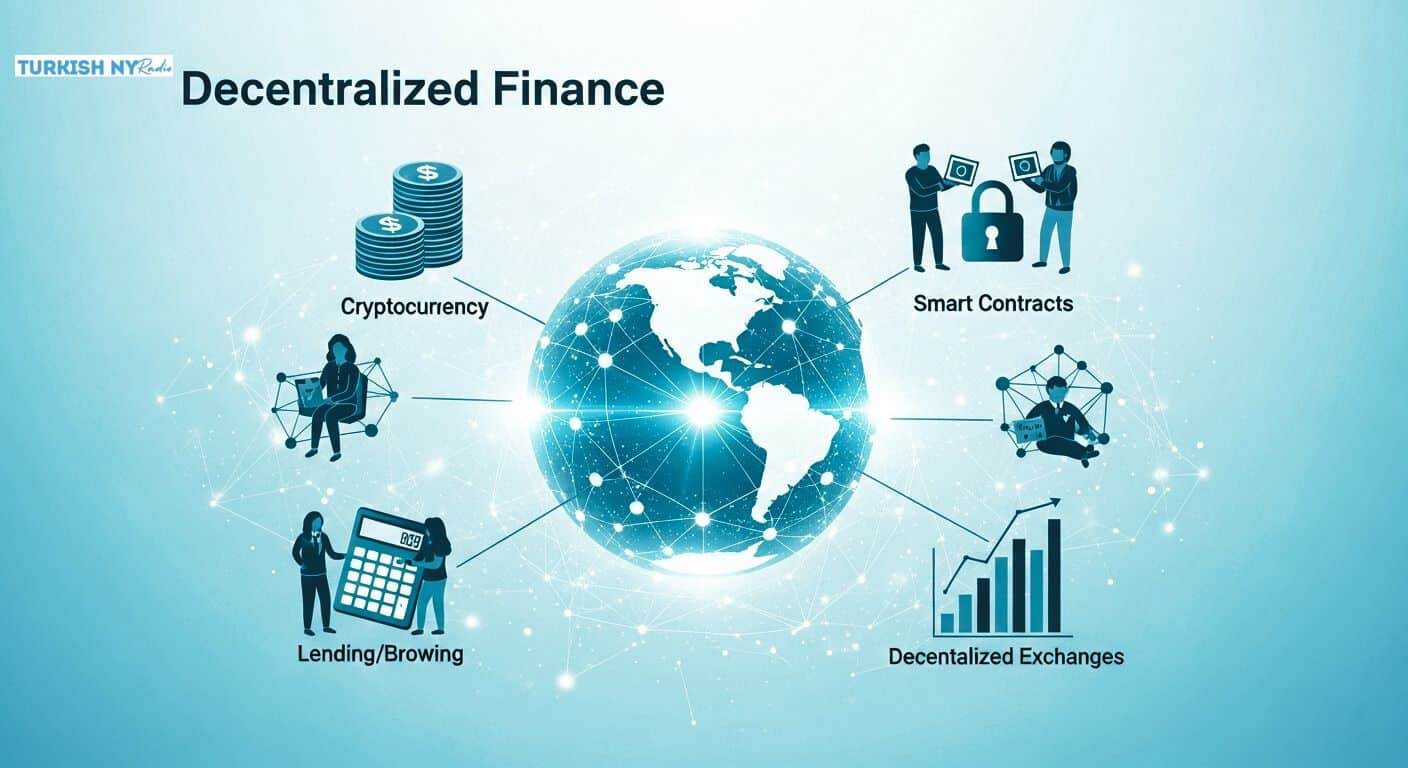
DeFi is based on three main pillars: blockchain networks, smart contracts, and decentralized applications (dApps).
Blockchain: DeFi is implemented on blockchain technology (primarily Ethereum, but also Solana, Polygon, Avalanche, etc.). A blockchain is a public ledger that is distributed and cannot be changed. All the transactions are recorded on this ledger; which makes it available for all to see. Since the ledger is decentralized among different nodes; no one institution has control over the data.
Smart Contracts: These are programs run on the blockchain that automatically enforce the financial agreements. For instance, a lending protocol’s smart contract will take possession of collateral, compute interest, and disburse funds once the terms are fulfilled.
Experts say smart contracts constitute the main support of DeFi; enabling automated and clear execution of agreements without the presence of intermediaries. When the smart contract is activated, its code is fixed and it will fulfill exactly as stipulated, thus eliminating the chance of human mistakes.
Decentralized Applications (dApps): Developers create dApps as platforms for users of DeFi. These are similar to conventional apps (be it web or mobile); but they operate on smart contracts on the blockchain.
The user can connect their crypto wallet to a dApp; put tokens into a lending pool or carry out a trade through the dApp interface. The user can then interact with protocols for lending, trading, insurance, etc.
Thus, these elements allow the provision of financial services to take place without the help of trusted intermediaries.
Notable DeFi Services and Platforms
Decentralized Finance encompasses many financial activities. The table below summarizes these services:
| DeFi Service | Description | Example Protocols |
| Lending and Borrowing | Users lend crypto to earn interest; borrowers provide crypto collateral. Smart contracts manage rates and collateral. | Aave; Compound; MakerDAO |
| Decentralized Exchanges | Trade tokens directly from wallets; using on-chain liquidity pools (no order books). | Uniswap; SushiSwap; Curve |
| Stablecoins | Crypto pegged to fiat (e.g. USD); via collateral or algorithms. Used for stable value. | DAI (MakerDAO); FRAX; USDC |
| Yield Farming | Users stake tokens in pools and earn extra tokens/fees for providing liquidity. | Yearn Finance; Curve; PancakeSwap |
| Asset Tokenization | Real-world assets (RWA) represented as digital tokens on-chain (e.g. gold; bonds). Enables broad access. | Synthetix (synths); realT (real estate) |
Each of these services is brought to users by smart contracts, making DeFi a whole lot more composable. Users can combine services; for example, borrow on MakerDAO, swap on Uniswap, and stake on Yearn, in a permissionless way. This modularity really does foster a culture of rapid innovation.
In practice, DeFi protocols use liquidity pools and automated market makers (AMMs) instead of order books. Liquidity providers (users) lock their funds in pools and others can borrow or trade against these pools.
If a user wants a loan, in DeFi they typically send crypto to a smart contract as collateral and receive another token in return. If the borrower repays, the collateral is released; if not the contract liquidates it back to the lender. This happens instantly on-chain without credit checks or paperwork.
What is So Great About Decentralized Finance?
DeFi brings with it several potential advantages over the average, everyday traditional finance setup:
Getting Financial Tools to Those Who Need Them: With DeFi, anyone with a smartphone can get into the game, no need for KYC or banking infrastructure. This permission-less access is opening financial tools up large number of unbanked people worldwide. For instance, someone in a remote area can get access to loans or savings tools through DeFi.
Seeing Everything in Black and White: All DeFi transactions are recorded in these public ledgers called blockchains. Users can independently verify what protocol code is doing and what transactions have taken place.
Smart contracts are published on a blockchain and records of completed transactions are available for anyone to review. No central authority can freeze or alter funds; as users are always in control of wallets at all times.
Lower Fees and Faster Settlements: By cutting out the middlemen, DeFi can reduce costs. Peer-to-peer lending and trading get rid of bank fees and the delays associated with manual settlement. Transactions can settle in minutes as opposed to days and DeFi markets are on all the time, 24/7, no matter where users are in the world.
Earning a Return: Many DeFi users are earning returns by providing liquidity or staking assets. For instance, staking Ether or stablecoins in a lending pool might yield 5-10% interest (which is a whole lot higher than the average savings rate).
The Risks and Challenges of Decentralized Finance
Even with all its promise, DeFi also comes with some significant risks that users should be aware of:
Smart Contract Bugs and Hacks: Those smart contracts can have bugs in them or be exploited by the bad guys. Hackers have managed to drain DeFi protocols of billions of dollars already. Sources report that over $2.5 billion has been lost to hacks and scams in the first half of last year. The code-driven nature of DeFi means that a simple error in a contract can result in massive losses.
Market Volatility: Cryptocurrency prices can swing wildly. Even if the dollar value is stable with a stablecoin, the actual value of the collateral users are using can crash. Users can unexpectedly be liquidated if the markets move against them.
Lack of Regulation and Recourse: Most DeFi is currently completely unregulated. There is no FDIC insurance or financial authority oversight. If funds are stolen or lost; there is often no way to recover them. Law enforcement is still figuring out how to deal with cross-border crypto crime.
Complexity and User Experience: All too often, DeFi platforms require users to have some kind of technical know-how. Users are expected to manage their own private keys and try to make sense of unfamiliar interfaces. One slip up can prove disastrous. Sources say, it is this complexity that’s a major barrier to mainstream adoption, making it hard for average folk to get on board.
Expert Thoughts and Future Directions
For many, DeFi is seen as a fast-moving sector that’s always changing. The last few years have seen rapid growth across the DeFi ecosystem, with TVL soaring from about $16 billion in early 2021 to $202 billion by the time April 2022 rolled around.
Of course, the big crash of 2022 brought things back down a notch, but growth has been picking up again in the last 3 years: TVL went from $42 billion in October 2022 to $170 billion in September 2025.
Institutions are finally starting to dip their toes in the DeFi water, and the latest inflows to Ether-based protocols and some newer liquid staking products are showing just how much interest there is in institutional staking.
Analysts think that this is going to bring on some big changes. With new advances in Layer-2 scaling such as optimistic rollups and zk-rollups, the market expects to see DeFi on Ethereum getting cheaper and faster.
Despite all its challenges, many builders in the space remain pretty optimistic. At the 2025 Bitcoin Conference, developers were saying that DeFi could make Bitcoin a real financial instrument and could potentially outcompete traditional finance in terms of yields and efficiency.
As one Bitcoin developer put it at the time,


“once Bitcoin DeFi is up and running the most liquid markets will be on-chain, and so the best interest rates will be onchain.”
Conclusion
Based on the latest research, decentralized finance is a great leap in finance, offering open, permissionless access to financial services via blockchain. Users can lend, borrow, trade and earn yields without banks, using automated smart contracts.
Though sources report DeFi’s total locked value has bounced back to around $170 billion by end of 2025, but risks from hacks, volatility and regulatory uncertainty remain prominent. As experts put it, DeFi is what the industry calls “anonymous financial services 24/7 without a middleman”.
Glossary
DeFi: Financial services and applications built on blockchain, no banks.
Blockchain: A digital ledger that records everything in “blocks” on-chain.
Smart Contract: Self-executing code on the blockchain that enforces agreements. In DeFi, smart contracts handle loan collateral, trades, and more, no humans.
dApp: A user-facing app (web or mobile) that talks to smart contracts on the blockchain. Examples are wallets, trading platforms, and lending interfaces.
DEX: An on-chain platform to trade crypto directly from your wallet. DEXs use smart contracts and liquidity pools instead of central order books.
Liquidity Pool: A smart contract pool of tokens provided by users. Pools provide liquidity for trading and loans in DeFi. Providers earn fees or tokens for staking assets.
Yield Farming: Earning rewards often in tokens; by providing liquidity to DeFi protocols. Yield farmers move funds across protocols to get the highest returns.
Impermanent Loss: A DeFi concept where liquidity providers in a trading pool; may lose value relative to holding assets; due to price divergence.
Flash Loan: A quick; uncollateralized loan that must be borrowed and repaid in one blockchain transaction. Enables advanced strategies but also exploits.
Frequently Asked Questions About Decentralized Finance
What are the main differences between Decentralized Finance and traditional finance?
DeFi is established on public blockchain networks where the users deal with each other directly through smart contracts, bypassing the middleman.
How do decentralized exchanges (DEXs) work?
DEXs utilize smart contracts on the blockchain and liquidity pools instead of relying on a central order book. Users provide funds to the pools; and the rest can easily trade against them.
What are stablecoins and why are they important in DeFi?
Stablecoins are crypto tokens whose value is tied to that of a stable asset (usually USD). They eliminate the price fluctuation factor in the otherwise very volatile crypto market. In the case of DeFi, stablecoins (like DAI or USDC) are injected into the lending/borrowing and trading scenarios, so the users can maintain a stable value by locking in.