
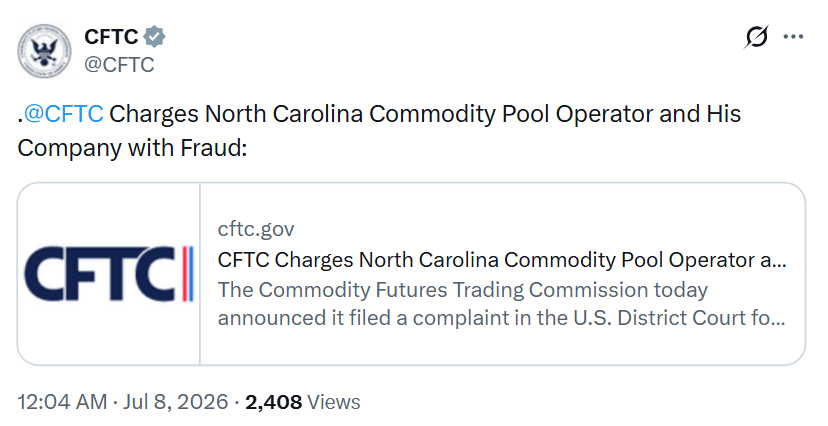
The U.S. Commodity Futures Trading Commission has sued North Carolina resident Trevor Vernon and Argent Capital Management. The agency accused them of running a commodity pool with crypto exposure and defrauding investors of more than $14 million.
The CFTC crypto fraud lawsuit was filed in federal court on Tuesday. It alleges that Vernon solicited $14.8 million from at least 60 investors between March 2022 and February 2026. The agency said he claimed to be a successful trader while the pool suffered heavy losses.


CFTC Crypto Fraud Lawsuit Details Heavy Trading Losses
The complaint said Argent Capital Management traded equity index futures, options on equity index futures, and crypto. The CFTC said the crypto activity included Bitcoin and Ether. It also described both assets as commodities.
According to the regulator, Vernon’s trading caused more than $8.6 million in losses. The agency alleged that investors did not receive full disclosure. It also said they received false quarterly updates and monthly performance emails.
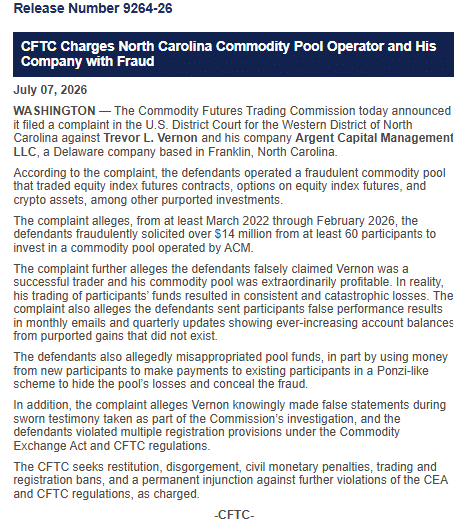
The CFTC crypto fraud lawsuit centers on alleged fraud, false reporting, registration failures, and misuse of money. The agency said Vernon used investor funds in ways that hid poor performance.
The complaint alleged that Vernon misappropriated $3 million to pay investors in a manner similar to a Ponzi scheme. It also claimed he used $136,000 for private air travel.
CFTC Says Investors Were Misled
The agency said Vernon made false statements to current and potential investors. Those statements allegedly made the commodity pool appear stronger than it was.
The CFTC said the pool had “consistent and catastrophic losses.” It alleged that Vernon did not clearly disclose those losses.
Registration Claims Add Pressure
The CFTC accused Argent Capital Management of failing to register with the agency. The complaint said registration was required under federal commodities law.
The agency also alleged that Vernon made false statements to the regulator in January. The CFTC crypto fraud lawsuit includes seven counts tied to fraud, failure to register, and false statements.
Agency Seeks Court Penalties
The CFTC asked the court for strong remedies. It wants Vernon permanently banned from registration and trading.
The agency also requested disgorgement, civil penalties, and restitution. Disgorgement would seek the return of alleged wrongful gains. Restitution would seek repayment for harmed investors.
Crypto Oversight Remains in Focus
The case comes as the CFTC faces wider attention over crypto oversight. The agency is seeking a larger role in digital asset markets.
Lawmakers have questioned whether the regulator has enough resources. The sector remains complex and fast moving.
The CFTC crypto fraud lawsuit is different from market-structure disputes. It focuses on alleged misconduct inside a managed pool.
Other CFTC Disputes Continue
The CFTC is also facing legal pressure from CME Group. CME sued the agency over its approval of U.S. crypto perpetual futures. It argued that those products should be treated as swaps.
The agency is also under pressure over prediction markets. Senators Adam Schiff and John Curtis asked the CFTC to review Polymarket advertising claims.
Rule Change Adds Context
The CFTC recently scrapped its no-deny settlement rule. That change gives defendants more room to dispute agency claims after settling enforcement cases.
The rule change does not alter the allegations against Vernon. However, it adds context to the agency’s enforcement posture.
Conclusion
The CFTC crypto fraud lawsuit adds another crypto linked matter to the agency’s docket. The case alleges that investors were misled, losses were hidden, and funds were misused.
The complaint remains an allegation unless proven in court. Still, it highlights risks tied to unregistered commodity pools and crypto trading programs.
Appendix: Glossary of Key Terms
Commodity Pool: A pooled investment vehicle where investor funds are combined for trading.
Argent Capital Management: The company accused by the CFTC of operating the alleged pool.
Trevor Vernon: The North Carolina resident named in the CFTC complaint.
Bitcoin and Ether: Crypto assets the CFTC described as commodities in the lawsuit.
False Reporting: Misleading updates or statements allegedly given to investors.
Misappropriation: The alleged misuse of investor funds for purposes not properly disclosed.
Ponzi-Like Payments: Payments made to investors using other funds to hide losses.
Frequently Asked Questions About CFTC Crypto Fraud Lawsuit
1- What is the CFTC crypto fraud lawsuit about?
It is about allegations that Vernon and Argent defrauded investors through a commodity pool involving crypto, futures, and options.
2- How much money did investors provide?
The CFTC said Vernon solicited $14.8 million from at least 60 investors.
3- What crypto assets were involved?
The complaint said the pool traded Bitcoin and Ether.
4- What penalties is the CFTC seeking?
The agency seeks a trading and registration ban, disgorgement, penalties, and restitution.