
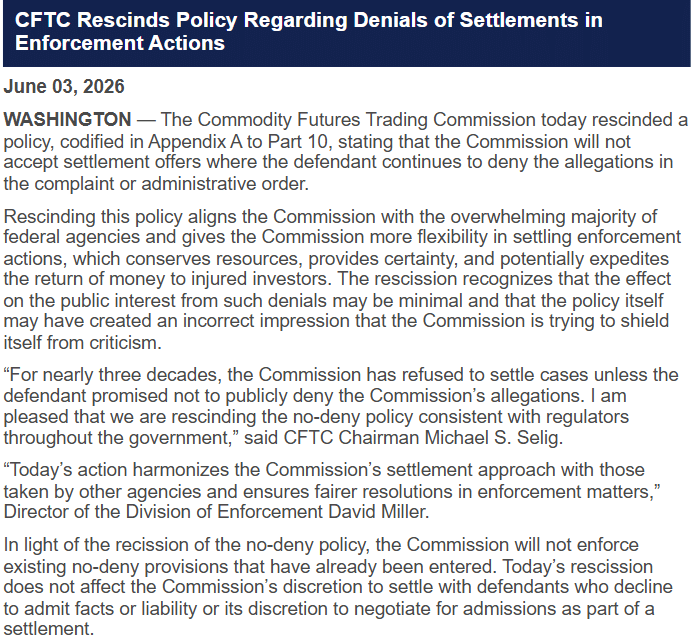
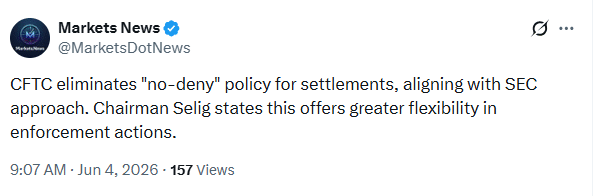
The CFTC settlement policy has changed after the agency ended its long-running “no-deny” rule for enforcement cases. The rule had blocked settlements when defendants continued to deny allegations in a complaint or administrative order.
The decision affects how companies may resolve enforcement cases. It also changes the speech limits attached to many regulatory settlements.


CFTC Settlement Policy Aligns With SEC Rule Change
The Commodity Futures Trading Commission adopted the no-deny rule in 1998. It remained part of the agency’s enforcement settlement process for nearly three decades.
Chairman Michael Selig said the Commission is now moving in line with other government regulators. The agency said the old rule may have created the view that it wanted to shield itself from criticism.
The CFTC settlement policy shift follows a similar move by the Securities and Exchange Commission. The SEC removed its own no-deny rule in May.
That SEC policy dated back to 1972. It limited public denials after enforcement settlements. SEC officials said the change would allow clearer public records and more open criticism.
No-Deny Rule Ends After Decades
The old rule shaped settlement talks for years. A defendant could settle a case without admitting wrongdoing. However, the defendant could not continue denying the agency’s allegations in public.
That structure often created tension. Companies could pay penalties and close a case. Yet they had limited room to explain why they disagreed with the regulator.
Gemini Case Adds Crypto Context
The CFTC settlement policy change comes as Gemini remains part of a wider enforcement debate. The exchange agreed in January 2025 to pay $5 million to settle CFTC charges.
The case involved alleged misleading statements linked to a Bitcoin futures product. Gemini settled without admitting or denying the allegations. The CFTC has since asked a federal judge to vacate the earlier order against the exchange.
Crypto Firms May Gain More Room
Crypto firms have long criticized no-deny language. They argued that settlement terms forced companies to stay silent even when they disputed agency claims.
The new CFTC settlement policy may give future defendants more room to speak after settlement. A company could resolve a case, pay a penalty, and still publish its disagreement with the allegations.
Existing Enforcement Powers Remain
The change does not erase past investigations. It also does not rewrite commodity law. The CFTC can still bring enforcement actions, seek penalties, and request admissions where needed.
The agency also said it can still demand admissions of facts or liability in future deals. That means the new approach adds flexibility, not immunity.
SEC Alignment May Reduce Complexity
The CFTC and SEC are now closer in their settlement approach. That matters for digital asset companies that deal with both agencies.
A more consistent settlement structure may reduce compliance confusion. It may also make enforcement negotiations easier to assess. Still, each case will depend on its facts, evidence, and regulatory claims.
Digital Asset Settlements Could Change
The CFTC has expanded its digital asset enforcement footprint in recent years. The agency oversees derivatives and related market activity. That gives it authority over a meaningful part of crypto trading.
Uniswap Labs settled with the CFTC for $175,000 in 2024. Gemini paid $5 million in 2025. Future defendants may now negotiate with fewer speech restrictions.
Conclusion
The CFTC settlement policy update marks a major enforcement change. It removes a rule that shaped settlement language since 1998.
The shift may make settlements easier to reach. It may also allow companies to defend their public position after resolving a case. However, the CFTC still keeps broad enforcement authority.
Appendix Glossary of Key Terms
No-deny rule: A settlement restriction that limited public denials after enforcement cases.
Enforcement settlement: An agreement that resolves a regulatory case without a full court trial.
Commodity Futures Trading Commission: The U.S. regulator overseeing derivatives and related markets.
Digital asset enforcement: Regulatory action involving crypto assets, derivatives, or related products.
Admissions of liability: Formal statements where a defendant accepts legal responsibility.
Settlement language: The wording used in an enforcement agreement between a regulator and defendant.
Public denial: A statement where a defendant rejects allegations after a settlement.
Regulatory consistency: Similar enforcement practices across agencies such as the CFTC and SEC.
Frequently Asked Questions About CFTC Settlement Policy
1- What did the CFTC change?
The CFTC ended its no-deny settlement rule for enforcement cases.
2- What does the CFTC settlement policy change mean?
It may allow defendants to settle while still denying agency allegations.
3- Does this affect crypto firms?
Yes. Crypto firms may get more flexibility in future settlement language.
4- Can the CFTC still seek admissions?
Yes. The agency can still seek factual or liability admissions when needed.
References