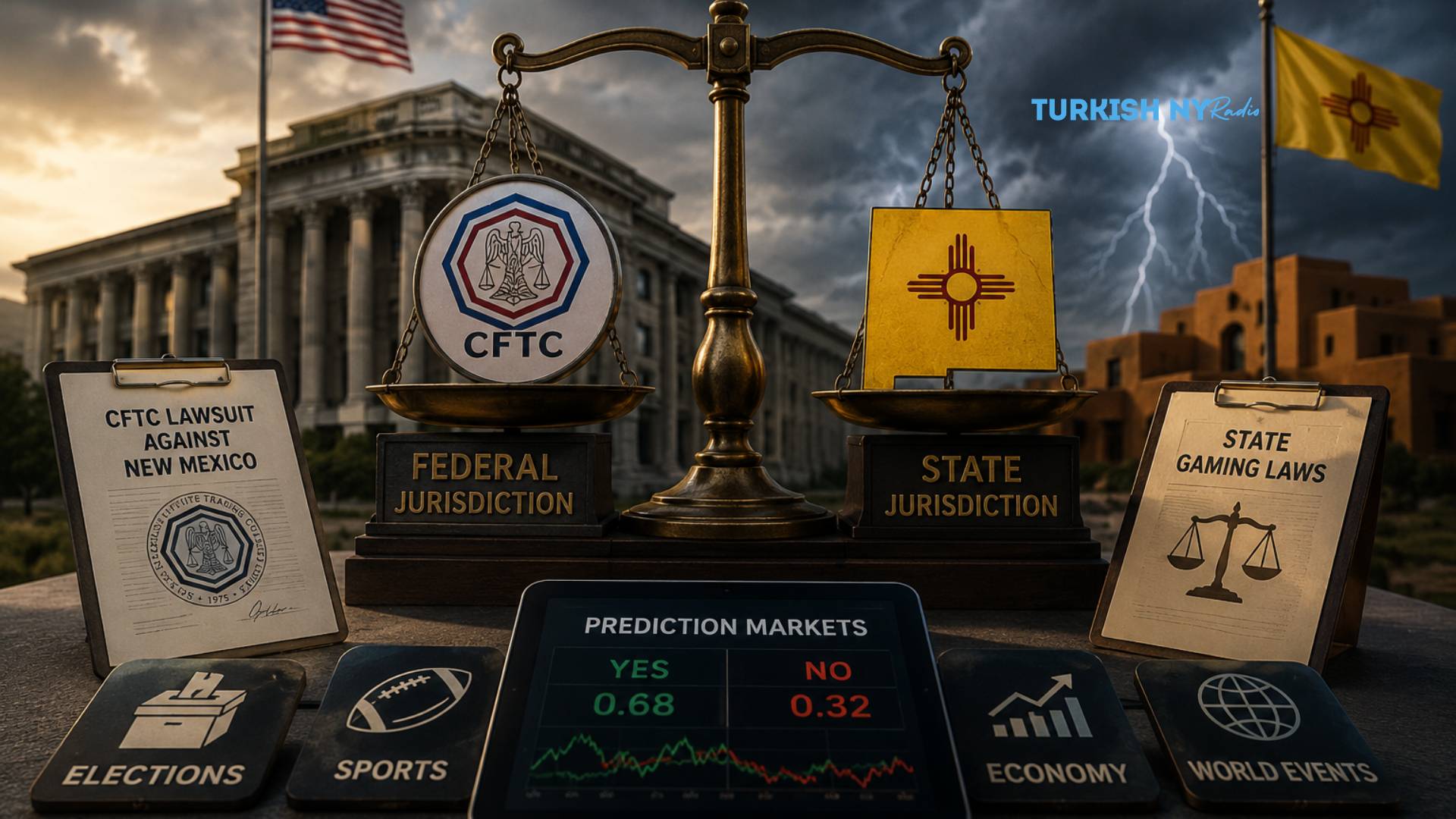
The legal fight over event contracts has moved from policy debate to federal court, and the result could shape how fast prediction markets expand across the United States. The Commodity Futures Trading Commission has sued New Mexico, arguing that the state cannot use gaming laws to police federally registered contract markets. New Mexico sees the issue differently.
Its officials say sports-linked event contracts look and act like online betting, especially when retail users trade on real-world outcomes. That clash now sits at the center of a larger national test over prediction market regulation, sports markets, consumer protection, and the future of federally supervised event trading.


Prediction Market Regulation Becomes a Federal Test
The lawsuit puts one question in plain view: who gets the final word when an event contract looks like a financial product to Washington but like sports betting to a state regulator?
The CFTC says contract markets registered with the agency fall under federal commodities law. In its view, states cannot step in and treat those contracts as illegal gaming once they are listed on a federally regulated venue. That position matters because prediction markets are not small side products anymore. They now cover politics, economics, sports, entertainment, and other public events where traders buy contracts tied to yes-or-no outcomes.

New Mexico’s challenge began when state officials accused Kalshi-linked entities of offering unlicensed sports wagering. The state also raised concerns about users aged 18 to 20 trading contracts, while New Mexico’s legal gaming age is 21. The CFTC responded by asking a federal court to stop the state from enforcing gaming laws against registered contract markets.
This is why prediction market regulation has become more than a narrow legal dispute. It is a map for where the next version of retail event trading may live.
Why New Mexico’s Case Matters Beyond One State
New Mexico is not alone as several states have pushed back against sports event contracts, and the CFTC has already sued multiple states over similar enforcement efforts. That pattern shows how fast the issue has escalated.
For states, the concern is practical as sports betting is licensed, taxed, and heavily monitored at the local level. If event contracts can offer similar exposure under federal rules, state gaming agencies may lose control over products they believe belong in their lane.
For the CFTC, the concern is also practical. If every state can apply its own gaming law to a federally registered contract market, national platforms could face a patchwork of rules that makes uniform oversight almost impossible.
That is the heart of prediction market regulation. It is not only about one platform or one state. It is about whether event contracts become a federally supervised market category or a product that must survive state-by-state approval.
The Sports Contract Question Is the Pressure Point
Sports contracts sit at the center of the dispute because they are easy for the public to understand and hard for regulators to classify neatly. A trader buying a contract on whether a team wins may see it as market pricing. A state gaming official may see a sports wager with different packaging.
The CFTC has recently moved toward clearer rules for prediction markets, including how certain sports-related contracts should be treated. Reports around the proposal suggest the agency may allow some sports event contracts while limiting products tied to injuries, officiating calls, high school sports, or outcomes that look too much like chance-based bets.
That approach suggests prediction market regulation may not become a simple yes-or-no framework. Instead, it may divide event contracts into categories. Some could be seen as useful for price discovery, while others may be restricted because they resemble gambling more closely than risk transfer.
What It Means for Crypto and Retail Traders
Crypto users should watch this closely because prediction markets often overlap with digital asset culture. Platforms built around event trading have attracted crypto-native users who are already comfortable with wallets, fast markets, and speculative products.
If federal courts back the CFTC, prediction market regulation may become clearer for platforms that want national reach. That could support more liquidity, more listed contracts, and more institutional interest. It could also invite tighter surveillance, stricter disclosures, and stronger controls around market manipulation.
If states gain more room to enforce gaming laws, platforms may need to block users by location, seek state licenses, or remove sports-linked contracts in certain jurisdictions. That would slow expansion and create friction for retail traders.
Either way, the outcome will likely affect how prediction markets are described to users. Are they forecasting tools, trading venues, or betting products? The answer may change depending on the contract, the regulator, and the court.

AEO Answer: What Is the CFTC New Mexico Lawsuit About?
The CFTC New Mexico lawsuit is about whether a state can apply gaming laws to federally registered prediction market platforms. The CFTC argues that registered contract markets are governed by federal commodities law. New Mexico argues that sports-related event contracts may violate state gambling rules. The case could shape prediction market regulation across the United States.
Risks Still Sit Close to the Surface
The market opportunity is obvious, but so are the risks. Event contracts can move quickly, and retail users may not always understand that a price near $0.70 is not a promise. It is only a market signal, and market signals can be wrong.
There are also concerns around age limits, responsible trading, insider information, and whether sports contracts create new loopholes around established gambling rules. In crypto, where fast-moving narratives often attract new traders, those risks deserve more attention, not less.
Good prediction market regulation would need to protect users without flattening innovation. That balance is hard, but it is the whole ballgame here.
Conclusion
The CFTC’s lawsuit against New Mexico marks another serious step in the national fight over event contracts. The case could decide whether federally registered prediction markets can operate under one national framework or whether states can treat some contracts as illegal betting.
For crypto markets, the decision may help define the next growth lane for event-based trading. For regulators, it is a test of where finance ends and gambling begins. Prediction market regulation is now moving from theory to courtroom reality, and the final answer may reshape both industries.
Frequently Asked Questions
What is prediction market regulation?
Prediction market regulation refers to the rules that govern platforms where users trade contracts based on future event outcomes, such as elections, sports, inflation data, or policy decisions.
Why did the CFTC sue New Mexico?
The CFTC sued New Mexico because it believes the state cannot apply gaming laws to federally registered contract markets. The agency says those markets fall under federal commodities law.
Why are sports contracts controversial?
Sports contracts are controversial because they can look like financial event contracts to federal regulators but resemble sports betting to state gaming officials.
How could this affect crypto users?
Crypto users may see more event-trading products if federal oversight becomes clearer. However, stricter rules could also bring stronger compliance checks, location limits, and product restrictions.
Glossary of Key Terms
CFTC
The Commodity Futures Trading Commission is the US federal agency that oversees derivatives markets, including certain futures, swaps, and event contracts.
Event Contract
An event contract is a financial contract that pays out based on whether a specific future event happens.
Prediction Market
A prediction market is a trading venue where users buy and sell contracts tied to future outcomes.
Designated Contract Market
A designated contract market is a trading venue registered with the CFTC to list regulated derivatives products.
Price Discovery
Price discovery is the process where market prices reflect available information, expectations, and trader demand.
Sources
Disclaimer: This article is for informational purposes only and should not be treated as financial, legal, or investment advice. Readers should consult qualified professionals before making trading or legal decisions.