


The divide between traditional finance and blockchain just got thinner. BNB Chain has officially integrated with Chainlink Data Feeds to bring verified U.S. government economic data, including GDP, inflation, and consumption metrics, directly onchain.
The integration allows developers to access trusted macroeconomic indicators straight from the U.S. Bureau of Economic Analysis, a first-of-its-kind step that could permanently change how decentralized finance reads the world.


This move places BNB Chain and Chainlink at the intersection of blockchain innovation and real-world data, enabling decentralized systems to interpret government-verified economic conditions with the same precision as traditional finance institutions.
A Turning Point for Onchain Transparency
In the past, DeFi protocols largely operated in isolation, locked in their own on-chain logic, detached from macroeconomic reality. With the new BNB Chain and Chainlink integration, that limitation begins to fade.
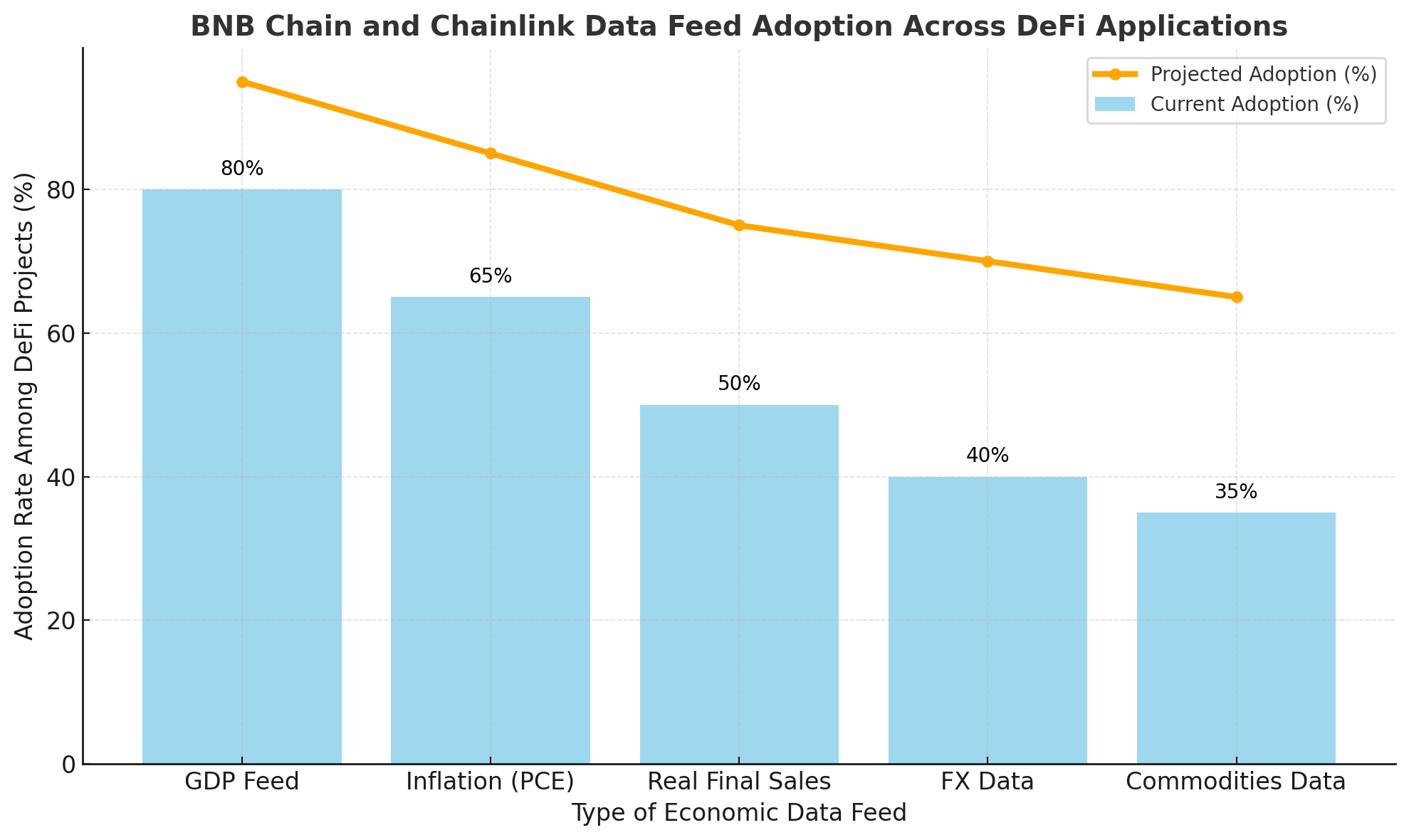
Through secure oracles, key U.S. indicators like Gross Domestic Product (GDP), the Personal Consumption Expenditures (PCE) Price Index, and Real Final Sales will be streamed directly on-chain, adhering to the same release schedule as the federal data.
A Chainlink spokesperson explained on X, “By bringing verified U.S. government data on-chain, we’re helping smart contracts respond directly to real-world economic conditions.”
The data, fully verifiable and tamper-resistant, will be available to DeFi builders on BNB Chain, allowing protocols to adjust to real-world economic trends instead of relying on speculation or manually fed inputs.
Smart Contracts That React to Reality
What makes this development so groundbreaking is not just data access, it’s automation. Smart contracts built on BNB Chain and Chainlink can now trigger functions based on macroeconomic events.
Imagine decentralized lending platforms that automatically adjust collateral ratios when inflation rises, or yield protocols that rebalance returns based on shifts in U.S. output. With verified data in play, the next generation of DeFi could operate like digital finance engines tuned to the pulse of the global economy.
Developers can also experiment with tokenized derivatives tied to GDP growth or inflation trends, something previously impossible without reliable on-chain feeds.
An independent blockchain researcher wrote, “BNB Chain’s integration with Chainlink could redefine on-chain risk management, giving DeFi the same real-time awareness that Wall Street models use.”
Why This Matters for DeFi Builders
Bringing official U.S. economic data on-chain gives DeFi applications something they’ve long lacked, legitimacy through verified sources. In a market that constantly wrestles with volatility and trust issues, this is no small feat.
Data oracles are the backbone of decentralized ecosystems. The partnership between BNB Chain and Chainlink strengthens that foundation by offering developers high-quality, audit-ready information that aligns with regulatory transparency standards.
It also opens the door for institutional players. Funds or fintech firms wary of unreliable on-chain data can now build or audit blockchain models with the confidence that figures like GDP or inflation are sourced from the same agencies Wall Street uses.
A Step Toward Converging Economies
This collaboration fits into a larger narrative where on-chain and off-chain economies are finally beginning to converge. Chainlink has already established partnerships that deliver foreign exchange and commodity data through its oracles. Adding macroeconomic metrics is the logical next step.
For BNB Chain, the upgrade enhances its ecosystem’s competitiveness by positioning it as a home for data-driven decentralized applications. By hosting verifiable U.S. data, it transforms from a mere smart contract platform into an economic data hub for blockchain finance.
As one analyst put it on X, “This is the missing bridge, DeFi can finally talk to the real world using official numbers, not just token prices.”
Conclusion
The integration between BNB Chain and Chainlink represents more than technical progress, it’s philosophical. It merges the objectivity of government data with the autonomy of decentralized networks.
If successful, it could mark the beginning of a new class of applications where economic policy, inflation, and even global growth metrics play a direct role in onchain decision-making. DeFi, in essence, may be about to gain its first true sense of economic awareness.
Frequently Asked Questions
1. What kind of data is being brought onchain through BNB Chain and Chainlink?
It includes verified U.S. government economic indicators such as GDP, inflation (PCE Price Index), and Real Final Sales.
2. How will DeFi developers use this data?
They can design smart contracts that automatically react to real-world events, improving risk models, stablecoin management, and yield protocols.
3. Why is this integration significant for institutional adoption?
Institutions require verifiable data. The BNB Chain and Chainlink collaboration delivers that through transparent, government-sourced metrics.
4. Is the data updated in real time?
No. It follows the official release schedule—some metrics are monthly, others quarterly—maintaining consistency with traditional economic reporting.
Glossary of Key Terms
Oracle: A system that delivers real-world data to blockchain smart contracts securely.


DeFi (Decentralized Finance): Financial services built on blockchain without intermediaries like banks.
GDP (Gross Domestic Product): The total value of goods and services produced within a country.
Chainlink Data Feeds: Trusted oracle infrastructure that delivers external data—like prices or economic metrics—to blockchain applications.