




This Article Was First Published on TurkishNY Radio.
According to a recent survey, 67 percent of institutional investors expect Bitcoin to increase in value in the next three to six months, suggesting that market participants have confidence in Bitcoin’s medium-term trend.


Among 124 respondents, there was a substantial divide, with 45% of institutions suggesting the market is in the waning days of a bull run, while for non-institutions, it was only 27%.
This discrepancy highlights how various institutional players may be conceptualizing the opportunity in a different manner.
The institutional outlook for Bitcoin remains bullish on macro and liquidity catalysts, not speculation alone. This institutional appetite towards Bitcoin is said to be based on the liquidity of the crypto market.
Institutional Bullish Outlook for Bitcoin Q1 2026 Update
Bitcoin is currently valued at around $111,211 USD as of press time, according to finance data. Other sources have recent quotes from $110,700 to $112,500.


With its price firmly above six figures, the institutional bullish narrative for Bitcoin is being constructed on the basis of high price, strong network data, and macro liquidity.
Here’s Why the Institutional Bull Case for Bitcoin Just Grew Even Stronger
The institutional long-term thesis for Bitcoin is based on several key pillars: Corporate treasuries and digital asset holdings continue to grow, further bolstering both fund supply headwinds and demand.
The expectation of more cuts by the Federal Reserve and a large amount of money market funds on the sidelines are likely going to mean some new capital comes into risk assets like Bitcoin.
On-chain metrics like exchange outflows tell you the accumulation story, not distribution.
“Right now, the structurally bullish institutional backdrop for Bitcoin is inherently structural demand and growing macro factors.”
she said in this wake.
Those factors are “resilient liquidity conditions, a strong macro backdrop, and supportive regulatory dynamics,” according to Coinbase, which underlie what it sees as Bitcoin’s near-term upside potential.
Price Prediction Table for Bitcoin Institutional Investor Sentiment 2026
| Scenario | Q4 2025 Range | Q1 2026 Range | Key Imperatives |
| Bear | $85k–$107k | $75k–$105k | Growth shock, USD strength, ETF outflows |
| Base | $107k–$123k | $105k–$130k | Moderate Fed easing, steady ETF inflows, accumulation |
| Bull | $123k–$139k | $130k–$150k+ | Clear policy support, accelerating treasury buys, liquidity release |
This structured price forecast addresses the “Bitcoin mid-term price prediction Q4 2025” scenario and aligns with the institutional bullish outlook for Bitcoin while avoiding unrealistic hype.
On-Chain Signals and Institutional Behavior
The institutional bullish narrative for Bitcoin is further strengthened by on-chain flows and treasury activity; public companies cumulatively own over 1 million BTC, while the mining network hashrate persists at high levels, implying structural support.
Buy-the-dip behavior also persists in corporate treasuries, despite pockets of market corrections. When institutions see that the institutional bull thesis for Bitcoin is still alive and well, positioning may go from opportunistic to strategic.
Threats to the Corporate Bull Case for Bitcoin
Even with institutional bullish sentiments on Bitcoin, caution is needed. Key risk factors include:
A geopolitical shock or trade wars could cause risk-off flows and pressure on Bitcoin.
An unexpected hawkish turn of the Federal Reserve or monetary authorities could distort anticipated liquidity tailwinds.
Technical breakdowns: If Bitcoin falls below its 200-day moving average or breaks through key support around $103k, momentum may turn.
While the institutional cheer for Bitcoin is a good way to hang hope on, that does not diminish the imperative of remaining observant.
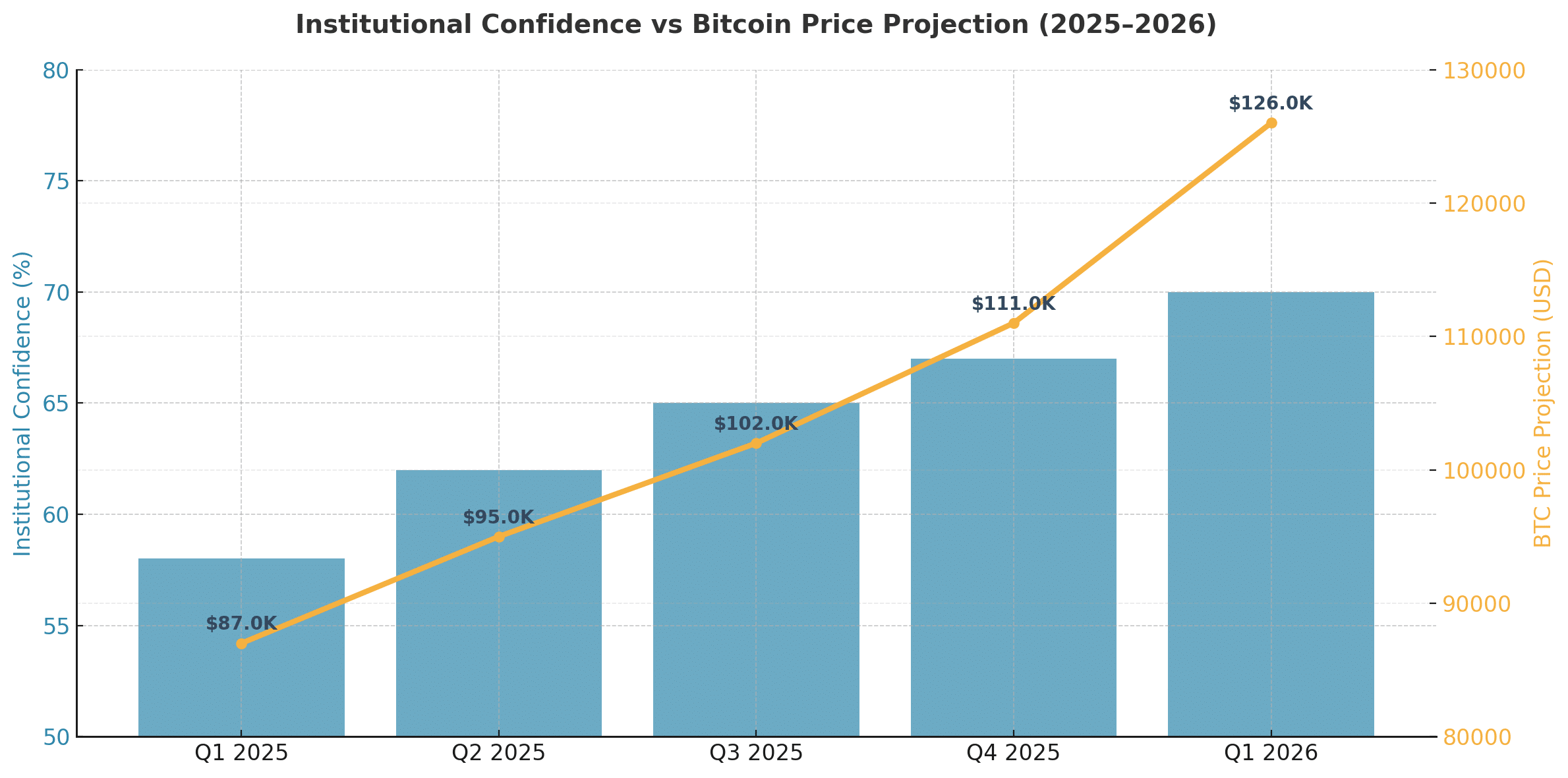
Bullish Sentiment For Bitcoin As An Institutional Investment Grows In Credibility
Institutional bias towards Bitcoin has credible support from poll data and macro metrics. With BTC currently trading at approximately $111k USD and structural supports still intact, the argument for higher through Q1 2026 remains strong both in base and bull scenarios.
The overall institutional view is bullish for Bitcoin and tries to tell us that many big players have a bigger upside in their heads than down.
As market dynamics develop, monitoring institutional behavior, macro flows, and on-chain signs will remain important for understanding how the institutionally bullish perspective on Bitcoin is unfolding.
Summary
67% of institutional investors are looking at Bitcoin’s six-year prospects in a positive light, according to Coinbase’s most recent survey.
The bullish mood is based on better liquidity, regulatory clarity, and favorable macroeconomic factors.
Institutions keep on accumulating Bitcoin, underpinning long-term confidence as well as stability in the market.
Experts steer Bitcoin’s price to fluctuate between $123,000 and $150,000 by Q1 2026.
Catalysts for growth include corporate treasury investment, ETF inflows, and solid on-chain fundamentals, suggesting the bull market might keep growing.
Glossary of Essential Terms
1. Institutional Investors
Institutions: Financial organizations, e.g., mutual funds and pension plans which manage pools of assets. Their entrance is also sometimes taken to be a sign of market maturation and confidence in Bitcoin.
2. Coinbase Institutional Survey
Coinbase A recurring study conducted by Coinbase tracking how professional investors feel about the current market conditions, providing insight into the attitudes of institutional holders towards Bitcoin’s price potential and market confidence.
3. Bitcoin Price Forecast
A benchmarked score expressed as an alternative to the incredibly volatile fare figure Changes in macroeconomic trends and adoption rates foster Bitcoin Use, liquidity rates and participation of institutional money will give possible value.
4. Market Liquidity
“Best” refers to how easily Bitcoin can be traded without moving the price too much. Greater liquidity infers a healthier market and decent institutional trading terms.
5. Exchange-Traded Funds (ETFs)
Exchange-traded products, which are securities, allow exposure to Bitcoin for traditional investors without them having to buy or hold it. Institutional ETF inflows are very bullish for long-term price growth.
6. Hashrate
The sum total of all computational power devoted to mining and securing Bitcoin. An increasing hash rate indicates a secure network and miners’ belief in Bitcoin’s long-term economic viability.
7. Macro Tailwinds
Macro-narratives, such as interest-rate cuts and regulatory certainty or fiscal stimulus, that drive demand for Bitcoin indirectly through better overall liquidity in the global market and risk-on behavior.
8. MiCA Regulation
The Market in Crypto-Assets (MiCA) framework of the European Union intended to harmonize crypto compliance, bring transparency, and offer legal certainty for institutional investors functioning within the realm of digital assets.
Frequently Asked Questions About Institutional bullish outlook for Bitcoin
1. What does institution-man bullish Bitcoin price action mean?
That speaks to increasing conviction among big financial institutions that Bitcoin will see strong appreciation and price adoption between now and 2026 on the back of macro conditions and regulation.
2. How would institutional bullishness impact the 2026 price prediction for Bitcoin?
Institutional accumulation tends to decrease market volatility, bolster liquidity, and put buying pressure on the price, and this is where indications point to with predictions of Bitcoin trading between 123k and 150k by the beginning of 2026.
3. Is institutional Bitcoin investment safe and legal?
Yes, through regulated custodians and compliance frameworks (e.g., MiCA or U.S. ETF approvals), institutional Bitcoin holdings have to follow more security, audit, and transparency standards.
4. Which changes or events will impact institutional Bitcoin sentiment going forward?
Future macro developments, ETFs coming online worldwide, inspired regulations, and next-gen blockchain scaling solutions are anticipated to continue the trend in institutional involvement and market stability through 2026.