
Bitcoin is walking a tightrope right now, and the on-chain data is doing nothing to ease investor nerves. With the asset hovering around $62,500, a wave of fresh Bitcoin exchange inflows has emerged at a scale not seen in months, signaling that a growing number of market participants are quietly preparing for the possibility of a sharper price decline. Whether that decline materializes depends on what happens in the next several trading sessions.
What the Bitcoin Exchange Inflow Data Actually Reveals
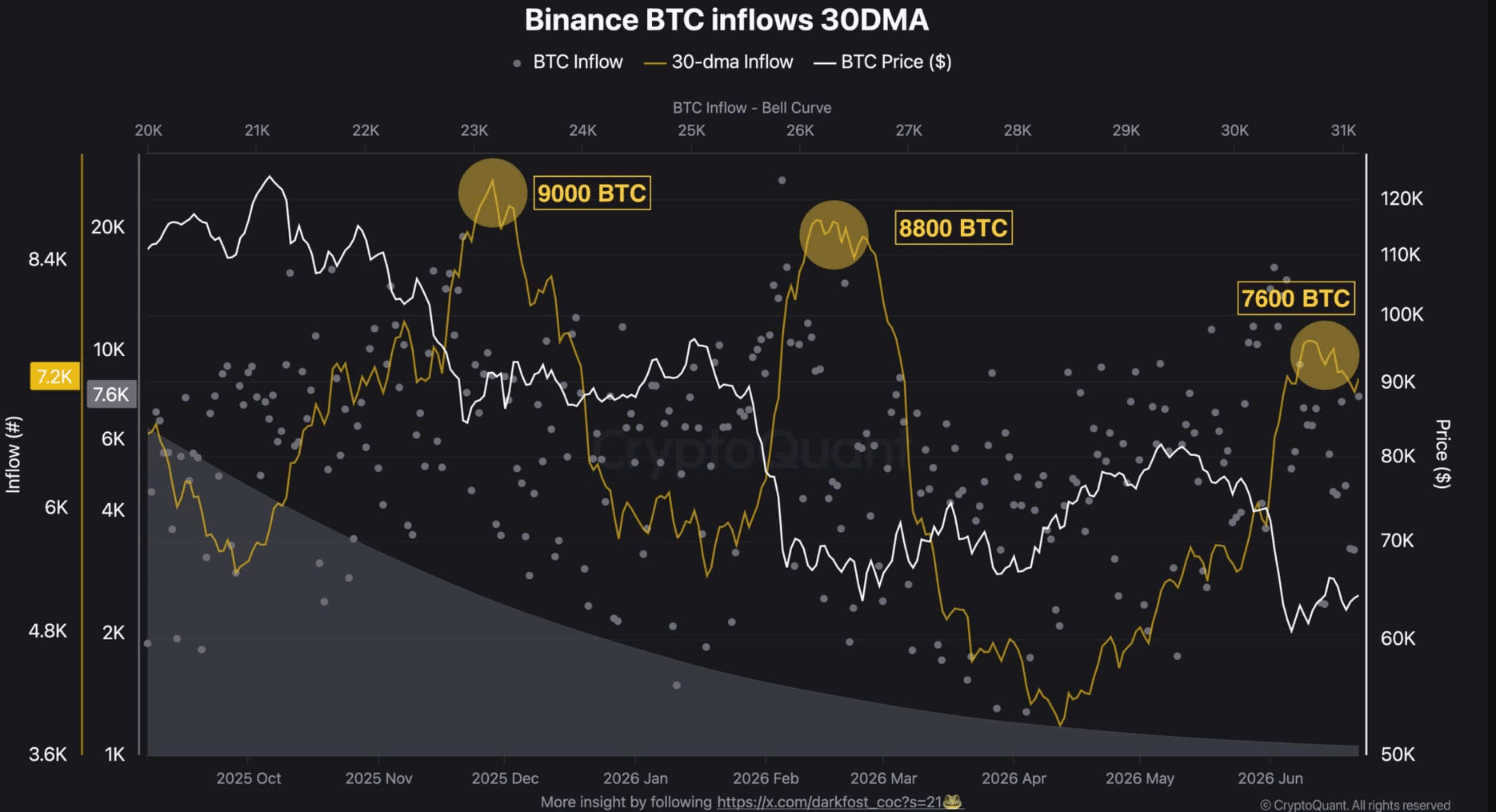
When Bitcoin moves onto exchanges in large volumes, it does not always mean selling has started. What it does mean is that selling could start quickly, and that distinction matters enormously to anyone tracking market structure. Bitcoin exchange inflows into Binance have climbed to an average monthly figure of 7,600 BTC, currently valued at roughly $475 million, up from just 3,880 BTC recorded back in April. That is nearly double in a matter of weeks, and the comparison to prior cycles is difficult to ignore.


The same pattern of rising Bitcoin exchange inflows appeared in November 2025, when the figure reached 9,000 BTC as the price slid to $84,000, and again in February when 8,800 BTC flowed in during a drop to $60,000. History does not always repeat in crypto, but it rhymes often enough that these signals carry real analytical weight.
The broader exchange reserve currently reflects $240.8 billion worth of Bitcoin sitting on trading platforms, an increase of approximately $229 million within just the last two days. That is a meaningful accumulation of sell-side firepower.
Long-Term Holders Are Starting to Stir
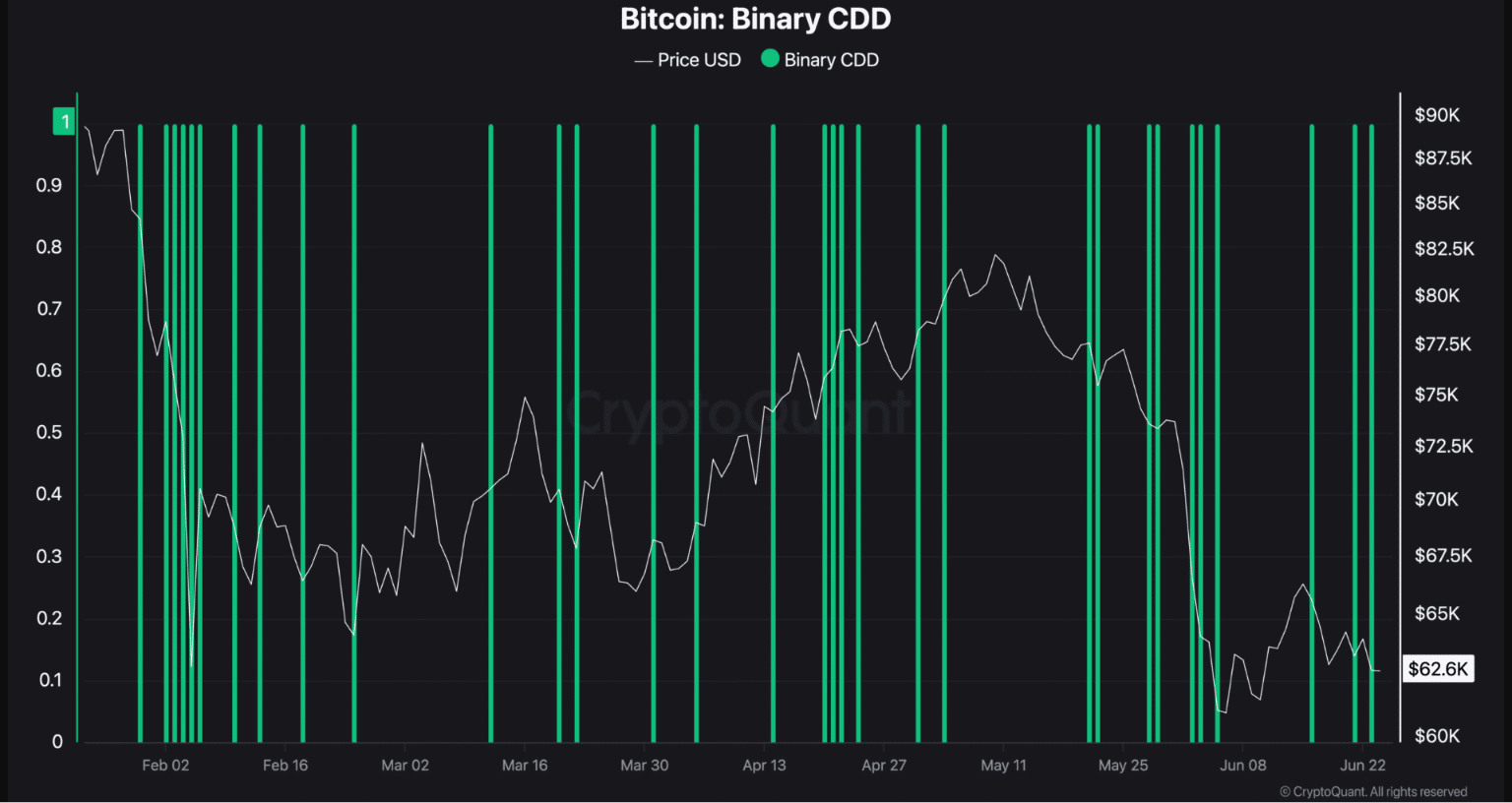
Perhaps the most telling detail in the current setup is that long-term holders, the group that typically provides a stabilizing floor for Bitcoin during downturns, are showing signs of movement. The Binary Coin Days Destroyed metric, which tracks whether previously dormant coins are being moved, has posted a reading of 1. That single data point carries a lot of weight because it indicates that coins which had been sitting untouched for extended periods are now being transferred, which historically correlates with distribution behavior rather than accumulation.
These are not panic sellers in any traditional sense. Long-term holders tend to move with deliberation, and their timing around key psychological levels like $60,000 is rarely accidental. When this cohort begins repositioning, it adds a layer of supply pressure that short-term traders cannot easily absorb. The deposit transaction count has climbed toward 9,220 on the chart, reinforcing the picture of investors systematically moving assets closer to the point of potential sale rather than withdrawing them into cold storage.
Bitcoin Exchange Inflows and the Broader Sentiment Shift
Beyond the on-chain metrics, institutional sentiment has taken a visible hit. U.S. spot Bitcoin ETFs recorded outflows of approximately $113.78 million on June 23rd, marking back-to-back daily outflows for the first time since the recent rally began to lose steam. That sequence of redemptions, layered on top of the existing Bitcoin exchange inflows spike, creates a compounding narrative where both retail positioning and institutional demand are simultaneously softening.
Spot market netflow reached $30.56 million during the same period, which on its own might seem manageable, but viewed alongside the broader data it fits a pattern of cautious withdrawal rather than confident accumulation. The market is not in freefall, but the weight of evidence suggests it is being priced by people who are hedging rather than betting.
Key Price Levels to Watch This Week
The liquidation heatmap provides a useful technical lens through which to read the near-term risk. Significant liquidation clusters are concentrated in the $59,000 to $60,000 range, meaning that a sustained move below $62,000 could trigger cascading liquidations that accelerate the decline toward that support zone. On the upside, $65,460 represents the level where bullish momentum would need to reassert itself convincingly to shift the narrative back in favor of the buyers.
Neither outcome is certain, and that ambiguity is precisely what makes the current Bitcoin exchange inflows data so consequential. If selling pressure materializes from the holders now parked on exchanges, the downside scenario becomes more probable. If buyers step in at scale and absorb the available supply, the rally toward $65,460 remains a live possibility.
Conclusion
Bitcoin is at a genuinely pivotal moment, and the data leaves very little room for comfortable interpretations. Rising Bitcoin exchange inflows, a stirring among long-term holders, softening ETF demand, and tightening price structure around a critical support zone collectively paint a picture of a market that is more fragile than the $62,500 price tag might suggest.
Investors tracking this situation closely would do well to watch exchange reserve changes, the Binary CDD metric, and ETF flow data as the week unfolds, because the next major move is likely being decided right now in the data rather than the headlines.
Frequently Asked Questions
What are Bitcoin exchange inflows?
Bitcoin exchange inflows refer to the volume of BTC being deposited onto trading platforms, which signals that holders may be preparing to sell.
Why do rising Bitcoin exchange inflows matter?
Higher inflows increase available sell-side liquidity on exchanges, which can lead to downward price pressure if selling activity follows.
What is the Binary Coin Days Destroyed metric?
It is an on-chain indicator that measures whether long-dormant coins are being moved, with a reading of 1 indicating recent movement of previously inactive Bitcoin.
What is the significance of the $60,000 level for BTC?
The $60,000 zone is a major psychological and technical support level, with significant liquidation clusters concentrated between $59,000 and $60,000.
Glossary of Key Terms
Exchange Inflows: The total volume of a cryptocurrency deposited into centralized trading platforms, often interpreted as potential selling intent.
Coin Days Destroyed (CDD): An on-chain metric that weights Bitcoin movement by how long coins were held, helping analysts identify when long-term holders become active.
Liquidation Clusters: Price zones where a high concentration of leveraged positions would be forcibly closed if the market reaches those levels, often amplifying price moves.
Exchange Reserve: The total value or volume of a cryptocurrency currently held across all centralized exchanges, representing the available supply for immediate sale.
Spot Market Netflow: The net difference between exchange inflows and outflows, indicating whether capital is entering or leaving the market on balance.
Sources