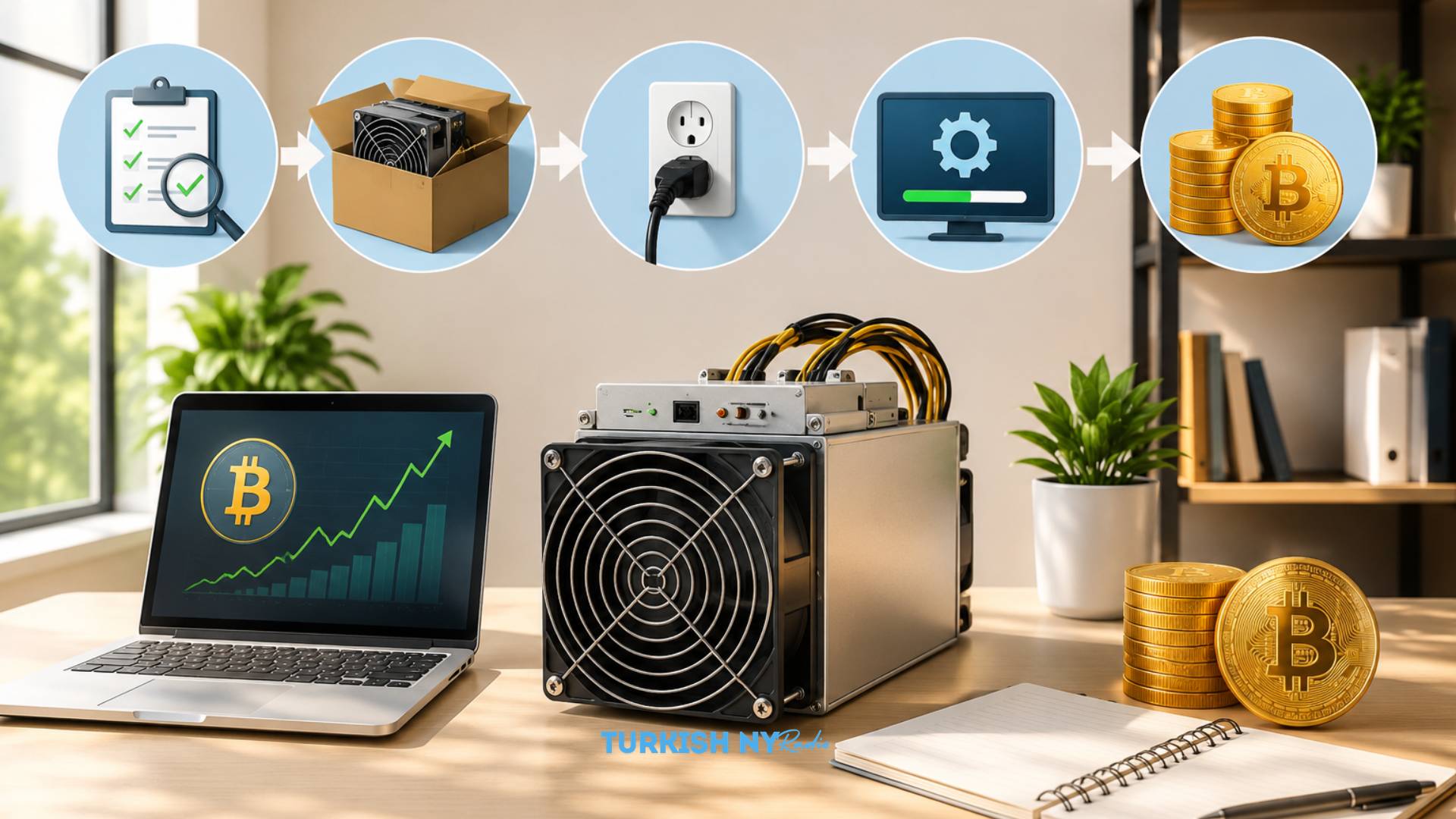
Bitcoin mining in 2026 is not what it looked like even three years ago. The network has crossed the symbolic 1 zettahash per second threshold, competition among miners has intensified to levels no one predicted, and the April 2024 halving permanently reset the economics of block rewards down to 3.125 BTC per block.
Meanwhile, Bitcoin itself has been trading in the $62,000 to $75,000 range through mid-2026, which means every decision around hardware efficiency and electricity sourcing carries real financial consequences. For anyone seriously researching how to mine Bitcoin in this environment, the honest starting point is not enthusiasm but arithmetic.


The opportunity still exists, but the margin between a profitable operation and a costly mistake is thinner than it has ever been, and getting that math right from the beginning is the difference between building something sustainable and learning an expensive lesson.
What Bitcoin Mining Actually Does and Why It Still Matters
Before anyone invests a dollar in hardware, understanding what mining actually accomplishes is worth more than any equipment review. Every Bitcoin transaction that gets sent across the network needs to be validated, bundled with thousands of others into a block, and permanently recorded on the blockchain. Miners are the people and institutions doing that work.
They compete globally to solve a cryptographic puzzle rooted in the SHA-256 hashing algorithm, and the first machine to find a valid solution earns the block reward along with any transaction fees attached to the transactions in that block. This process is called Proof of Work, and it is by design computationally expensive because that cost is precisely what makes the blockchain trustworthy.
The network automatically recalibrates how difficult this puzzle is every 2,016 blocks, which works out to roughly every two weeks, to ensure that new blocks keep appearing approximately every 10 minutes regardless of how much or how little global hashrate is active.
This adjustment mechanism is what makes Bitcoin remarkably self-regulating, and anyone learning how to mine Bitcoin needs to understand that this difficulty recalibration directly affects how much earning potential any given machine actually delivers over time.
How to Mine Bitcoin: Beginner’s Step-by-Step Guide for 2026
Step 1: Understand That Hardware Requirements Have Changed Significantly
The era of mining Bitcoin with a graphics card or home computer ended years ago, but 2026 has introduced a new layer of nuance even within the ASIC market itself. Machines consuming more than 25 joules per terahash are now largely unprofitable across most electricity markets, having been squeezed out by a combination of the 2024 halving and newer hardware generations that operate far more efficiently.
The benchmark machines generating real returns in 2026 are primarily those in the 13 to 16 joules per terahash range, such as the Bitmain Antminer S21 Pro at 234 TH/s and 3,510 watts, or newer models like the S21 XP running at approximately 13.5 joules per terahash.
Entry-level current-generation ASICs now start around $4,500, while top-tier hydro-cooled units push toward $16,500 and above. Hardware depreciates quickly in this market because each new chip generation renders the previous one less competitive, so factoring in that depreciation curve before purchasing is not optional.
Step 2: Run the Electricity Numbers Before Spending Anything
If there is one piece of advice that every experienced miner would give a newcomer in 2026, it is this: electricity cost is the single variable that decides whether the entire enterprise makes sense. A modern ASIC at $0.05 per kilowatt-hour operates with comfortable profit margins, while the same machine at $0.10 per kilowatt-hour barely breaks even under current hashprice conditions.
Research published in mid-2026 puts the typical break-even electricity rate for sub-15 joule-per-terahash hardware at approximately $0.07 per kilowatt-hour, with operators paying above that threshold facing slim or negative returns at today’s Bitcoin prices.
Industrial miners with contracted power rates below $0.06 per kilowatt-hour hold a structural advantage that home miners on retail electricity plans simply cannot overcome through hardware choices alone. Running the numbers through a reputable mining profitability calculator, using one’s actual local electricity rate, is not a step that should be skipped or estimated.
Step 3: Choose a Mining Pool That Reflects Your Scale and Goals
Solo mining Bitcoin in 2026 is statistically comparable to buying a single lottery ticket and expecting to win enough to retire on. With the global network hashrate now sitting around 1 zettahash per second, the computational share held by a single ASIC is so small that finding a block independently could take centuries at today’s difficulty levels.
Mining pools solve this problem by aggregating hashrate from hundreds or thousands of participants, finding blocks far more frequently, and distributing rewards proportionally based on each miner’s contributed work.
The two most common payout structures are Pay Per Share, which rewards miners for every valid share submitted whether or not the pool finds a block, and Pay Per Last N Shares, which ties payouts to block discovery but reduces long-term payout variance.
Pool fees typically land between 1% and 2% of earnings. When evaluating how to mine Bitcoin through a pool, transparency of reporting, historical uptime, minimum withdrawal thresholds, and geographic server distribution all matter more than marketing claims.
Step 4: Secure a Bitcoin Wallet Before Setting Up Any Hardware
Mining rewards need somewhere to go, and that destination needs to be secure before the first block reward ever arrives. Hardware wallets provide the strongest protection because private keys never touch an internet-connected device, making them resistant to the kinds of remote attacks that have cost people significant sums over the years.
Software wallets offer more convenience for frequent access but carry correspondingly higher exposure. One decision miners consistently get wrong is routing pool payouts directly to an exchange wallet. Exchange platforms can freeze withdrawals, face insolvency events, or impose payout delays at exactly the wrong moment. Mining revenue should flow to a wallet the miner personally controls, and keeping detailed records of incoming transactions matters considerably at tax time in most jurisdictions.
Step 5: Configure the ASIC, Connect to the Pool, and Monitor Continuously
Setting up an ASIC involves accessing its onboard web interface through a local network connection, entering the mining pool’s stratum server address, creating a worker name, and linking the wallet address where payouts will land.
Most current-generation machines from major manufacturers walk through this in a straightforward sequence, and large pools maintain detailed setup documentation for their most popular hardware configurations. The part beginners underestimate is ongoing management.
Running ASIC miners continuously under high thermal load requires consistent monitoring of hash rate output, chip temperatures, fan speeds, and power consumption. Management software that aggregates this data across multiple machines into a single dashboard pays for itself quickly when it catches a degraded hash board or an overheating unit before the problem becomes a hardware failure.
Is Bitcoin Mining Still Profitable in 2026? The Real Numbers
This is the question that brings most beginners to the research phase, and the honest answer is more complicated than yes or no. The Bitcoin network hashrate peaked above 1.16 zettahashes per second in late 2025 before settling back toward the 1 zettahash range in early 2026, and JPMorgan analysts noted in January 2026 that daily block reward revenue per exahash had fallen 32% year over year to record lows.
Industry data from KuCoin’s 2026 mining analysis estimates the average all-in production cost for Bitcoin across the sector at roughly $77,000 per coin, with full-cost models for many operators exceeding $100,000. At Bitcoin’s current trading range around $65,000 to $75,000, that means a significant portion of the mining industry is operating near or below full-cost breakeven, with profitability concentrated among those who secured low electricity rates and deployed efficient hardware before the halving.
That is not the same as saying mining is finished. Operators with power contracts below $0.06 per kilowatt-hour running sub-15 joule-per-terahash hardware are generating genuine returns. The post-halving shakeout has simply eliminated the forgiving margins that used to make inefficient setups viable, and that dynamic will only become more pronounced as each successive halving approaches.
The Environmental Dimension of Bitcoin Mining in 2026
The energy consumption debate around Bitcoin mining has matured considerably since the conversation first entered mainstream awareness. According to the 2025 Cambridge Digital Mining Industry Report, Bitcoin’s annual electricity consumption now sits around 138 terawatt-hours, with approximately 52% of that energy sourced from sustainable sources including renewables and nuclear.
The Cambridge Bitcoin Electricity Consumption Index, maintained by the Cambridge Centre for Alternative Finance, remains the most widely cited academic benchmark on the topic and provides live comparisons that help contextualize Bitcoin’s energy footprint against other industrial activities.
Increasingly, mining operations are being built alongside renewable energy projects specifically because miners can serve as flexible load customers, absorbing excess generation that would otherwise be curtailed, which creates an economic case for green mining that goes beyond regulatory optics.
Conclusion
Understanding how to mine Bitcoin in 2026 means accepting that this is no longer a casual side project but a capital-intensive industrial activity where the difference between profit and loss is measured in fractions of a cent per kilowatt-hour.
The network is more competitive, the hardware requirements are more demanding, and the post-halving revenue environment rewards only those who approached the decision with disciplined cost analysis and efficient equipment choices.
That said, the underlying opportunity remains real for miners who source low-cost power, deploy current-generation ASICs, participate in reputable pools, and manage operations with the same attention that any serious business demands.
The barrier to entry has risen significantly, but so has the sophistication of the tools, data, and educational resources available to help newcomers make informed decisions before committing capital. Doing the homework thoroughly is not a suggestion for those learning how to mine Bitcoin today; it is the foundation on which every profitable mining operation is built.
Frequently Asked Questions
Q: Can someone still mine Bitcoin profitably at home in 2026?
A: Home mining is possible but genuinely difficult to make profitable unless access to below-average electricity rates exists. At retail electricity prices of $0.10 per kilowatt-hour or above, most current-generation ASICs produce slim or negative margins under 2026’s hashprice conditions. Miners in regions with subsidized or industrial-rate electricity stand the best chance.
Q: How much does a Bitcoin mining ASIC cost in 2026?
A: Entry-level current-generation machines start around $4,500, with mid-tier options in the $6,000 to $10,000 range and premium hydro-cooled units running $14,000 to $16,500 or more. Prices fluctuate with Bitcoin’s market price, so buying during periods of market weakness tends to offer better hardware value.
Q: What is the current Bitcoin block reward in 2026?
A: Following the April 2024 halving, the block reward stands at 3.125 BTC per block. The next halving is projected to occur in April 2028, which would reduce it further to 1.5625 BTC.
Q: Is joining a mining pool required in 2026?
A: For any individual miner operating fewer than a few hundred ASICs, pool mining is essentially necessary. Solo mining at any practical scale carries such extreme variance that earning rewards could realistically take years or decades given today’s network hashrate above 1 zettahash per second.
Glossary of Key Terms
ASIC (Application-Specific Integrated Circuit): Hardware engineered exclusively to perform SHA-256 hashing for Bitcoin mining, far exceeding the efficiency of any general-purpose chip for this specific task.
Block Reward: The newly created Bitcoin awarded to the miner who successfully adds a valid block to the blockchain. Currently 3.125 BTC per block following the April 2024 halving.
Hash Rate: A measurement of computational power expressed in hashes per second. Higher hash rate increases the statistical probability of solving a block before competing miners.
Hashprice: A metric expressing mining revenue per unit of computational power, typically stated in dollars per petahash per second per day. It is the most direct measure of how profitable mining conditions are at any given moment.
Joules per Terahash (J/TH): The primary efficiency metric for Bitcoin mining hardware. Lower numbers indicate less electricity consumed per unit of mining output, which directly determines profitability at any given electricity rate.
Mining Pool: A collective of miners who combine their computational resources to increase block discovery frequency and share rewards proportionally based on contributed work.
Network Difficulty: A self-adjusting parameter controlling how hard it is to find a valid block hash. It recalibrates every 2,016 blocks to maintain the network’s target 10-minute block time.
Proof of Work (PoW): Bitcoin’s consensus mechanism requiring miners to expend measurable computational energy as the condition for participating in block creation, making the blockchain resistant to manipulation.
SHA-256: The cryptographic hashing algorithm at the core of Bitcoin mining. ASIC hardware is designed specifically to compute this algorithm as rapidly and efficiently as possible.
Stratum Protocol: The standard communication protocol connecting mining hardware to pool servers, handling work assignment and share submission between the two.
Halving: The programmatic event occurring approximately every four years that reduces the Bitcoin block reward by 50%, controlling the pace at which new supply enters circulation and reinforcing Bitcoin’s long-term scarcity.
Zettahash (ZH/s): One zettahash equals one trillion gigahashes per second. The Bitcoin network crossed the 1 ZH/s milestone in late 2025, representing the total combined computational power of all miners globally.
Sources
Disclaimer: This article is intended for informational and educational purposes only and does not constitute financial, investment, or legal advice.