Crypto investors often spend hours watching price charts, token unlocks, funding rates, and market sentiment, yet many still leave their exchange accounts protected by weak passwords, reused emails, or basic text-message verification. That is a costly mistake.
A crypto exchange account can hold trading balances, identity documents, bank details, API access, and withdrawal routes, so it deserves the same level of care as a brokerage account, banking app, and digital vault combined.


Strong crypto exchange account security is no longer a technical extra for advanced traders. It is a basic survival skill in a market where scams, phishing pages, fake support agents, malware, and account takeovers keep evolving.
Why Crypto Exchange Account Security Matters More Than Ever
Exchanges are convenient because they let users buy, sell, swap, stake, and withdraw crypto quickly. That same convenience also creates risk. Unlike a traditional bank dispute, a mistaken crypto withdrawal can be final once it is confirmed on-chain. A criminal who gains access to an account may not need to break blockchain technology. He only needs the user to click a fake login page, approve a malicious device, or share a one-time code.
Good crypto exchange account security starts with a simple idea: the account should be difficult to enter, difficult to change, and difficult to drain. That means the user needs protection at every layer, from email access to withdrawal settings. It also means traders should stop treating an exchange like a long-term vault. Exchanges are useful tools, but they are not a substitute for personal custody when large balances are involved.
Use a Fresh Email Built Only for Crypto
A crypto account should not be tied to the same email used for shopping, gaming, social media, and old forums. That email has likely appeared in data leaks or spam lists over the years. A separate email reduces exposure and makes phishing easier to spot.
The email should have its own strong password and phishing-resistant authentication. A user should also review recovery settings, remove old phone numbers, and avoid linking the email to public profiles. If an attacker controls the email, the exchange account becomes far easier to reset, change, or drain. In many real cases, the email account is the first door that breaks.
Build Passwords Like They Are Private Keys
A strong password should be long, unique, and stored in a trusted password manager. Reused passwords are one of the oldest security failures in crypto. If one old website leaks login details, attackers can test the same credentials across exchanges, wallets, and email accounts.
The password should not include names, birth dates, favorite teams, phone numbers, or common crypto terms. A password manager can create a random password that is hard to guess and easy to store. It also helps detect fake login pages because the manager will usually refuse to autofill credentials on a lookalike domain.
For better crypto exchange account security, the password manager itself should be protected with strong authentication. If the password manager is weak, everything behind it becomes weaker.

Upgrade From SMS Codes to Stronger 2FA
Text-message verification is better than no second factor, but it is not the gold standard. SIM-swap attacks, number porting, and social engineering can make SMS risky, especially for users with public crypto activity. A stronger option is an authenticator app, hardware security key, or passkey where supported.
Passkeys and hardware security keys raise the bar because they are harder to phish than standard codes. A fake website can trick a user into typing a password and a 6-digit code, but phishing-resistant methods are designed to check that the user is logging into the real service.
The best setup is simple but firm: a password manager, a strong password, phishing-resistant 2FA, and backup recovery codes stored offline. Recovery codes should never sit in screenshots, cloud notes, or email drafts.
Lock Down Withdrawals Before Trouble Starts
Withdrawal protection is one of the most useful account settings, yet many users skip it because it feels slower. That delay is the point. Withdrawal allowlists, also called address whitelists, let users approve trusted wallet addresses in advance. If a hacker enters the account, he cannot easily send funds to a new wallet.
Users should enable withdrawal allowlisting, add only verified personal wallets, and turn on cooldown periods for new addresses. A cooldown creates a waiting window before a newly added address can receive funds. That window can save an account if the user notices an alert in time.
For serious crypto exchange account security, withdrawal settings should require strong 2FA for every change. The account should also send alerts for logins, password changes, new devices, API updates, and withdrawal requests.
Treat API Keys Like Open Doors
API keys are useful for traders using bots, portfolio tools, tax software, or market dashboards. They can also become dangerous if poorly managed. Some API keys only allow viewing balances. Others may allow trading or withdrawals. The difference matters.
A user should create API keys only when needed and remove old ones after use. Withdrawal permission should stay disabled unless there is a very specific, professional reason. IP restrictions should be used when available. That means the API key can only work from approved internet addresses.
API activity should be reviewed often. If there are unknown trades, strange order placements, or unfamiliar app connections, the user should revoke the key immediately and contact support through official channels.
Watch the Security Indicators Inside the Account
Crypto traders track indicators such as volume, liquidity, open interest, volatility, and funding rates. Account protection has its own indicators too. Login history, active sessions, approved devices, withdrawal address changes, API activity, and security notification logs all show whether the account is healthy.
A login from an unknown country, a new device that the user does not recognize, or repeated failed login attempts should not be ignored. These are warning lights on the dashboard. The same goes for sudden password reset emails or support messages the user did not request.
Good crypto exchange account security requires a habit of checking these signals, not just checking coin prices. A trader may be right about the market and still lose funds because the account itself was left exposed.
Avoid Fake Support, Fake Apps, and Sponsored Login Traps
Many account takeovers begin outside the exchange. A user searches for help, clicks a fake support page, downloads a fake app, or replies to someone pretending to be an employee. The scam often feels urgent. The victim is told that the account is locked, funds are at risk, or verification must be completed right away.
Real support teams should never ask for passwords, 2FA codes, private keys, seed phrases, or remote access to a device. Any request like that should be treated as a red flag.
Users should type the exchange address directly, bookmark the real login page, and download mobile apps only from official app stores. Search ads can be risky because scammers sometimes buy promoted placements that look legitimate at first glance.
Separate Trading Funds From Long-Term Holdings
An exchange account should hold what the user needs for trading, not everything the user owns. Long-term assets are safer in wallets where the user controls the keys, provided the user understands backup and storage duties. This does not mean every beginner must move funds instantly, but it does mean large balances should not sit on an exchange without a reason.
A practical rule is to split funds by purpose. Trading capital stays on the exchange. Long-term holdings move to self-custody. Emergency cash remains outside crypto. This structure limits damage if one account, one wallet, or one device is compromised.
Strong crypto exchange account security is not only about stopping attacks. It is also about reducing the size of a possible loss.
Secure the Device Used for Trading
An exchange account is only as safe as the phone or computer used to access it. Malware, browser extensions, remote-access tools, and infected downloads can steal passwords or hijack sessions. A device used for crypto should stay clean, updated, and boring.
Users should update operating systems, browsers, and security software. They should remove unnecessary extensions, avoid cracked software, and never install tools sent by strangers on chat apps. Public Wi-Fi should be avoided for account access unless a trusted secure connection is used.
The user should also lock the device with biometrics or a strong passcode. If a phone is lost and remains logged into an exchange, the account risk rises quickly.
Create a Response Plan Before an Attack Happens
Security works better when the user has a plan before panic begins. If suspicious activity appears, the user should know the first steps: freeze withdrawals if the platform allows it, change the password from a clean device, revoke active sessions, remove unknown API keys, secure the email account, and contact official support.
The user should also keep a private record of account details, support links, device names, and wallet addresses. This record should not include passwords or seed phrases, but it can help speed up recovery. In crypto, minutes matter.
Better crypto exchange account security comes from preparation. Waiting until the account is under attack is like buying a fire extinguisher after the kitchen is already burning.
Human Habits Still Decide the Outcome
Technology helps, but behavior decides a lot. A user who clicks every link, stores codes in screenshots, and ignores alerts can defeat even strong tools. A careful user with clean habits becomes much harder to target.
The safest approach is calm and repeatable. Verify links. Pause before approving withdrawals. Read security emails carefully. Never rush because a message says the account will be closed in 10 minutes. Scammers push urgency because it weakens judgment.
Crypto markets already carry enough risk through price swings, liquidity gaps, and leverage. Account security should not add another avoidable layer of danger.
Conclusion
Securing an exchange account is not about paranoia. It is about control. A trader cannot control Bitcoin volatility, altcoin liquidity, regulatory headlines, or sudden market sell-offs, but he can control passwords, 2FA, withdrawal settings, device hygiene, API permissions, and account alerts. That is where discipline pays off.
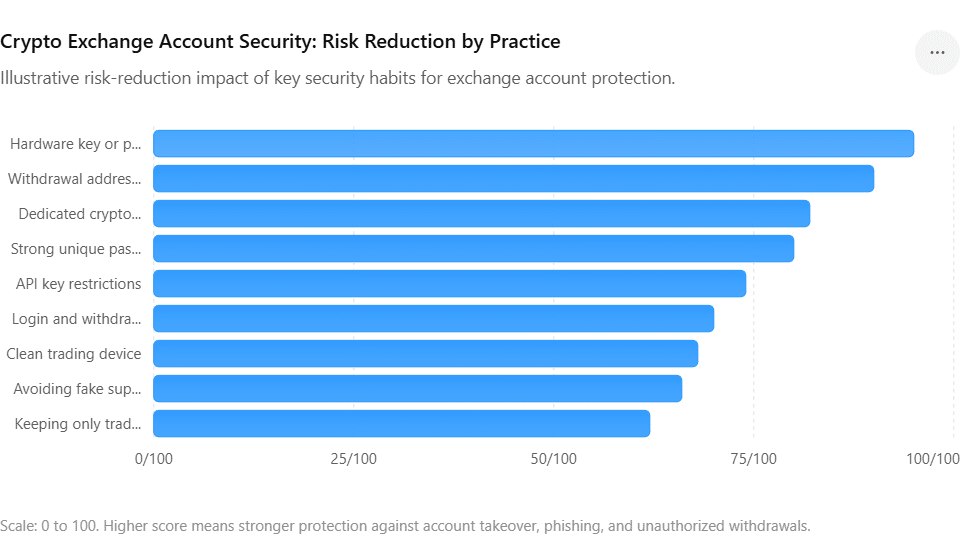
The best protection comes from layers. A dedicated email, strong password, phishing-resistant authentication, withdrawal allowlists, limited balances, clean devices, and regular account reviews work together. No single tool is perfect, but combined habits make an attacker’s job much harder.
In a market where one careless click can cost more than a bad trade, crypto exchange account security should be treated as part of every investor’s strategy, not a task saved for later.
Frequently Asked Questions
What is the most important step for securing a crypto exchange account?
The most important step is enabling strong 2FA that does not rely on SMS when better options are available. A strong password is also essential, but 2FA adds another layer if the password is stolen.
Is SMS 2FA safe for crypto accounts?
SMS 2FA is better than having no 2FA, but it is weaker than authenticator apps, passkeys, or hardware security keys. Phone numbers can be targeted through SIM-swap fraud and social engineering.
Should crypto be stored on an exchange?
An exchange can be useful for active trading, but long-term holdings are often better kept in a personal wallet where the user controls the keys. The right choice depends on the user’s skill, balance size, and risk tolerance.
What is a withdrawal allowlist?
A withdrawal allowlist is a security setting that lets funds move only to approved wallet addresses. It can stop or slow an attacker who tries to withdraw to a new address.
How often should users review account security settings?
Users should review security settings at least once a month and immediately after any suspicious email, login alert, device change, or market event that attracts scam activity.
Glossary of Key Terms
2FA: Two-factor authentication adds a second proof of identity, such as an app code, passkey, or security key, after the password.
Passkey: A modern login method that uses cryptography and is designed to reduce phishing risk compared with passwords and one-time codes.
Withdrawal Allowlist: A list of approved crypto addresses that are allowed to receive withdrawals from an exchange account.
API Key: A digital access key that allows external apps or trading bots to connect with an exchange account.
SIM Swap: A fraud method where criminals try to move a victim’s phone number to another SIM card to intercept calls or text codes.
Phishing: A scam that tricks users into entering login details, 2FA codes, or other sensitive information on fake pages or through fake messages.
Session: An active login on a device or browser. Unknown sessions should be revoked immediately.
Self-Custody: A method of holding crypto where the user controls the private keys instead of leaving assets with a third party.
Sources
Disclaimer
This article is for educational and informational purposes only. It is not financial, investment, legal, tax, or cybersecurity advice.