



A New Chapter for the World’s Oldest Asset
Gold has been a global store of value for millennia, but its trading structure has sometimes fallen behind modern financial institutions. Market players have been dissatisfied by settlement delays, high transfer costs, and restricted collateral flexibility.


On September 3, 2025, the World Gold Council (WGC) announced a revolutionary proposal called Wholesale Digital Gold, which promises to bring blockchain-style efficiency to the $900 billion bullion market.
The model includes Pooled Gold Interests (PGIs), a novel settlement method that combines the security of allocated gold with the flexibility of unallocated holdings. This breakthrough enables institutions to own portions of vaulted gold while transferring it quickly via digital records.
Why Digital Gold Matters Now
This move’s timing is no coincidence. With global economic turmoil and growing interest in tokenized assets, gold is back in the limelight.


In the cryptocurrency and securities markets, traditional trading mechanisms, which are frequently predicated on delayed paper-based transfers, have been surpassed by digital collateral systems.
The Wholesale Digital Gold concept attempts to increase gold’s competitiveness as a financial asset by closing this gap.
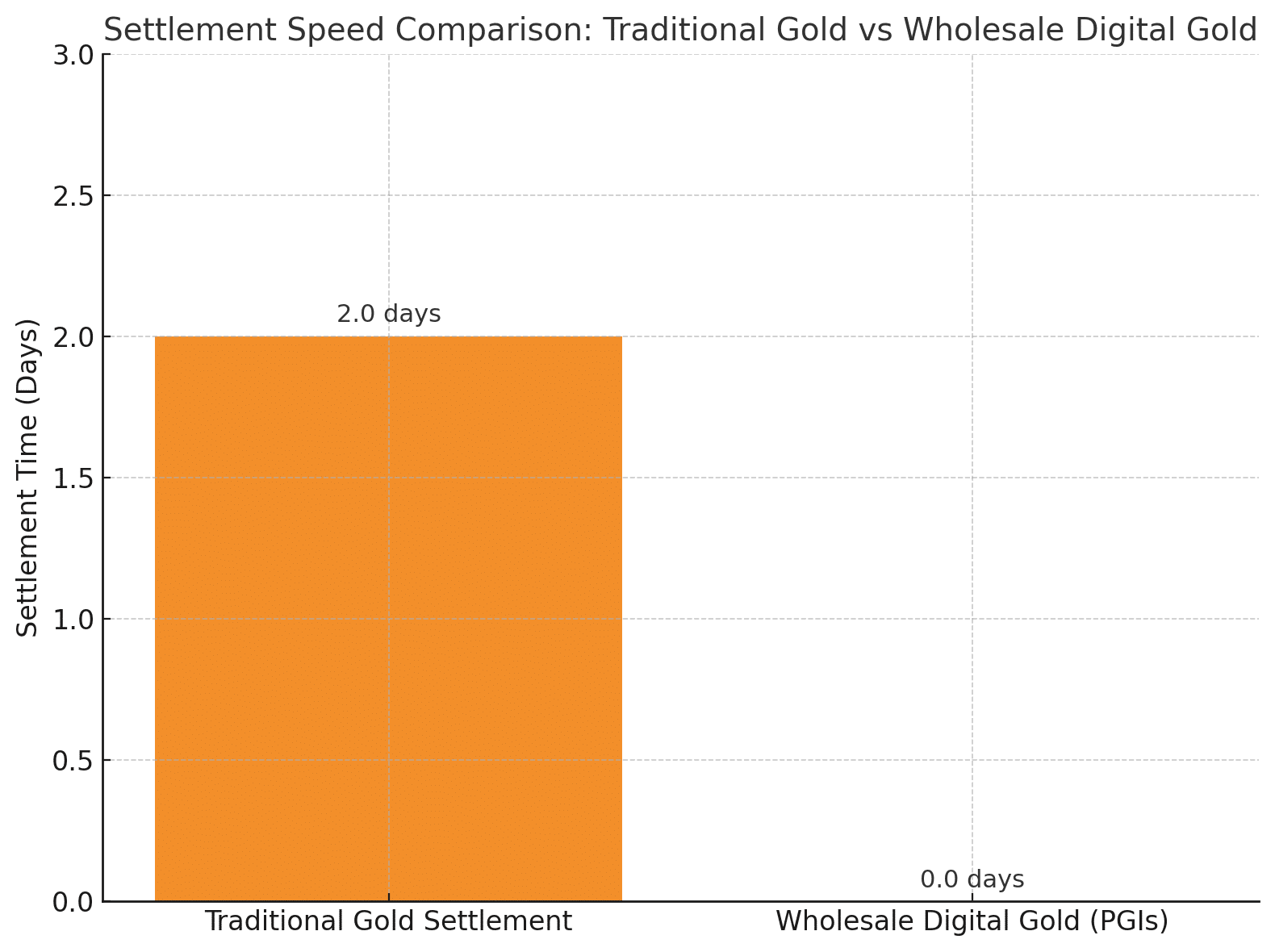
The WGC’s CEO, David Tait, claimed that the goal is to “make gold a more effective and income-generating asset”. Analysts believe that PGIs might boost gold’s significance in derivatives trading by allowing for real-time settlement, similar to how stablecoins have transformed digital payments.
A clash between tradition and technology
The project will begin with a test program in London’s bullion market, which is the world gold trading hub. Trillions of dollars in transactions are cleared there each year, with settlement times typically lasting more than two days.
With PGIs, institutions may instantaneously transfer ownership of vaulted gold, lowering expenses and minimizing counterparty risk.
This structure also permits gold to be posted as collateral at venues like the CME without the need for physical delivery. For dealers and institutions, the combination of physical certainty with digital agility might alter how gold interacts with other asset classes.
Lessons from Cryptocurrency’s Rise
This approach has significant parallels with the bitcoin business. Blockchain coins representing gold have been around for a while, but most lack legal legitimacy or institutional adoption.
PGIs, on the other hand, are backed by the World Gold Council, Linklaters provides legal foundations, and Hilltop Walk Consulting designs the structural elements. This official backing might be what separates PGIs from other gold-backed tokens in the crypto market.
Crypto traders are already discussing how this news would impact digital assets. Some think that tokenized gold may compete with stablecoins as a preferable collateral form, particularly in regulated situations.
Others see synergy, believing that PGIs would someday interface with blockchain rails, connecting traditional bullion and decentralized finance.

Risks and considerations
While the promise is evident, problems persist. Liquidity, regulatory certainty, and market trust will all be critical factors in widespread adoption.
If PGIs are perceived as overly complicated or fail to attract significant banks, the movement may stop. Furthermore, global regulators may investigate digital representations of actual gold as they tighten their regulation of tokenized assets.
Still, the Wholesale Digital Gold initiative is an important step toward digital commodities. Analysts believe that success here might spur comparable revolutions in the silver, platinum, and possibly oil markets.
Conclusion: A defining experiment
Wholesale Digital Gold may be the most important advance in the gold industry in decades. It reflects the fusion of centuries-old riches and twenty-first-century technology. If broadly implemented, it has the potential to transform how institutions trade, hedge, and collateralize the world’s most durable asset.
For crypto traders and financial analysts alike, the growth of PGIs presents both a competitive threat and a collaborative opportunity.
The future of gold may not be restricted to vaults and paper. With digital models transforming banking, gold’s function as a timeless store of wealth may soon be seamlessly integrated with blockchain-style innovation.
Glossary
PGIs (Pooled Gold Interests) – New settlement units combining physical gold security with digital transferability.
Collateral – Assets pledged to secure loans or trading positions.
Tokenization – Converting real-world assets into digital representations.
Stablecoins – Cryptocurrencies pegged to stable assets like the U.S. dollar.
OTC Market – Over-the-counter market where assets are traded directly between parties.
FAQs
1. What are Pooled Gold Interests (PGIs)?
PGIs are fractional, transferrable ownership units of vaulted gold designed for instant settlement.
2. How is Wholesale Digital Gold different from gold-backed tokens?
PGIs are legally structured, backed by the WGC, and aimed at institutional adoption.
3. Where will this model be tested first?
The pilot will begin in London’s $900 billion bullion market.
4. Could this affect cryptocurrencies?
Yes, tokenized gold could compete with stablecoins for use as collateral.
5. Is this financial advice?
No. This article is for informational purposes only and does not constitute financial advice.