This article was first published on TurkishNYR.
Restaking is a new-age crypto concept that allows participants to reuse already staked tokens to secure different networks at once.


In other words, crypto restaking involves putting one’s crypto on one blockchain (say, Ethereum) and then “restaking” it on another protocol in order to earn rewards without depositing more coins.
It increases capital efficiency, which means the same tokens can be made to work harder, but it also raises risk in the event that anything goes wrong.
Understanding Staking vs. Restaking
In Proof-of-Stake (PoS) blockchains, staking requires users to lock up a certain amount of their tokens (for example, ETH in Ethereum), to contribute to the security and maintenance of the network and earn rewards on these tokens (as interest).
For instance, when a user stakes ETH, their tokens help validate transactions and secure the chain. In exchange, they receive half of the new ETH rewards.
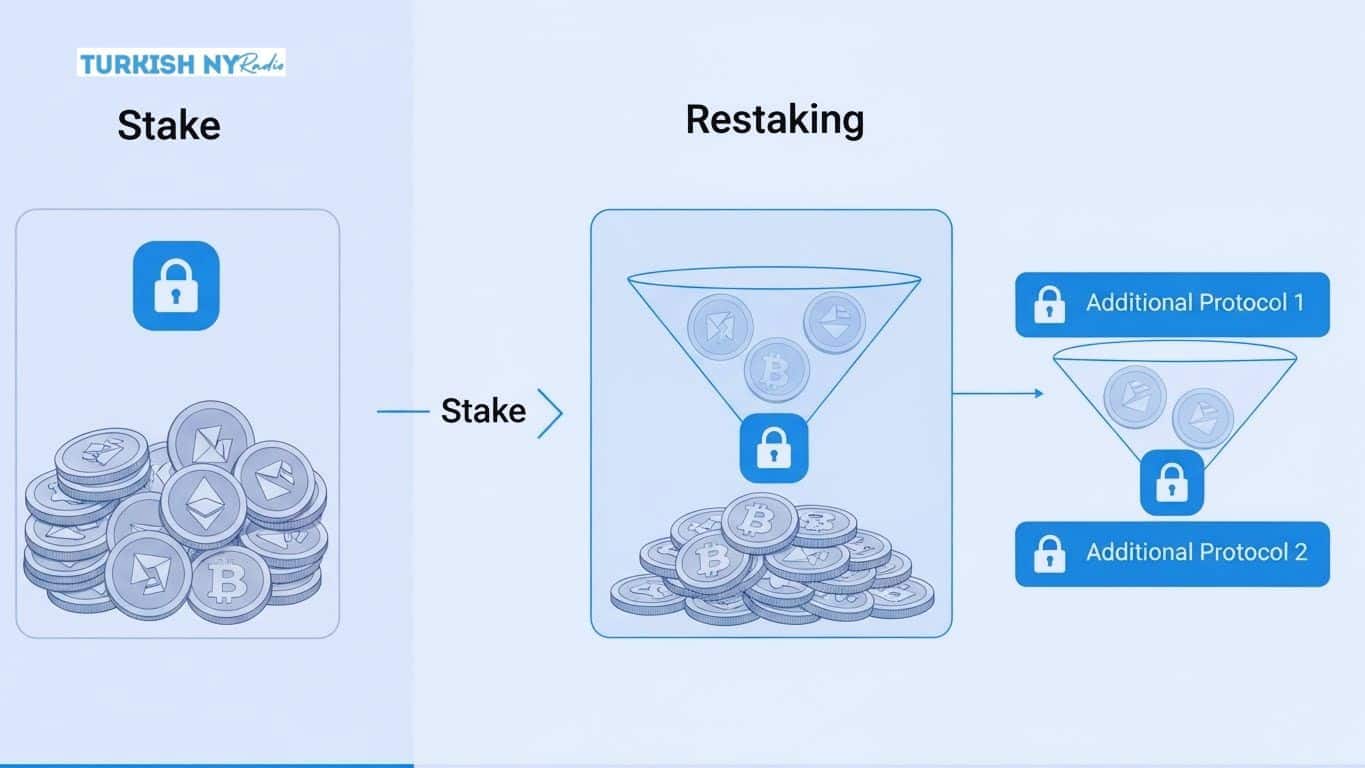
Restaking, on the other end, is a step above staking. Instead of just leaving the staked tokens after ensuring the security of the main chain, one can also take those same tokens and apply them to help secure other projects or services in the ecosystem.
In other words, one token fills the roles of lots. That means that one gets base rewards if they stake, and also earn additional rewards from the secondary projects.
As one crypto guide describes it, restaking is a process in which users stake the same tokens on both the main chain and other protocols, in order to secure multiple networks at the same time.
Imagine, in the simplest terms, that one has a house (your tokens). Staking is essentially the equivalent of renting it out to a tenant (the blockchain) for rent (rewards). Restaking is also like renting it out as a film location at the same time. One generates income from the same asset in two different ways.
How Does Crypto Restaking Work?
Crypt restaking involves borrowing a blockchain’s security in order to secure new platforms. EigenLayer is a notable example on Ethereum. The way this works is simple.
Stake on the Main Chain: Stake tokens (e.g. ETH) in the blockchain’s network itself (for example Ethereum). This turns you into a validator or delegator on the chain.
Opt Into Restaking: With a protocol like EigenLayer, you “opt in” your staked tokens for more duties. Operationally, validators switch their withdrawal credentials to point to the restaking protocol’s smart contract or users delegate and stake their staked tokens to them in the restaking pools.
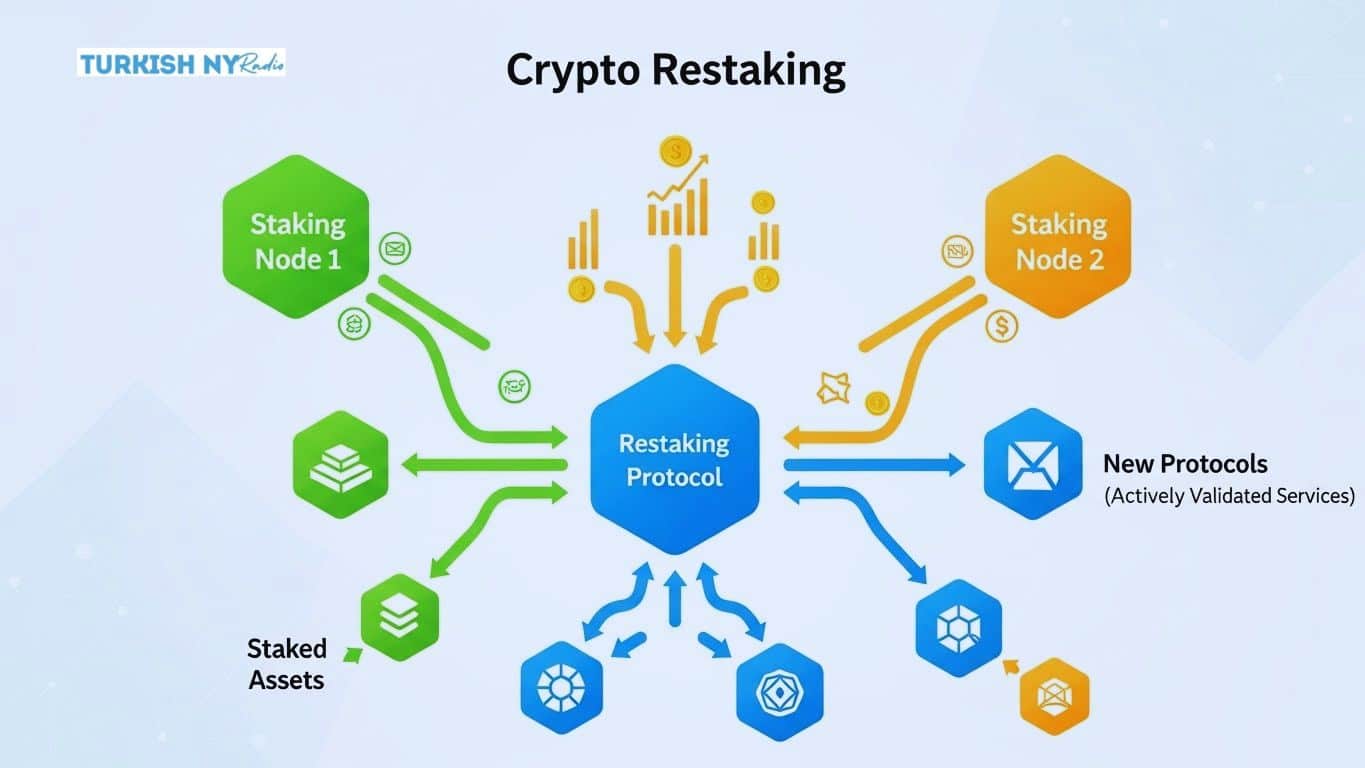
Securing New Services: The staked tokens, “restaked” are used to secure Actively Validated Services (AVSs) which can come in several forms such as blockchains, bridges, oracles, data layers and more. In this way, the restaking protocol mashes all staked tokens together and they act to secure multiple systems.
Earn Layered Rewards : One also earns extra rewards (in native project tokens or the secondary 3rd party project token) for helping secure these extra services on top of the original staking reward. It can be thought of as being paid twice for the same stake: once by Ethereum itself, and once again by the new project.
Control Risk: If a validator causes trouble on any of the networks they protect, they can be punished (slashed). Restaking protocols usually come with elaborate game-theoretical incentives for players to play fair, often including multistep slashing conditions. Restakers must decide that those risks are worth the opportunity for higher rewards.
Restaking pools security in one place. For example, if ten projects all required 100ETH staked to be secured, that’d usually total 1,000 ETH. With restaking, those 100ETH can back all ten projects, creating a combined security pool of 100ETH instead of 1,000ETH.
This jacks up the cost of attacking any single service because an attacker now has to compromise the whole pool rather than just one isolated chain. In other words, restaking expands Ethereum’s security to new places and makes the entire ecosystem stronger.
Types of Crypto Restaking
There are two general methods of restaking, and both fit some different users:
Native Restaking (Direct): For Users who run their own Validator Node. A validator chooses to opt in by running extra software or connecting with a restaking protocol. For instance, a proof-of-stake validator for ETH might use special restaking code. When it is good to go, the validator’s stake is put to work automatically securing more networks. This places the validator directly in control; however, it requires technical abilities as well as the 32ETH minimum (for Ethereum).
Liquid Restaking: This is a more user friendly method. One, users do liquid staking on platforms like Lido or Rocket Pool and receive a Liquid Staking Token in return (like stETH or rETH) that represents their stake.
So, participants take that LST and stake it again in a restaking protocol, to get a new token (frequently referred to as Liquid Restaking Tokens, or LRT).
This LRT is their claim to the staked tokens + a little extra yield from restaking these rewards. In short, one can avoid having to run a node ever: the stake is instead tokenized and re-used.
These types differ in liquidity and risk as seen below:
| Feature | Native Restaking | Liquid Restaking |
| Who Can Do It? | Validators running own node | Any staker using an LST (like stETH) |
| Process | Validator opts in (e.g. update validator settings, connect to EigenLayer) | Delegate assets to Lido/RocketPool – receive LST (stETH, etc) – stake LST on restaking protocol, get LRT |
| Rewards | ETH staking rewards + restaking rewards (protocol fees/tokens) | LST staking yields + new rewards from restaking (often in ETH or other tokens) |
| Liquidity | Locked until normal unstaking rules | Maintains some liquidity via LST token; LRT can often be traded or staked elsewhere |
| Complexity | High (requires validator infrastructure) | Lower (handled by staking services) |
| Risk | Validator slashing on all networks | Additional smart-contract risk from restaking; some slashing risk |
Liquid restaking is expanding rapidly as it significantly reduces this barrier to entry. For example, leading exchanges are providing restaking to customers who already hold staked ETH today.
Kraken’s new integration (powered by Kraken Staked) enables ETH holders to earn additional yield by restaking staked ETH with a few simple clicks. This makes layered rewards accessible to regular investors, and not just the tech literate validators.
How Restaking Enables Capital Efficiency
The magic of crypto restaking is capacity efficiency, that is doing more with the same asset. So instead of one’s ETH just sitting idly by, it serves a dual purpose.
Participants are still getting based staking rewards on the main chain, and also receive fees or tokens for securing more projects.
In addition to the regular staking reward in ETH, users earn rewards’ also in the tokens of each protocol where their staked ETH is used.
Restaking yields are in the low single digits extra (4-5% APY on top of normal staking yield) currently, but it depends on a project perspective or market.
Restaking also reduces bootstrapping costs for new projects. In the past, a new blockchain or oracle would have to accumulate their own separate pool of validators.
Crypto restaking allows them to instead “rent” Ethereum’s vast validator network. Under this shared-security model, dozens of services can share staked capital.
If, say, there were 100 such protocols each with $1billion staked then this can be squashed to a single $100bil pool, making life much harder for an attacker.
According to Hacken, restaking combines the overall security, raises barriers for any type of attack and creates a more sustainable environment.
EigenLayer and Ether.fi
The most prominent platform that supports restaking recently is the EigenLayer on Ethereum. Launched in the middle of 2023, EigenLayer validators can redeploy their already staked ETH or LSTs to secure additional networks and services.
This is accomplished by users first joining EigenLayer and deciding which services (AVSs) to support. Bridges, DALs, and oracles are already in the process of implementing EigenLayer for security.
EigenLayer’s growth highlights restaking’s momentum. In 2025, its TVL rose to over $18 billion, placing it among DeFi’s top players in the ranks of giants like Lido. (At one point, it was even $20B TVL.)
This surge is an example of how eager users are for earning layered yields.
Another project, Ether. fi, which was just based on this idea, is a liquid restaking protocol. Users stake ETH on Ethereum, receive a token called eETH and can re-stake the token into EigenLayer to get additional rewards. It became the top liquid restaking platform with more than $2.8B TVL in 2025.
Ether. fi collaborates with EigenLayer to broaden its security solutions.
Even centralized players have joined. For example, Kraken now allows staked ETH to be restaked through its service Kraken Staked, which opens up this strategy for more people.
Benefits of Restaking
Higher Yields: Stakers would be able to increase their overall yield by receiving rewards from across multiple networks. It makes staking a multi-source income stream.
Shared security: New and small projects will be able to use Ethereum’s large security pool. They don’t need to build their own validator network now; they can instead utilize restaked ETH. It increases the overall security of the ecosystem.
Efficient Capital: Restaking frees up dormant capital. One token to do them all, and in the process also unlocking liquidity for other purposes(especially with liquid restaking). This value for money is appealing to users and developers alike.
Innovation: Restaking enables more experimentation by reducing security costs. Developers can launch their new set of dApps, rollups, or chains without needing to raise loads of staking capital on day one.
Market Trends and Expert Analysis
Crypto restaking evolved from a marginal concept to the headlines in just a couple of years. It’s now a staple in DeFi, where it has become a central narrative for 2025.
A recent DeFi research had reported that: “If 2025 is the year restaking went mainstream…it will be powered by EigenLayer.”.
The results are obvious from the growth of the sector. EigenLayer’s TVL rose from about $1billion in early 2024, to more than $18billion by late 2025.
It now comprises the overwhelming majority of assets that have been restaked, thus becoming a multi-billion-dollar market. This boom has actually surpassed much of the traditional DeFi areas, which shows a healthy institutional hunger.
One analysis points out investors are drawn by restaking’s “structured, risk-adjusted yield” atop Ethereum’s security.
Put simply, experts see restaking as a new venture. It turns staking from a one-trick pony into an entire multiverse.
However, the community remains vigilant. The spike capital and new levels of complexity indicate ongoing research and risk management are required. Knowing how networks are linked is important before getting stuck.
Conclusion
Crypto restaking is the new blockchain breakthrough that allows participants to take advantage of their already-staked crypto to secure more networks at the same time, thereby increasing yields and security in DeFi.
By allowing staked assets to work as a collateral for new protocols, it brings better capital efficiency and more shared security to smaller projects.
However, it also presents new risks (such as smart-contract bugs and heavier slashing penalties) that warrant care.
Crypto restaking could redefine how crypto networks coordinate but participants should consider its benefits against the daunting hurdles.
Glossary
Proof-of-Stake (PoS): A method of consensus on a blockchain wherein validators are required to “stake” a number of tokens in order to help secure the network. PoS networks incentivize validators to behave properly by rewarding them with new tokens when they do and slashing new ones from their stake when they don’t.
Validator: A network participant that stakes tokens and generates or attests blocks. Validators are rewarded with incentives for verifying transactions.
Slashing: A PoS network has a penalty system where, if a validator behaves dishonestly or breaks certain protocol rules, some of that person’s stake is forfeited.
Liquid Staking Token (LST): A token that stands for a staked asset. If, for instance, one stakes ETH through Lido, one receives stETH (an LST), which is tradeable or usable and continues to earn staking rewards on your behalf on the underlying ETH.
Liquid Restaking Token (LRT): An LST that had already been re-staked. It is the native staked asset plus any yield/interest from restaking.


Total Value Locked (TVL): The amount of assets (in USD) staked or locked in a protocol. The higher the TVL, the more user capital that is captured by the protocol.
EigenLayer (EIGEN): A protocol for restaking on Ethereum where ETH can be used to re-stake (LSTs)/secure new services. EigenLayer brought the modern concept of restaking to the cryptoverse.
Capital Efficient: How good an investment is at creating returns. Restaking improves capital efficiency as one token has multiple networks being secured through it, maximizing potential yield for a single token.
Frequently Asked Questions About Crypto Restaking
What is staking and restaking?
Staking locks up tokens to help secure one network and earn rewards. Restaking involves using the same staked tokens to secure other networks or services and yields additional rewards on top of original staking yield.
What is the difference between native and liquid restaking?
Native staking means that validators running their own nodes would be able to opt in to additional security responsibilities. Liquid restaking means using a liquid staking service (such as Lido) to stake, receiving in return some token (e.g. stETH) with which one can then use as input for some restaking protocol.
Can any cryptocurrency be restaked?
Restaking nowadays is generally talked about when it comes to Proof-of-Stake chains (especially Ethereum) and their liquid staking tokens. Protocols must specifically support restaking. Ethereum validators and Ethereum LSTs can restake on platforms like EigenLayer.
Is restaking safe?
Restaking can be safe if executed carefully, but it’s an added risk. Because one is in multiple networks, any of those networks suffering an attack or downtime would harm one’s stake (by slashing). One should take the time to learn every service’s rules. No system is completely risk-free.