

• Home
  • About Us
  • Terms and Conditions
  • Privacy Policy
  • Disclaimer
  • Contact
1 May Friday, 2026
  • tr Türkçe
  • en English
TurkishNY Radio
No Result
View All Result
  • Home
  • Cryptocurrency
  • Business
  • Economy
  • Home
  • Cryptocurrency
  • Business
  • Economy
No Result
View All Result
  • tr Türkçe
  • en English
TurkishNY Radio
No Result
View All Result
Bitcoin Bitcoin (BTC) $78,347.52 ↑ 2.68%
Ethereum Ethereum (ETH) $2,311.18 ↑ 2.12%
Tether USDt Tether USDt (USDT) $1.00 ↑ 0.03%
XRP XRP (XRP) $1.39 ↑ 1.49%
BNB BNB (BNB) $621.26 ↑ 1.02%
USDC USDC (USDC) $1.00 ↑ 0.00%
Solana Solana (SOL) $84.53 ↑ 1.66%
TRON TRON (TRX) $0.33 ↑ 0.25%
Dogecoin Dogecoin (DOGE) $0.11 ↑ 3.58%
Hyperliquid Hyperliquid (HYPE) $40.95 ↑ 4.97%
UNUS SED LEO UNUS SED LEO (LEO) $10.35 ↑ 0.08%
Cardano Cardano (ADA) $0.25 ↑ 1.72%
Bitcoin Cash Bitcoin Cash (BCH) $445.86 ↑ 0.86%
Monero Monero (XMR) $380.92 ↑ 1.02%
Chainlink Chainlink (LINK) $9.23 ↑ 1.00%
Zcash Zcash (ZEC) $350.52 ↑ 4.85%
Canton Canton (CC) $0.15 ↑ 0.10%
Stellar Stellar (XLM) $0.16 ↑ 1.37%
Dai Dai (DAI) $1.00 ↑ 0.01%
World Liberty Financial USD World Liberty Financial USD (USD1) $1.00 ↑ 0.03%
Litecoin Litecoin (LTC) $55.45 ↓ -0.33%
MemeCore MemeCore (M) $3.09 ↓ -10.02%
Avalanche Avalanche (AVAX) $9.18 ↑ 0.67%
Ethena USDe Ethena USDe (USDe) $1.00 ↑ 0.00%
Hedera Hedera (HBAR) $0.09 ↓ -0.02%
Shiba Inu Shiba Inu (SHIB) $0.00 ↑ 1.78%
Sui Sui (SUI) $0.92 ↑ 1.68%
PayPal USD PayPal USD (PYUSD) $1.00 ↑ 0.03%
Toncoin Toncoin (TON) $1.34 ↑ 2.25%
Cronos Cronos (CRO) $0.07 ↑ 0.56%
Bittensor Bittensor (TAO) $263.46 ↑ 4.80%
Tether Gold Tether Gold (XAUt) $4,586.35 ↓ -0.95%
Global Dollar Global Dollar (USDG) $1.00 ↑ 0.02%
PAX Gold PAX Gold (PAXG) $4,586.92 ↓ -0.96%
Mantle Mantle (MNT) $0.63 ↑ 1.48%
Uniswap Uniswap (UNI) $3.24 ↑ 1.11%
Polkadot Polkadot (DOT) $1.21 ↓ -0.43%
Pi Pi (PI) $0.18 ↑ 2.78%
Sky Sky (SKY) $0.08 ↑ 2.04%
World Liberty Financial World Liberty Financial (WLFI) $0.06 ↓ -5.88%
OKB OKB (OKB) $83.61 ↑ 1.71%
Aster Aster (ASTER) $0.66 ↑ 0.28%
NEAR Protocol NEAR Protocol (NEAR) $1.31 ↓ -1.19%
Pepe Pepe (PEPE) $0.00 ↑ 2.62%
USDD USDD (USDD) $1.00 ↑ 0.03%
Ripple USD Ripple USD (RLUSD) $1.00 ↑ 0.01%
Aave Aave (AAVE) $93.43 ↑ 0.35%
Bitget Token Bitget Token (BGB) $2.02 ↑ 0.59%
Ethereum Classic Ethereum Classic (ETC) $8.47 ↑ 1.02%
Internet Computer Internet Computer (ICP) $2.38 ↓ -1.00%
Ondo Ondo (ONDO) $0.27 ↑ 1.89%
KuCoin Token KuCoin Token (KCS) $8.53 ↑ 0.96%
United Stables United Stables (U) $1.00 ↓ -0.05%
Polygon (prev. MATIC) Polygon (prev. MATIC) (POL) $0.09 ↓ -1.31%
Algorand Algorand (ALGO) $0.11 ↓ -2.45%
Cosmos Cosmos (ATOM) $1.90 ↓ -0.46%
DeXe DeXe (DEXE) $11.15 ↓ -0.21%
Morpho Morpho (MORPHO) $2.00 ↓ -0.43%
Ethena Ethena (ENA) $0.10 ↑ 0.46%
Kaspa Kaspa (KAS) $0.03 ↑ 1.30%
Render Render (RENDER) $1.71 ↑ 1.34%
Quant Quant (QNT) $69.06 ↓ -1.23%
Aptos Aptos (APT) $1.01 ↑ 0.56%
GateToken GateToken (GT) $7.24 ↑ 0.36%
Worldcoin Worldcoin (WLD) $0.24 ↓ -1.55%
Arbitrum Arbitrum (ARB) $0.13 ↓ -0.82%
Stable Stable (STABLE) $0.03 ↑ 1.98%
JUST JUST (JST) $0.09 ↓ -0.67%
Filecoin Filecoin (FIL) $0.93 ↑ 0.51%
Flare Flare (FLR) $0.01 ↑ 0.75%
Pudgy Penguins Pudgy Penguins (PENGU) $0.01 ↑ 4.71%
VeChain VeChain (VET) $0.01 ↑ 0.30%
Pump.fun Pump.fun (PUMP) $0.00 ↑ 3.44%
Jupiter Jupiter (JUP) $0.18 ↑ 1.71%
XDC Network XDC Network (XDC) $0.03 ↓ -0.98%
Nexo Nexo (NEXO) $0.90 ↑ 1.87%
Bonk Bonk (BONK) $0.00 ↑ 1.15%
OFFICIAL TRUMP OFFICIAL TRUMP (TRUMP) $2.33 ↓ -1.69%
Midnight Midnight (NIGHT) $0.03 ↓ -3.36%
Humanity Protocol Humanity Protocol (H) $0.19 ↑ 12.98%
siren siren (SIREN) $0.71 ↑ 4.30%
TrueUSD TrueUSD (TUSD) $1.00 ↑ 0.07%
PancakeSwap PancakeSwap (CAKE) $1.46 ↑ 0.11%
Virtuals Protocol Virtuals Protocol (VIRTUAL) $0.71 ↑ 1.45%
LayerZero LayerZero (ZRO) $1.43 ↓ -1.43%
Dash Dash (DASH) $35.79 ↑ 4.54%
Artificial Superintelligence Alliance Artificial Superintelligence Alliance (FET) $0.20 ↑ 1.91%
EURC EURC (EURC) $1.18 ↑ 0.55%
Aerodrome Finance Aerodrome Finance (AERO) $0.47 ↑ 3.80%
Chiliz Chiliz (CHZ) $0.04 ↑ 1.32%
edgeX edgeX (EDGE) $1.22 ↑ 0.95%
Venice Token Venice Token (VVV) $9.14 ↑ 9.62%
Stacks Stacks (STX) $0.22 ↑ 1.73%
Sei Sei (SEI) $0.06 ↑ 0.94%
First Digital USD First Digital USD (FDUSD) $1.00 ↑ 0.02%
Terra Classic Terra Classic (LUNC) $0.00 ↓ -2.84%
Tezos Tezos (XTZ) $0.37 ↑ 0.09%
Injective Injective (INJ) $3.64 ↑ 4.46%
SKYAI SKYAI (SKYAI) $0.36 ↑ 13.66%
Curve DAO Token Curve DAO Token (CRV) $0.24 ↓ -0.08%
Home Cryptocurrency

Visa Stablecoin Settlement Pilot Reaches $7B Annual Run Rate

Victoria James by Victoria James
1 May 2026
in Cryptocurrency, Economy, News
Reading Time: 5 mins read
0
Visa Stablecoin Settlement

Visa Stablecoin Settlement Pilot Hits $7B What it Means Now

This article was first published on TurkishNY Radio.

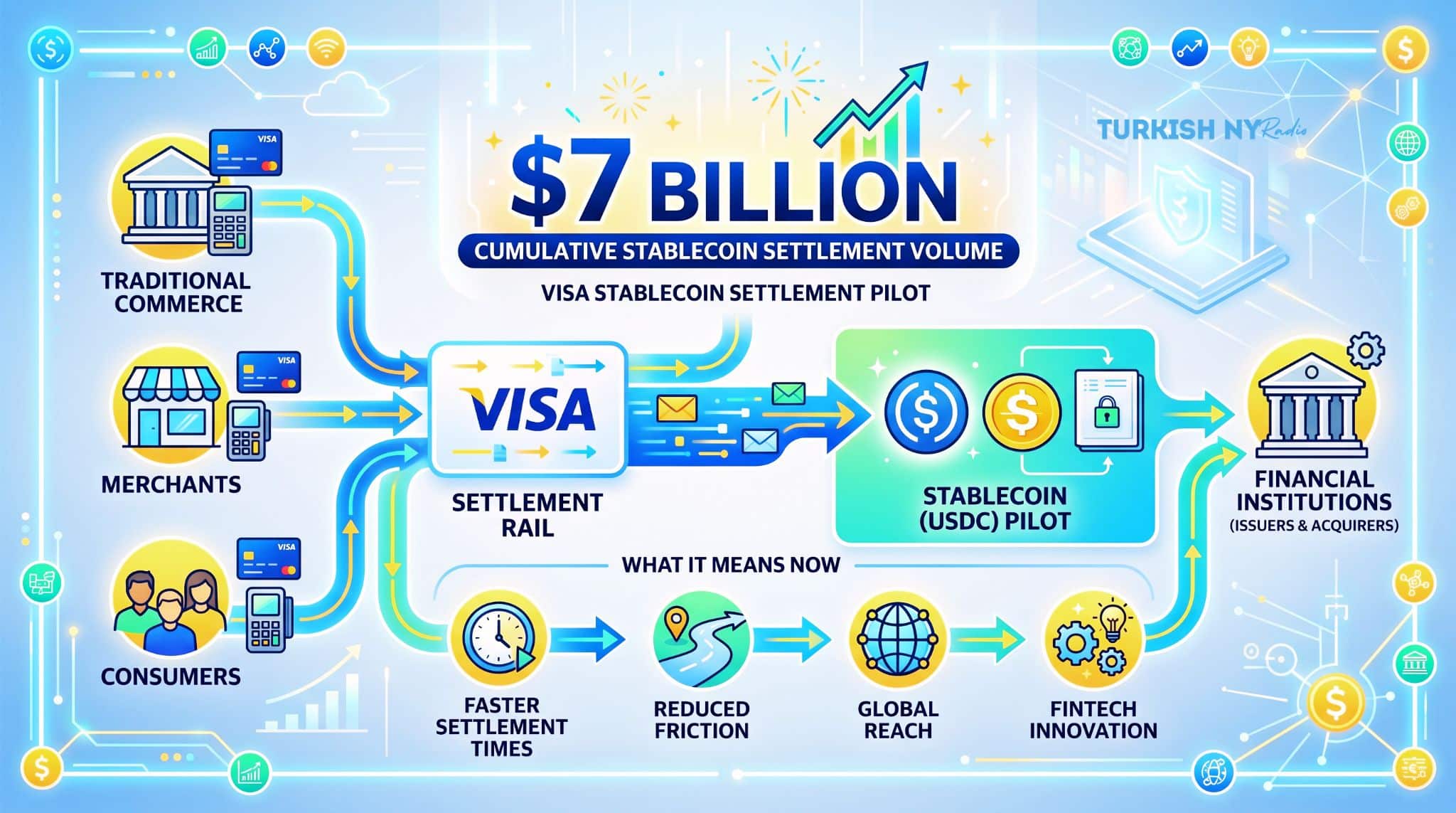
The Visa stablecoin settlement pilot is steadily moving deeper into the mechanics of global payments, with the company confirming support for nine blockchain networks and an annualized settlement run rate of $7 billion. 

Table of Contents

Toggle
    • YOU MAY BE INTERESTED
    • The “I Missed It” Cycle Strikes Again – Bitcoin Exploded, SUI Took Off, Now APEMARS Is Quietly Becoming the Best Crypto to Invest In
    • Bitcoin ETF Outflows Reach $490M: Is BTC Losing Steam?
  • Visa Stablecoin Settlement Pilot Enters Backend
  • Visa Stablecoin Settlement Pilot Expands Multi-Chain
  • Why the New Blockchain Additions Matter
  • Institutional Use Is Growing Faster Than Consumer Adoption
  • What Comes Next for Visa’s Stablecoin Strategy
    • Summary
  • Glossary of Key Terms
  • FAQs About Visa Stablecoin Settlement Pilot
    • 1. What is the Visa stablecoin settlement pilot?
    • 2. How does Visa stablecoin settlement pilot improve payments?
    • 3. Is the Visa stablecoin settlement pilot safe to use?
    • 4. What could happen next with the Visa stablecoin settlement pilot?
      • References

YOU MAY BE INTERESTED

image 9

The “I Missed It” Cycle Strikes Again – Bitcoin Exploded, SUI Took Off, Now APEMARS Is Quietly Becoming the Best Crypto to Invest In

1 May 2026
Bitcoin ETF Outflows Reach $490M: Is BTC Losing Steam?

Bitcoin ETF Outflows Reach $490M: Is BTC Losing Steam?

1 May 2026

The update, shared in Visa’s official announcement on April 29, reflects growing institutional use of stablecoins not at checkout, but behind the scenes where transactions are finalized.

According to Visa, the expanded pilot now includes Arc, Base, Canton, Polygon, and Tempo, alongside Avalanche, Ethereum, Solana, and Stellar. 

The company also noted that the Visa stablecoin settlement pilot has increased by about 50% from the previous quarter, indicating a measurable rise in activity within its payment infrastructure.

Visa Stablecoin Settlement Pilot Enters Backend

The key takeaway from the Visa stablecoin settlement pilot is not just the number of supported blockchains, but where these assets are being used.

Stablecoins are being tested within the settlement layer the part of the payment process that moves funds between banks and financial institutions after a transaction is approved.

This layer is largely invisible to consumers, yet it is central to how money flows globally. By introducing stablecoins here, Visa is examining whether blockchain-based assets can operate alongside traditional rails without altering the user experience at the point of sale.

Data from DefiLlama shows that stablecoin market capitalization is approaching $320 billion, reinforcing their growing role in financial operations.

Meanwhile, transaction data tracked by Blockchain.com highlights consistent usage of stablecoins across multiple networks, particularly for transfers and liquidity movement.
Visa stablecoin settlement pilot
Visa Stablecoin Settlement Pilot Hits $7B What it Means Now

Visa Stablecoin Settlement Pilot Expands Multi-Chain

The current Visa stablecoin settlement pilot builds on earlier work dating back to 2023, when Visa confirmed that it had moved USDC between partners using Ethereum and Solana. Those initial tests included collaborations with Crypto.com and payment processors such as Worldpay and Nuvei.

By late 2025, Visa extended stablecoin settlement capabilities to U.S. banking partners, including Cross River Bank and Lead Bank. These integrations allowed transactions to settle faster and remain operational outside traditional banking hours.

Today, the Visa stablecoin settlement pilot is part of a broader system that includes more than 130 stablecoin-linked card programs across over 50 countries. This indicates that the initiative is no longer experimental in isolation, but tied to real payment flows and financial partnerships.

Why the New Blockchain Additions Matter

Each newly added network in the Visa stablecoin settlement pilot brings a specific function. Arc is designed for stablecoin-native transactions with predictable fees, while Base developed by Coinbase connects payment flows with exchange liquidity.

Canton introduces privacy features suited for institutional finance, allowing transaction details to remain visible only to relevant parties. Polygon focuses on cost-efficient global payments, and Tempo emphasizes settlement precision and reconciliation tools.

This combination suggests that Visa is building optionality into its system, allowing partners to choose networks based on operational needs such as speed, cost, or compliance requirements.

Institutional Use Is Growing Faster Than Consumer Adoption

The Visa stablecoin settlement pilot shows that stablecoin adoption is currently being driven by institutions rather than everyday users. These assets are being used for treasury operations, liquidity management, and cross-border settlements functions that occur after consumers complete transactions.

Research linked to BlackRock has also pointed to this shift, noting that stablecoins are increasingly being positioned as settlement infrastructure within traditional finance.

At the same time, regulatory discussions particularly in the United States are shaping how stablecoins may be integrated into mainstream systems. Proposed frameworks aim to define their role within payment networks and financial institutions.

Visa blockchain payments
Visa Stablecoin Settlement Pilot Hits $7B What it Means Now

What Comes Next for Visa’s Stablecoin Strategy

While the Visa stablecoin settlement pilot shows clear growth, there are still limits to what is publicly known. Visa has not disclosed how settlement volume is distributed across the nine supported blockchains or which regions are driving the most activity.

What is confirmed is that stablecoins are being tested as a parallel settlement option within existing payment infrastructure. What remains uncertain is whether this will become a standard feature across Visa’s global network or continue as a selective offering for specific partners.

For now, the Visa stablecoin settlement pilot signals a gradual but meaningful shift. Stablecoins are no longer limited to trading or decentralized finance they are being evaluated as part of how money moves between institutions, often without the end user ever noticing.

Summary

  • The Visa stablecoin settlement pilot has expanded to nine blockchains, reaching a $7 billion annual pace, showing steady uptake from financial institutions.
  • Instead of changing how people pay, stablecoins are being used quietly in the background to move money between banks.
  • New networks like Base and Polygon add flexibility for different payment needs.
  • The project builds on earlier USDC trials, while data from DefiLlama and Blockchain.com reflects growing real-world use.

Glossary of Key Terms

1. Stablecoin
A stablecoin is digital money that doesn’t swing in price like Bitcoin. It usually matches the value of a real currency, so it feels like holding dollars online.

2. Settlement
Settlement is when money actually moves after a payment is made. It’s like when you send money and it finally shows up in the other person’s account.

3. Blockchain
Blockchain is a secure digital record of transactions. You can think of it as a shared logbook that many people can see, but no one can secretly edit.

4. USDC
USDC is a widely used stablecoin that stays close to one US dollar. People use it to send money quickly without worrying about price changes.

ADVERTISEMENT

5. Payment Network
A payment network connects banks, businesses, and users to process transactions. It works quietly in the background, making sure payments go through smoothly.

6. Multi-Chain
Multi-chain means using several blockchains instead of just one. It’s like choosing different routes on a map depending on what’s faster, cheaper, or more convenient.

7. Settlement Layer
This is the behind-the-scenes system where money is actually transferred between banks. You don’t see it, but it’s what completes every payment.

8. Institutional Adoption
This happens when large companies or banks start using a technology. It often shows that the system is becoming trusted and ready for wider use.

FAQs About Visa Stablecoin Settlement Pilot

1. What is the Visa stablecoin settlement pilot?

The Visa stablecoin settlement pilot is a system that lets partners settle payments using stablecoins across blockchains, helping money move faster within existing payment networks behind the scenes.

2. How does Visa stablecoin settlement pilot improve payments?

The Visa stablecoin settlement pilot helps payments settle faster, works around the clock, and reduces delays tied to banking hours, making it easier for institutions to move money globally.

3. Is the Visa stablecoin settlement pilot safe to use?

The Visa stablecoin settlement pilot works with regulated partners and trusted networks, using secure systems and privacy-focused options to meet compliance needs and protect financial transactions across regions.

4. What could happen next with the Visa stablecoin settlement pilot?

The Visa stablecoin settlement pilot could expand to more countries, partners, and blockchains, and may become a common settlement option if demand grows and regulations become clearer over time.


References

Visa Investor Relations

CoinMarketCap

CoinDesk

Tags: stablecoin settlement VisaUSDC Visa settlementVisa blockchain paymentsVisa stablecoin settlement pilot
ShareTweetSharePinSend
Previous Post

The “I Missed It” Cycle Strikes Again – Bitcoin Exploded, SUI Took Off, Now APEMARS Is Quietly Becoming the Best Crypto to Invest In

Victoria James

Victoria James

I offer insightful, well-researched, and engaging news coverage writing. Helping readers cut through the noise with ideas about market movements, blockchain technologies, regulatory developments, and more.

SIMILAR NEWS

image 9
Sponsored Article

The “I Missed It” Cycle Strikes Again – Bitcoin Exploded, SUI Took Off, Now APEMARS Is Quietly Becoming the Best Crypto to Invest In

1 May 2026
Bitcoin ETF Outflows Reach $490M: Is BTC Losing Steam?
en

Bitcoin ETF Outflows Reach $490M: Is BTC Losing Steam?

1 May 2026
Crypto OTC Laundering Case
World

Crypto Laundering Case: French National Sentenced Over $470M Scheme

1 May 2026

Leave a Reply Cancel reply

Your email address will not be published. Required fields are marked *

Search

No Result
View All Result
DMCA
PROTECTED

Categories

  • Business
  • Cryptocurrency
  • Economy
  • en
  • News
  • Politics
  • Sponsored Article
  • World

Recent Posts

  • Visa Stablecoin Settlement Pilot Reaches $7B Annual Run Rate
  • The “I Missed It” Cycle Strikes Again – Bitcoin Exploded, SUI Took Off, Now APEMARS Is Quietly Becoming the Best Crypto to Invest In
  • Bitcoin ETF Outflows Reach $490M: Is BTC Losing Steam?
  • Crypto Laundering Case: French National Sentenced Over $470M Scheme
  • Next 100x Meme Coin to Buy Alert: Pudgy Penguins Weakens, Moo Deng Cools, While APEMARS Stage 18 Signals Early-Stage Breakout Momentum
TurkishNY Radio

Site Navigation

  • Home
  • About Us
  • Terms and Conditions
  • Privacy Policy
  • Disclaimer
  • Contact

TurkishNY Radio

Banner 1
Banner 2
No Result
View All Result
  • Home
  • Cryptocurrency
  • Business
  • Economy
  • tr Türkçe
  • en English

  • English