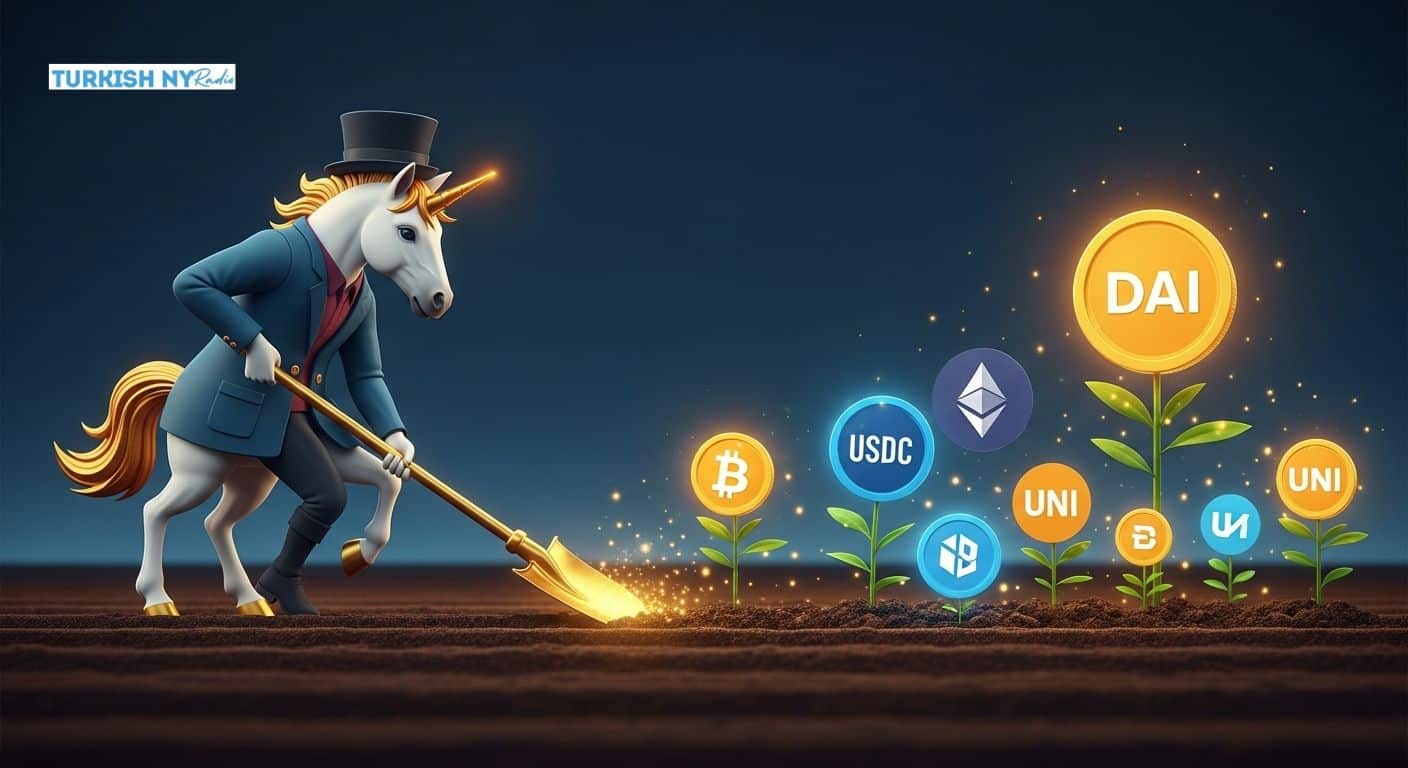
Uniswap yield farming is a way to earn passive crypto rewards by becoming a liquidity provider (LP) on Uniswap. When matching token pairs are supplied to a Uniswap pool, every trade that uses that liquidity pays a small fee to the provider.
In 2025, Uniswap is still one of DeFi’s largest platforms: over $1.6 trillion of trades have passed through Uniswap since launch. That scale means millions of dollars in daily fees for LPs.


What is Uniswap Yield Farming?
Uniswap yield farming simply means providing liquidity on Uniswap to earn fees. On Uniswap, any participant can deposit two tokens (for example ETH and USDC) into a liquidity pool. In return, LP tokens are received that represent a share of the pool.
Every time someone swaps tokens in that pool, Uniswap charges a fee commonly 0.3% of the trade for each swap.
That fee is split among all active LPs in that pool, proportional to each LP’s share. In this way, LPs earn a yield (in the form of fees) for helping the market stay liquid.
Uniswap yield farming is similar to liquidity mining. The term yield farming often implies additional token rewards. Early Uniswap protocols sometimes gave LPs extra tokens like the UNI token; to attract liquidity.
Today, most of the yield comes directly from trading fees. However, Uniswap’s design still rewards LPs: for example, V3’s concentrated liquidity feature allows LPs to focus their funds on a price range, boosting fee returns.
Research shows that V3 LPs earn about 54% more in fees on average than they would on the older V2 version for comparable pools. In short, Uniswap yield farming involves locking assets in a Uniswap pool to earn a share of swap fees.
Uniswap Versions
| Feature | Uniswap v2 | Uniswap v3 (2021–2024) | Uniswap v4 (2025+) |
| Capital Efficiency | Basic constant-product model (X × Y = k) | Introduced concentrated liquidity, LPs can choose specific price ranges for capital deployment | Combined concentrated liquidity with custom “hooks”, automated strategies like limit orders and time-based liquidity |
| Fee Returns (Passive) | Baseline fee split among all liquidity providers | Around 54% more passive LP returns than v2 | Expected to be even more efficient with lower gas fees and dynamic fee adjustments |
| Fee Tiers | Single pool with 0.30% fee | Multiple fee tiers per pair (0.01%, 0.05%, 0.3%, 1%) | Flexible fee rates (0-100%) per pool, configurable via governance or hooks |
| Gas and Transaction Costs | High, each pair had a separate contract | High, each pool managed by unique smart contracts and NFT-based positions | Much lower gas usage; single pool and batched accounting, more scalable |
| LP Token Type | Fungible ERC-20 LP tokens | NFT-based LP positions, unique liquidity ranges | Maintains NFT position model but with hook-enabled customization |
| Customization and Flexibility | None, all pools were the same | LPs could only choose price ranges | Highly customizable: limit orders, dynamic fees, custom oracles through programmable hooks |
How Uniswap Yield Farming Works
To farm yields on Uniswap, several steps are followed:
Choose a token pair: Two tokens of equal value (e.g., 1 ETH + $X USDC) are required to enter a Uniswap pool. Many LPs select popular pairs like ETH/USDC or stablecoin pairs (USDC/USDT). Popular pools have more trading volume, which leads to more fees.
Supply liquidity: Tokens are deposited into the Uniswap V3 pool using the web app or a connected wallet. In return, LP position tokens (NFTs in V3) are issued to represent the deposit and chosen price range.
Uniswap V3 allows setting a price range; if the price remains within this range, the liquidity stays active. Fees accrue only while the position is active.
Get fees: As trades occur, Uniswap charges a small swap fee; for example, 0.30% on many pools. Each trade’s fee is distributed among all LPs in that pool.
The smart contract adds those fee amounts to each LP position. Over time, accrued fees become part of the position value.
Monitor and rebalance: When market prices move outside the selected range, the liquidity stops earning fees until the price returns. Some advanced LPs rebalance by adjusting their range or shifting to different pools.
Even without active management, Uniswap’s V3 already provides about 54% higher passive fee returns on average compared to V2.


Withdraw funds: When exiting, LP tokens are burned to retrieve the fundamental tokens plus earned fees. If token prices fluctuate significantly, impermanent loss may occur. Withdrawals always include the original tokens plus accumulated fees.
In summary, Uniswap yield farming allows LPs to earn a portion of Uniswap’s trading revenue. One analysis notes that top Uniswap pools (like ETH/USDC) have at times yielded 5%-40% APY, depending on market conditions and volatility.
Stablecoin pairs (like USDC/USDT) typically earn lower APY often single digits, because price movements are minimal. The actual yield depends on pool fees, trading volume, and total liquidity.
Tools like DeFiLlama or Uniswap analytics can estimate current APRs for each pool.
Uniswap Yield Farming Strategies
Experienced DeFi users have developed strategies to boost Uniswap farming returns:
Many LPs start with stablecoin pairs (e.g. USDC/USDT). These pools have almost no price movement so impermanent loss is minimal. The tradeoff is lower APY (often <5% nowadays) because trades are mostly stablecoin swaps.
But participants earn risk-free trading fees. Some protocols also offer bonus rewards for stablecoin LPs (e.g. liquidity mining campaigns); though Uniswap itself rarely issues extra tokens beyond fees.
Providing liquidity to high-volume pools like ETH/USDC or WBTC/ETH can earn higher APY; especially when crypto markets are volatile.
For example; an ETH/USDC pool may currently yield around 5-10% APY in fees. But if $ETH’s price goes up or down, impermanent loss can occur. Many LPs in such pools accept moderate price risk for higher fees.
Some advanced farmers use bots or tools to rebalance or auto-compound fees into the liquidity pool. This can slightly increase effective yield by periodically reinvesting earned fees back into the pool.
Yearn Finance and other vaults sometimes offer automated Uniswap V3 LP vaults that handle this for participants (e.g. they collect fees and add them back on a set schedule). Using such vaults can save gas and improve returns.
A DeFi expert might combine Uniswap LPing with other protocols like borrowing against LP tokens. One could deposit USDC/ETH on Uniswap, earn fees, then take out a loan on Aave using those LP tokens as collateral, and redeposit that loan back into Uniswap or another protocol. These are complex strategies and riskier, but can amplify yield.
Occasionally, projects or chains partner with Uniswap to incentivize certain pools by giving extra tokens. In late 2022 and early 2023, Uniswap ran a UNI reward program for LPs on the Optimism chain.
An expert yield farmer would watch for such opportunities. These incentives can dramatically boost APY in the short term; sometimes into the triple digits, though they often end after a few weeks.
Risks of Uniswap Yield Farming
While Uniswap yield farming can be profitable, it carries risks that participants must understand:
Impermanent Loss (IL): This is the biggest risk. If the two tokens in the participant’s pool change price relative to each other, they could end up with less total value than if they had just held them. For example, if a participant provides ETH and USDC and ETH’s price jumps 50%, their LP position will hold less ETH and more USDC than before.
When withdrawn, the total value might be lower than the initial investment plus fees. In stablecoin pairs, IL is near zero because prices don’t move, but in volatile pairs, IL can be significant, especially during big market moves.
Low Volume / Returns: Not all pools are busy. If a participant picks a very small or illiquid pool, the trading fees may be tiny. Some farms advertise 100%+ APY but those often rely on reward tokens or initial hype.
Without enough trading volume, participants might not earn much. Always check the pool’s daily volume vs the share. If a participant’s deposit is a big fraction of TVL, they get a large share of fees; if it’s tiny, the yields may be low.
Gas Fees: Uniswap on Ethereum costs gas. Each deposit, withdrawal, or adjustment costs ETH. If a participant has a small position, fees may eat into the yield. High gas spikes (like $50+ per transaction during congestions) can temporarily wipe out small gains.
As of V4, gas is much lower for some operations, but it’s still a cost factor.
Smart Contract Risk: Uniswap is audited and popular, so there might be less risk. But bugs or exploits can still happen. Always use the official interface or trusted wallets. For new or custom pools, the risk of malicious tokens or hacks is high. Diversifying deposits across pools would be advised..
Regulatory/Tax Risk: Crypto yields are taxable. In many places, earning trading fees or incentives is considered income or capital gains. Keep records of your yields and consult a tax pro. (Not financial advice.)
In essence, Uniswap yield farming can be profitable, but it is worth noting that higher yields mean higher risk. Stablecoin pools are safe but have low APY. Volatile pools pay more fees but beware of impermanent loss.
Gas and smart contract issues can also reduce net gains. Always weigh the fees against the risks before farming.
Conclusion
Uniswap yield farming is still a way to earn passive income in DeFi. Uniswap’s concentrated liquidity model (V3) has increased returns for LPs, and V4 features like hooks and flash accounting could make it even more efficient.
Data driven strategies like picking pools with high volume and automating are essential. For example, targeted liquidity incentives on Uniswap have been shown to produce strong ROI in practice and Uniswap’s growth of over $1.6T total volume means ongoing fee revenue for LPs.
But for smart farmers, they are cautious; they optimize for fee income while managing impermanent loss and gas costs.
Uniswap yield farming can be profitable if done right and the latest protocol updates and analysis are helpful for LPs.
Glossary
Liquidity Pool: A smart-contract pool holding two tokens (like ETH and USDC) that traders can swap between. LPs provide these tokens and earn fees.
Liquidity Provider (LP): A user who deposits equal-value tokens into a Uniswap pool.
Automated Market Maker (AMM): A protocol like Uniswap that uses a formula (X·Y=k) instead of order books. Traders swap directly against the pool’s reserves.
Impermanent Loss: A risk where an LP loses potential profit because token prices changed. The loss is “impermanent” only if prices revert; otherwise it becomes realized when withdrawing.
Concentrated Liquidity: A feature of Uniswap V3 where LPs can allocate funds to a specific price range; boosting efficiency and fee earnings.
Hook (Uniswap V4): A customizable module developers can attach to a pool; to implement limit orders or dynamic fees. This increases flexibility for LP strategies.
Frequently Asked Questions About Uniswap Yield Farming
How to start yield farming on Uniswap
Select a token pair and approve them in an Ethereum wallet. On app.uniswap.org, go to “Pool” and select Add Liquidity for the chosen pair. Enter equal values of each token and confirm the transaction. LP tokens are then received. These tokens continue to earn fees until withdrawn.
Is Uniswap yield farming profitable?
Profitability depends on pool volume, fees, and price movements. Stablecoin pools yield steady but low returns; high-volatility pairs generate more fees (sometimes double-digit APYs) but carry impermanent loss risk. Uniswap’s own research shows V3 LPs earn 54% more fees than V2, so participation can often be worthwhile.
What is impermanent loss?
Impermanent loss occurs when the deposited tokens change price relative to each other. If the price ratio shifts, the resulting mix may be less valuable than simply holding the tokens. It is called “impermanent” because if prices return to the original levels, the loss disappears. However, if funds are withdrawn while prices remain far apart, the loss becomes permanent.
Can multiple blockchains be used for Uniswap yield farming?
Yes. Uniswap operates on Ethereum and several layer-2 chains (Arbitrum, Optimism, Base, etc.). Fees and volumes vary across chains. Uniswap on Base or Arbitrum often has lower gas costs, which can improve yields for smaller LP positions. It is important to check where the tokens reside and confirm that the pool exists on the corresponding chain.