For centuries, ownership meant holding something physical, a book, a house, or a piece of art. In today’s digital age, that definition is shifting fast. Non-fungible tokens (NFTs) have come along as a new method to possess and validate rare digital assets.
Besides their role in the process, NFTs and digital ownership have already transformed how people deal with digital goods; they have simultaneously started to open up new issues relating to authenticity, rights, and long-term value.

The whole thing is no longer restricted to art or collectibles; it is molding all sectors of finance, gaming, entertainment, and business. For financial students, crypto aficionados, and blockchain programmers, keeping track of this alteration is a must to get a proper understanding of the coming digital economy’s operating principles.
The Foundation of Digital Ownership
Traditional digital goods like images, songs, or game items can be downloaded or shared, but real ownership rarely applies. If a platform shuts down, users often lose access to their content. NFTs changed that by recording ownership directly on a blockchain. Each token represents a unique digital item, complete with verifiable history and proof of authenticity.
According to a Harvard Business School study, NFTs allow digital ownership to exist independently of any platform by creating a permanent, verifiable record. The ERC-721 standard on Ethereum became the foundation for NFTs, defining how uniqueness and ownership are tracked. Unlike fungible cryptocurrencies, each NFT is distinct and traceable.
A recent industry report described NFTs as “digital deeds” that let users prove ownership without relying on intermediaries. This concept has sparked a wave of creative and financial innovation, giving rise to a growing number of NFT use cases across multiple industries.
From Art to Assets: Expanding NFT Use Cases
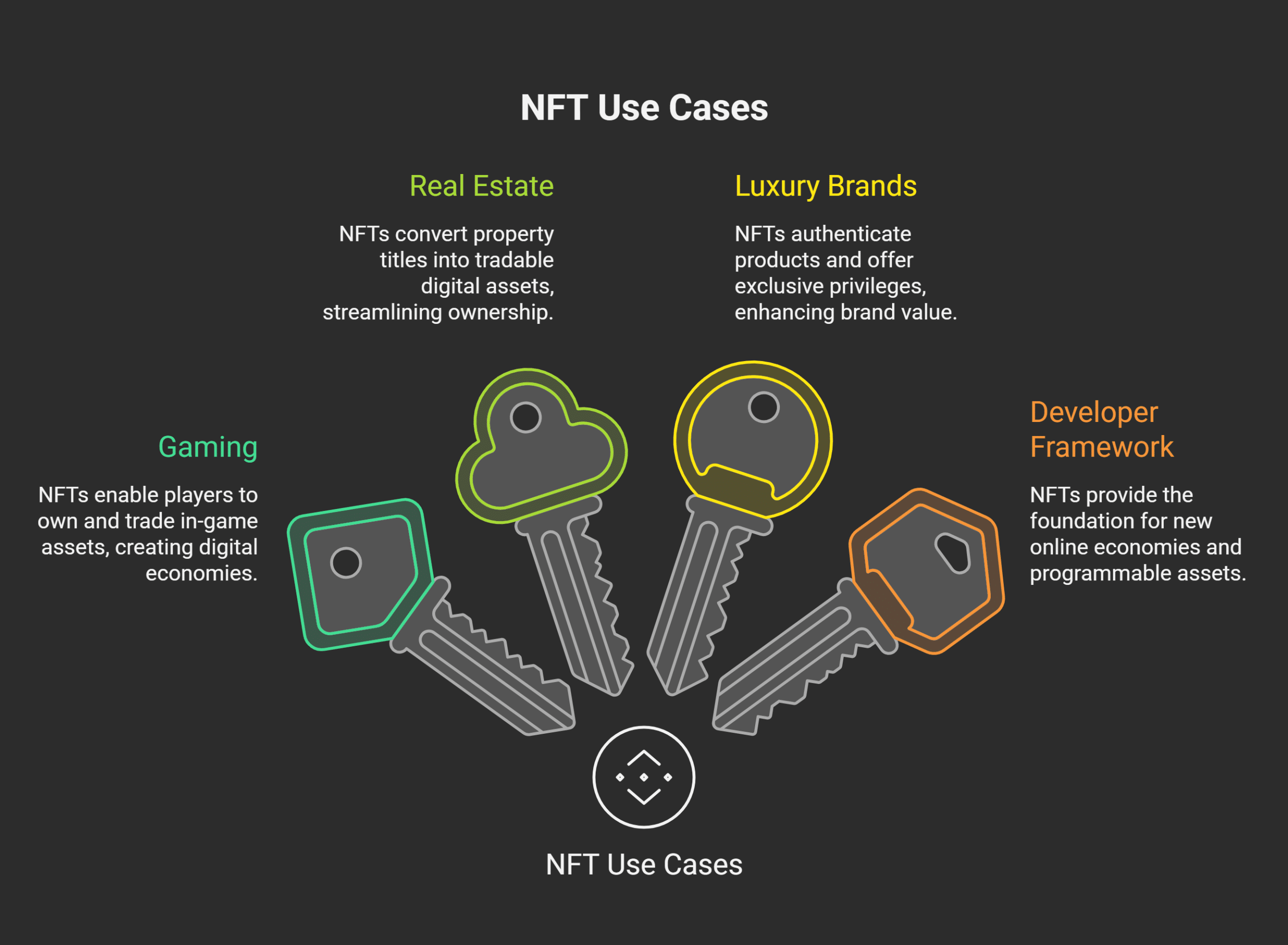
The real estate industry is also integrating the use of NFTs by converting property titles into tradable digital assets, thus eliminating the need for ownership documentation and creating verifiable on-chain records.
Luxurious brands are not staying behind by associating NFTs with their products in order to both confirm authenticity and provide special privileges. This blending of physical and digital ownership has become one of the strongest NFT use cases to date.
For developers, NFTs represent the framework for new online economies. For analysts, they function as programmable financial assets that combine scarcity, utility, and traceability. Each year brings new NFT use cases that stretch the definition of what digital property can represent.
Measuring Value in the NFT Economy
The second is smart contract quality. The standards that govern NFTs are the ERC-721 and ERC-1155, which determine the behavior of NFTs, thus securing the royalty and transfer mechanism. Contracts that are audited are also a preventive measure against fraud, as well as a factor in building investor trust.
Third is metadata reliability. Many NFTs link to external servers, which creates risk if those servers fail. To solve this, projects increasingly use decentralized storage systems like IPFS, ensuring the asset’s data remains accessible even if the issuing platform disappears.
Another factor is utility. The worth of an NFT is considered to be rising when it provides more than just the right to own it, such as access to events, membership benefits, or in-game features. The trend of shifting towards functional value is altering the NFT use cases, which are now able to provide tokens with practical advantages in addition to the traditional symbolic ones.
Finally, legal clarity is key. Owning an NFT doesn’t always mean owning the copyright of the associated item. Legal frameworks are still developing, but clear agreements and transparent rights are becoming essential to building trust.
Ownership Redefined
NFTs introduced something the digital world had never achieved before: scarcity. For the first time, a digital file can be both shareable and provably unique. This changes how creators, collectors, and companies think about digital assets.
Ownership is no longer confined to one platform. A verified NFT exists independently, making it impossible for a platform to delete or revoke it. This freedom creates a fairer system for creators and consumers alike.
For artists and developers, NFTs enable automated royalty payments coded into smart contracts. In the case of asset resale, the creator always receives a certain percentage of the proceeds. For the analysts, NFTs are furthermore a new class of assets characterized by their unique liquidity and pricing models.
From this, it is deduced that the transition coincides with the trends in the blockchain technology industry. Besides that, there are trading platforms like Solana, which have the ability to execute more than 60,000 transactions every second and thereby attract traders who deal in NFTs.
Many experts argue that Solana’s rise in activity and token demand is directly tied to expanding NFT use cases, particularly in gaming and entertainment.
Risks and Challenges
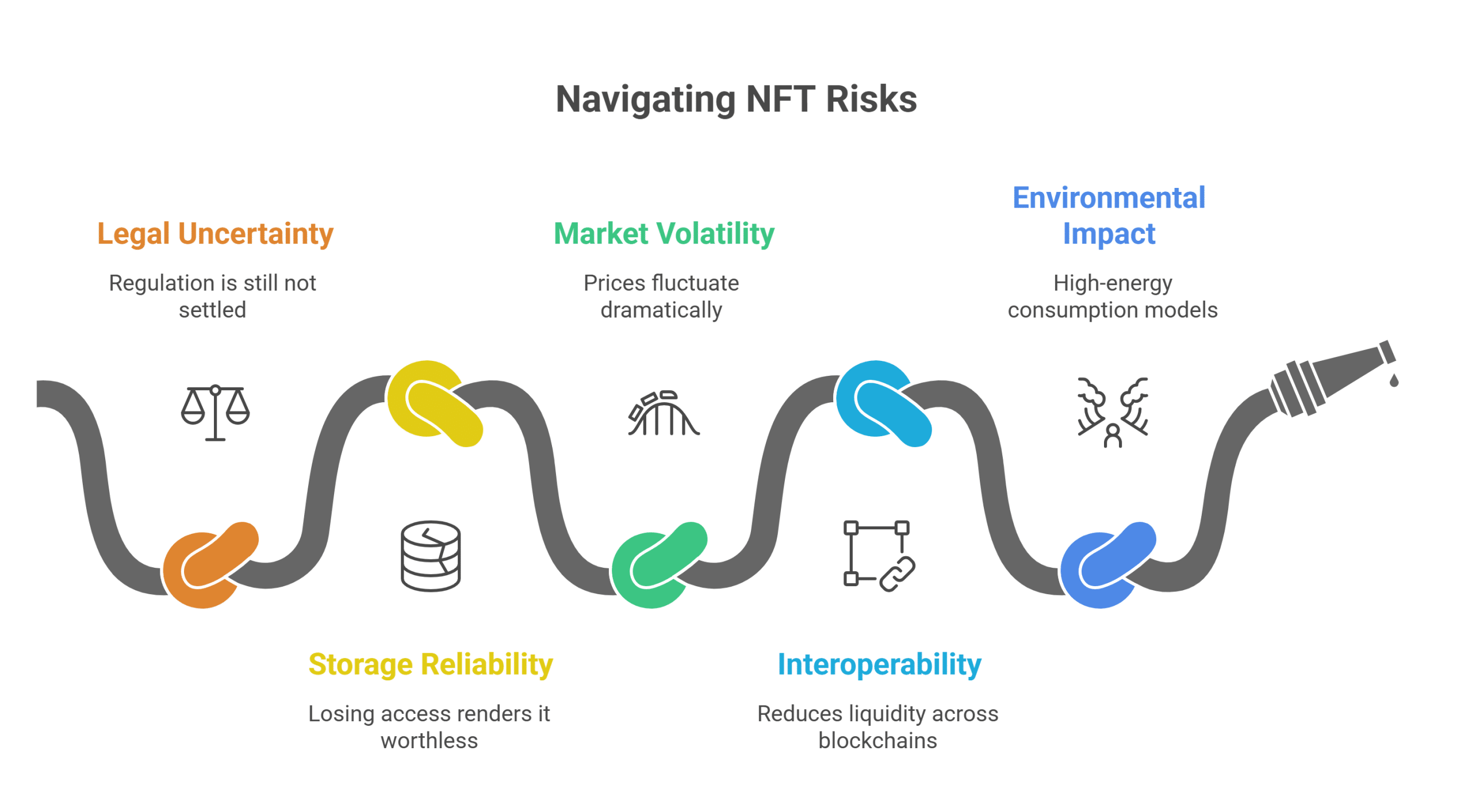
Despite their potential, NFTs face notable risks that users and developers must understand.
Legal uncertainty remains one of the biggest. Governments are still in discussions about whether to categorize NFTs as securities or consumer protection laws. A court decision in the US in 2025 validated that regulation is still not settled and that the situation for both creators and buyers is a gray zone.
Storage reliability is another challenge. If an NFT’s data is hosted on centralized servers, losing access can render it worthless. Developers are responding by using decentralized storage, but not all projects meet that standard.
Market volatility affects prices dramatically. Many NFTs gained or lost significant value within months. Analysts warn that speculation, rather than utility, still drives much of the market.
Interoperability is limited too. Some NFTs can’t move across blockchains, reducing liquidity. Developers are working on standards to improve cross-chain compatibility.
Finally, environmental impact matters. Older blockchains used high-energy consumption models, though newer ones like Solana and Polygon have adopted more sustainable proof-of-stake systems.
What Stakeholders Should Know
For financial students and analysts, NFTs are more than digital art. They are programmable financial assets whose market behavior can be modeled like commodities or securities. Analysts should study token liquidity, secondary-market activity, and rights management before assigning value.
For investors and enthusiasts, awareness is essential. An NFT is a token, not always the rights to that underlying content. Users must confirm their ownership, the mechanism of royalties, and the governance of the project before they put their money in. This concept is valid for all NFT use cases from digital art to real estate tokenization.
The Future of Digital Ownership
The next evolution of NFTs will focus on real-world integration and mass utility. Experts predict tokenized identity systems, academic records, supply chain tracking, and fractional real estate ownership will all become practical NFT use cases in the coming years, making NFTs part of everyday life.
Legal frameworks will mature too. Once global standards for digital ownership and consumer protection are finalized, institutions will likely join the ecosystem, shifting NFTs from speculative investments to functional digital assets.
The underlying idea is simple: ownership is moving from possession to proof. A blockchain record acting as a certificate of authenticity has a great impact on trust, trade, and storing value. NFTs aren’t going to take over traditional systems, but they will expand the scope of ownership in the digital economy, driving how value flows, creators earn, and consumers connect with brands and media.
Conclusion
NFTs and digital ownership have a great impact on the way the digital world’s value and authenticity are determined. They rely on transparency, security, and permanence, combining together to create ways through which artists and collectors can not only verify ownership but also gain trust within the digital economy.
The more the innovation, the wider the use cases for NFTs that will traverse the realms of art, gaming, real estate, and finance. This development signifies that the NFTs and digital ownership are not going to disappear after some time, but have become the foundation for the future of digital assets in terms of ownership, trade, and value estimation.
Glossary
Blockchain: A public ledger that records transactions securely and transparently.
Metadata: Information describing an NFT’s content or traits.
Smart contract: Code that automates transactions when set conditions are met.
Tokenization: Converting tangible or digital assets into tradable blockchain tokens.
Utility: Functional value of an NFT beyond collectability.
ERC-721: A standard that allows the creation of non-fungible tokens on the Ethereum blockchain
Interoperability: The capability of NFTs to transfer from one blockchain to another easily.
FAQs Regarding NFTs and Digital Ownership
What does it mean to possess an NFT?
It signifies that you have a blockchain-validated token that symbolizes a specific item or a right. Copyright or commercial rights may not be included.
Can NFTs be used outside their initial platform?
Only, in the case of cross-compatibility and interoperability. While some NFTs can be moved to similar platforms, this is not the case for all.
Are NFTs secure investments?
NFTs are subject to market and regulatory risks. The values can vary greatly, and legal structures are still forming. Always do extensive research.
In what way can NFTs be helpful to artists?
Artists can put royalties in the form of smart contracts, allowing them to get a portion every time their pieces get resold.