
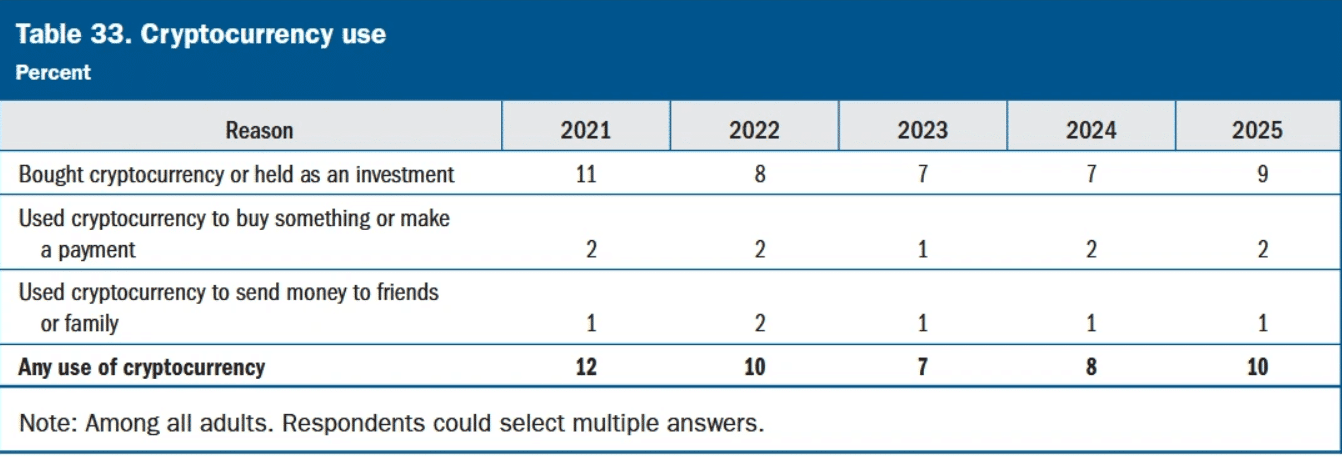
A fresh federal household finance report shows that cryptocurrency has regained some ground with American consumers, but the numbers also reveal a clear weakness. Around 10% of U.S. adults used or invested in crypto in 2025, the highest level in 3 years, yet only a small share used digital assets for payments or money transfers.
That gap matters because U.S. crypto adoption is no longer judged only by how many people buy Bitcoin, Ethereum, or other tokens. The larger test is whether crypto is becoming useful in daily financial life.


U.S. Crypto Adoption Shows Recovery After 2024
The latest data shows U.S. crypto adoption improved from 8% in 2024 to 10% in 2025, suggesting that digital assets remain relevant even after years of volatility, regulatory pressure, and retail caution. Still, the figure remains below the 12% level seen in 2021, when crypto markets were riding a broad speculative boom.
That difference is important. A higher ownership rate can signal stronger investor interest, but it does not always prove deeper financial use. In plain terms, many Americans still treat crypto like a high-risk asset, closer to a tech stock than a replacement for cash, cards, or bank transfers.
Investment Demand Remains the Main Driver
The strongest part of U.S. crypto adoption remains investment. The report found that nearly 1 in 10 adults bought or held crypto as an investment, while only 2% used it to buy something or make a payment. Just 1% used it to send money to friends or family.
This split explains the market’s mixed signal. Crypto can attract attention when prices rise, exchange-traded products gain inflows, or Bitcoin pushes into a new trading range. But payment adoption moves more slowly because consumers need trust, speed, low fees, tax clarity, and merchants willing to accept digital assets without friction.
For traders, the key indicators remain clear as Bitcoin dominance shows whether capital is flowing into safer crypto assets or rotating toward altcoins. Exchange inflows can signal selling pressure, while outflows often show long-term holding. Stablecoin supply is also worth watching because it reflects available liquidity that can move into risk assets. When these indicators rise together, U.S. crypto adoption may look healthier. When they diverge, caution usually follows.
The Bearish Catch: Utility Is Still Small
The bearish side of the data is simple: usage is wider, but not yet deeper. U.S. crypto adoption has improved on paper, yet crypto’s role in normal payments remains limited. That matters for valuations because long-term market strength usually needs more than investor hope. It needs repeated use.
The report also shows that crypto transactions are more common among adults with less access to traditional banking. About 6% of unbanked adults used crypto for financial transactions, compared with 2% of banked adults. This suggests crypto may still have a practical role for some users, especially where bank access is limited, costly, or inconvenient.
Among people who used crypto for transactions, 26% said the receiver preferred crypto. Others pointed to speed, privacy, and lower cost. Only 7% said they used crypto because they did not trust banks, which weakens the idea that most payment users are leaving the banking system altogether.
What This Means for the Crypto Market
For market watchers, U.S. crypto adoption now sits in a middle lane. It is not collapsing, but it is not breaking into everyday finance either. That creates a careful setup for Bitcoin, Ethereum, and payment-focused networks.
If prices rise while real usage stays flat, the rally may depend too much on speculation. If stablecoin payments, wallet activity, merchant acceptance, and remittance use grow together, the market gets a stronger base. That is where investors should separate noise from substance.
The next phase of U.S. crypto adoption will likely depend on regulation, user protection, simpler wallets, and clearer tax treatment for small transactions. Without those pieces, many consumers may keep crypto in the portfolio, but out of the checkout lane.
Conclusion
The latest numbers show a crypto market that is healing, but not fully maturing. U.S. crypto adoption has climbed back to 10%, which is a positive sign after a softer 2024. Still, the deeper message is more cautious. Americans are buying and holding crypto, but they are not yet using it like money in any broad sense.
That is not a failure. It is a reality check. For crypto to move from asset class to everyday finance, adoption must show up in payments, transfers, and practical use, not only in investment accounts.
Frequently Asked Questions
What percentage of Americans used crypto in 2025?
Around 10% of U.S. adults used or invested in cryptocurrency in 2025, according to the latest federal household finance data.
Is crypto being used widely for payments?
No. Only 2% of adults used crypto to buy something or make a payment, while 1% used it to send money.
Why is the data mixed for the market?
The headline adoption rate improved, but most use remains investment-based, which means everyday utility is still weak.
Glossary of Key Terms
Crypto adoption means the share of people using or investing in digital assets.
Stablecoin means a cryptocurrency designed to track a stable asset, often the U.S. dollar.
Exchange inflows means crypto moving onto trading platforms, often watched as a possible sell signal.
Bitcoin dominance means Bitcoin’s share of the total crypto market value.
Source
Disclaimer: This article is for informational purposes only and does not provide financial advice. Crypto assets are volatile, and readers should conduct independent research before making investment decisions.