Crypto’s next serious phase may not be led by the loudest market. In 2026, the sharper signal is coming from jurisdictions where digital assets are being connected to banks, payment systems and local currencies. The U.S. still matters for ETFs, liquidity and institutional capital, but global crypto regulation is now showing a different kind of progress: practical integration.
Global Crypto Regulation Is Becoming Financial Infrastructure
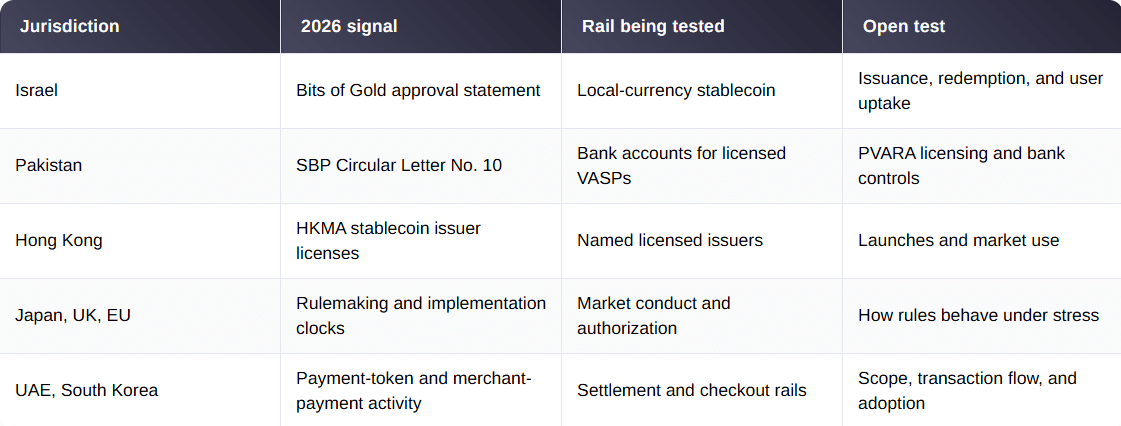
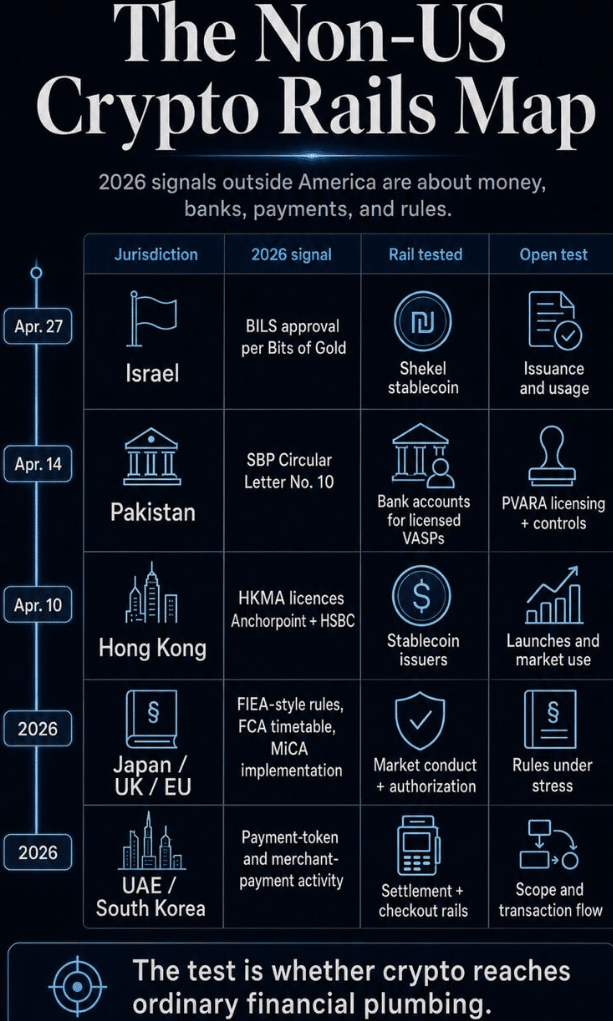
The latest wave of global crypto regulation is less about abstract policy and more about usable rails. Israel has approved BILS, a shekel-backed stablecoin, after a supervised process, giving the local market a regulated token tied to its national currency. Pakistan has also opened banking access for licensed virtual asset providers, allowing regulated firms to hold bank accounts after years of restrictions.


That matters because crypto cannot mature if it remains outside the banking system. Exchanges, custodians and payment firms need regulated accounts, clear reserve rules and compliance duties. Without that, the market stays half in the shadows, no matter how high token prices move.
Why Local Currency Stablecoins Matter
Dollar stablecoins still dominate, but local currency tokens are becoming more important. A shekel-backed stablecoin, a Hong Kong dollar stablecoin, or regulated payment tokens in Asian and Middle Eastern markets show that crypto is moving closer to daily financial use. Hong Kong has already granted stablecoin issuer licenses under its regulated framework, while authorities continue warning users to deal only through approved channels.
This is where global crypto regulation becomes more than investor protection. It becomes a bridge between blockchain networks and the normal economy. A stablecoin used for settlement, remittances or merchant payments is very different from a token traded only for price swings.
The U.S. Leads in Capital, Others Lead in Use Cases
The U.S. remains central because its capital markets are deep. Bitcoin ETFs, public companies holding crypto and regulated custodians all shape sentiment. Still, the wider market is watching a quieter shift overseas. Non-U.S. regulators are asking a practical question: how can crypto safely plug into banking, payments and public financial systems?
That question gives global crypto regulation a stronger real-world angle. In Pakistan, the banking opening gives licensed crypto firms formal access to local financial infrastructure. In Hong Kong, stablecoin licensing creates a pathway for approved issuers. In Japan, the UK, the UAE and South Korea, policymakers are also tightening frameworks around payments, custody, issuance and consumer protection.
Key Crypto Indicators Investors Should Watch
For crypto markets, regulation is now an indicator, not just background noise. Traders should watch banking access first, because firms with bank accounts can operate with less friction. Stablecoin licensing is another key signal, since reserve rules and redemption rights help show whether payment tokens are becoming safer. Merchant payment pilots also matter, especially when they connect crypto to tourism, remittances or retail spending.
Liquidity remains important, but it should be read beside regulation. Rising volume in a poorly supervised market can be fragile. Rising usage inside a licensed system is more durable. That is why global crypto regulation may become a stronger long-term indicator than short-term price momentum.
What This Means for the Market
The market is moving from hype cycles toward infrastructure checks. Investors are no longer only asking whether Bitcoin can break a price level or whether altcoins can rally. They are asking whether crypto can live inside financial systems without increasing fraud, sanctions risk or consumer losses.
That is the real test for global crypto regulation. Rules that only restrict activity may push users away. Rules that define reserves, licensing, redemption, custody and banking access can make the sector more investable.
Conclusion
Crypto’s 2026 direction is not only being shaped in Washington. It is being shaped in places where digital assets are being wired into local money, banking services and payment channels. Global crypto regulation is becoming a race to build trusted rails, not just pass laws. If that trend holds, the next phase of adoption may come from countries that make crypto useful before they make it famous.
FAQs
What is global crypto regulation?
Global crypto regulation means the legal and financial rules that govern crypto exchanges, stablecoins, custody, payments and banking access across different countries.
Why are stablecoins important?
Stablecoins help connect blockchain payments with real-world money because they are usually tied to fiat currencies like $1, shekel, euro or local currency units.
Why does banking access matter for crypto firms?
Banking access allows licensed crypto firms to operate more transparently, manage client funds properly and connect with the formal financial system.
Glossary
Stablecoin: A crypto token designed to track the value of a fiat currency.
VASP: A virtual asset service provider, such as an exchange, custodian or broker.
Reserve backing: Assets held to support a stablecoin’s value.
Payment rails: Systems that move money between users, banks and merchants.
Sources