

This article was first published on TurkishNY Radio.
Trust Wallet has expanded its usability push with a gas sponsorship feature that removes one of crypto’s biggest barriers. The update lets users swap tokens without holding a blockchain’s native gas coin first.


For many newcomers, that means no need to keep spare ETH, SOL, or BNB just to make a basic trade. Trust Wallet introduced the feature roughly two months ago, aiming to simplify onboarding into decentralized finance.
Users may still pay hidden costs through slippage, and the long-term sustainability of subsidized gas fees remains unclear. Trust Wallet’s approach highlights a wider Web3 trend: reducing friction while preserving self-custody.
Trust Wallet Sponsors Gas Fees on Top Chains
Trust Wallet now sponsors gas fees for approved token swaps across multiple networks. The feature works on Ethereum, BNB Chain, and Solana. It allows users to trade even if they do not own the network’s fuel currency.
The system comes with conditions. Sponsorship is limited to four swaps per day. Each supported network also has minimum trade values. For Ethereum swaps, the threshold is around $50, though requirements vary by chain.
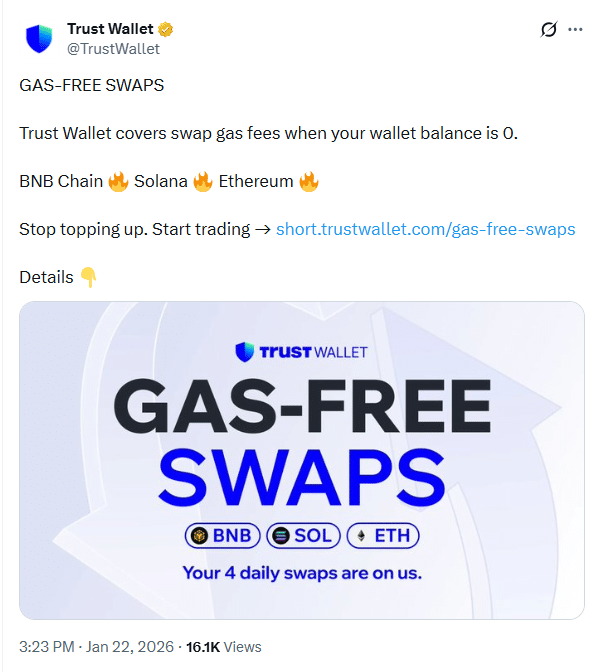
Trust Wallet pays the network fee through a dedicated sponsorship fund, which may be supported by partners, sponsors, or internal reserves.
Trust Wallet Simplifies Swaps by Covering Network Fees
In most blockchain transactions, gas is required to pay validators and processors. Without gas, the transaction fails. This has long created a usability problem, especially for new users.
Someone might hold stablecoins or tokens, but still be unable to swap because they lack the required native coin. Trust Wallet’s sponsorship removes that hurdle.
By covering the gas behind the scenes, Trust Wallet turns token swaps into a simpler experience similar to mainstream financial apps. However, the sponsorship only covers network transaction fees.
Also Read: Trust Wallet Hack 2025: How a Compromised Chrome Extension Led to Millions Lost
The trade itself can still include slippage, routing differences, and price impact. The feature is not “free trading,” but it eliminates one major step.
Trust Wallet Removes Gas Barriers for Swaps
Trust Wallet’s gas sponsorship is designed to reduce early-stage friction. Users can swap tokens on supported networks without preparing gas balances first. This matters because gas management is a common cause of abandoned transactions and failed onboarding.
By integrating the fee coverage directly into the swap flow, Trust Wallet improves usability without changing the self-custody model. The wallet still gives users full control over assets and keys. The update focuses on payment handling rather than custody structure.
How the Sponsorship Rules Work
The platform applies the feature only to eligible swaps. It limits usage to up to four sponsored swaps each day. This protects the fund from abuse while keeping the option available for regular users.
Minimum swap amounts also reduce unnecessary spending. Smaller trades can cost too much in relative gas fees, particularly on Ethereum. That is why the platform requires larger minimum values on some networks.
The Hidden Cost Users Still Pay
Even when gas is sponsored, swaps still carry indirect costs. The platform users may face price slippage depending on liquidity conditions and market volatility. The exchange rate offered by decentralized platforms can also shift during execution.
The platform displays the covered network fee, but the final outcome depends on DEX routing and pool depth. For that reason, sponsorship does not guarantee a cheaper transaction. It only removes the requirement to hold native gas tokens.
Sustainability Questions and Who Funds the Gas
The platform has not fully detailed how the sponsorship fund is financed over the long term. That creates speculation about whether partners subsidize the gas, whether Trust Wallet uses internal reserves, or whether fees are indirectly recovered through swap partnerships.
The main concern is whether sponsorship can continue at scale. If user volume grows sharply, the cost of paying gas for millions of transactions could become significant. That does not mean the platform will stop the program, but it highlights why transparency matters.
Ethereum Upgrades Shift Gas Payment Economics
Wallet innovation is also tied to Ethereum’s ongoing development. Ethereum upgrades and proposals are moving toward more flexible fee payments, allowing users to pay transaction fees with tokens other than ETH.
This change improves user experience but also alters fee economics. When native coins are not always used for operations, new questions emerge around routing, conversion costs, and settlement mechanics.
Why The platform Move Signals a Web3 Trend
Trust Wallet is not alone in focusing on usability. Web3 adoption increasingly depends on removing technical complexity. Account abstraction, paymasters, and wallet integrations all point toward the same goal: make blockchain tools feel simple without weakening decentralization.
The platform’s sponsorship fits that roadmap. It turns early DeFi experiences into smoother flows and reduces the chance of user drop-off. If adoption continues, similar designs could become standard across wallets and platforms.
Conclusion
Trust Wallet’s gas sponsorship feature has improved accessibility for token swaps by eliminating the need to hold native gas tokens. The feature supports Ethereum, BNB Chain, and Solana, with daily limits and minimum trade thresholds.
Trust Wallet may need stronger transparency around funding sources and long-term feasibility. Still, the direction is clear. The platform is positioning itself around usability as Web3 competes for mainstream adoption.
Also Read: Crypto Security for 2026: Wallet Selection and Cyber Threats
Appendix Glossary Key Terms
Gas Fee Sponsorship: Wallet pays for network fees on behalf of eligible swaps.
Native Token: The key coin for gas payment (ETH, BNB, SOL).
Gas Fee: Transaction charge of interest paid to validators and processors.
Slippage: Discrepancy between the expected and actual swap price.
Price Impact A measure of how much a transaction moves the market price.
DEX Routing: Route taken to perform a swap between liquidity pools.
Minimum Swap Amount: Minimum amount you must trade in order to be sponsored.
Account Abstraction: Easing use of UX and fees with wallet tech.
Self-Custody: User has direct control over private keys and funds.
Frequently Asked Questions About Trust Wallet
1- What does Trust Wallet’s gas sponsorship do?
Trust Wallet covers the blockchain gas fee for eligible token swaps, so users can trade without holding native gas tokens first.
2- Is swapping completely free with a Trust Wallet?
No. Trust Wallet only covers the network fee. Users may still pay slippage or receive a less favorable swap rate.
3- Which networks support the Trust Wallet sponsorship feature?
Trust Wallet currently supports gas sponsorship for swaps on Ethereum, BNB Chain, and Solana.
4- How many sponsored swaps are allowed?
Trust Wallet allows up to four sponsored swaps per day, with minimum swap values depending on the network.