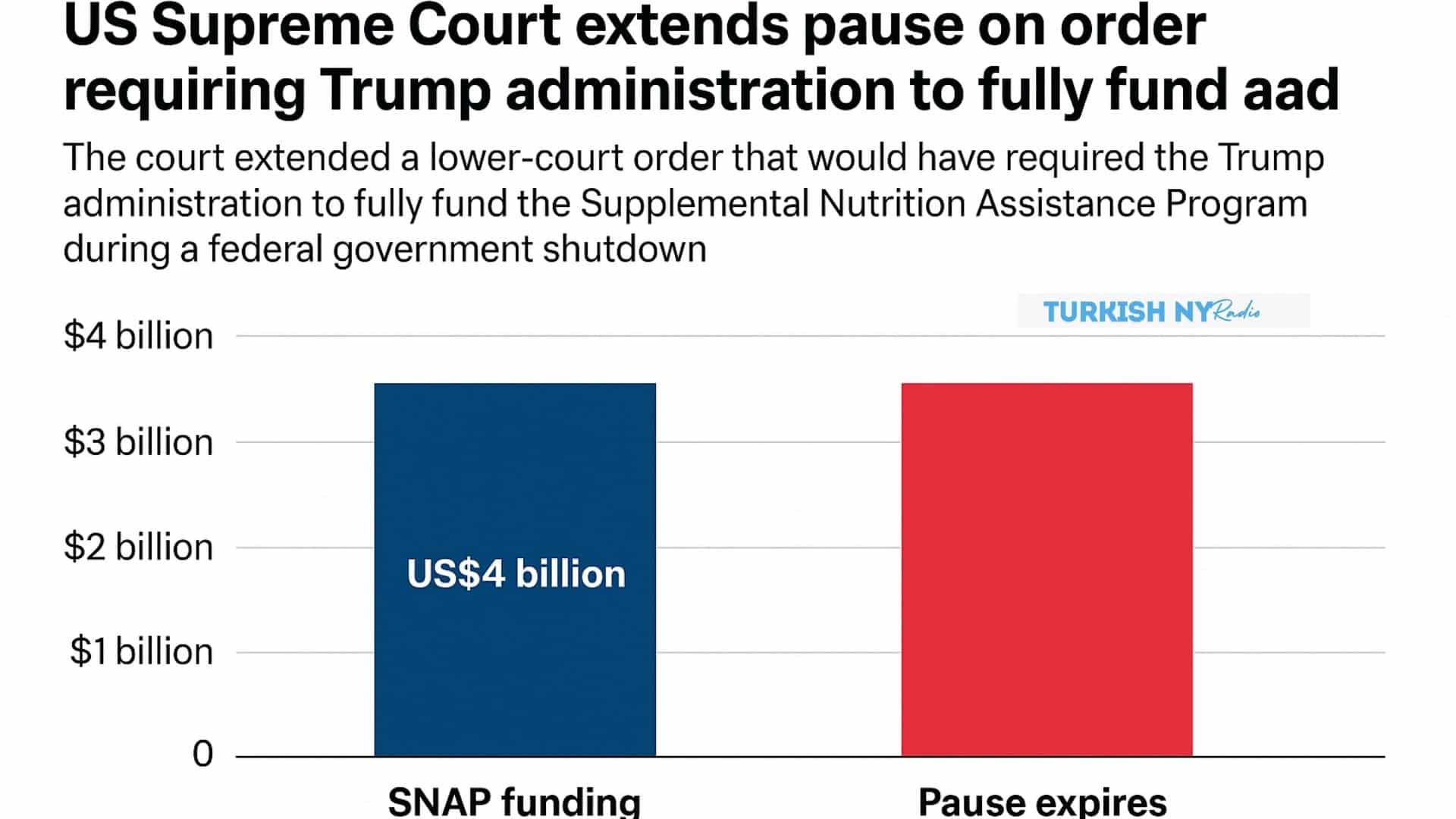
The Supreme Court SNAP decision has once again placed America’s social safety net at the center of political and moral controversy. In a temporary ruling, the Court allowed the Trump administration to continue its $4 billion reduction to the Supplemental Nutrition Assistance Program (SNAP), halting an earlier order that required full restoration of benefits.
The decision affects roughly 42 million low-income Americans who depend on SNAP to buy food. While the Court’s stay is temporary, it has intensified public concern about how political decisions are reshaping the nation’s approach to poverty and hunger.


Court Extends Pause on Full SNAP Funding
The Supreme Court SNAP decision extends a pause on a lower court’s mandate that sought to restore full food assistance during the ongoing federal government shutdown. The administration argued that reinstating benefits now would strain federal budgets already stretched thin.
For the moment, that argument has prevailed. The stay means reduced payments will continue until the justices decide whether to hear the case in full. “This decision is deeply troubling,” said Diane Yentel, president of the National Low Income Housing Coalition. “Every day that passes without full aid pushes more families toward desperation.”
Also read: Breaking: Bitwise Seeks SEC Approval for First Chainlink ETF
A Human Impact Felt Nationwide
For millions of Americans, the Supreme Court SNAP decision isn’t about politics, it’s about survival. In cities and rural towns alike, food banks are seeing record demand as families struggle to stretch smaller benefits.
“I’ve worked all my life, but now I’m choosing between paying rent and feeding my kids,” said a mother of three in Ohio. Her words reflect what many food assistance workers describe as a growing crisis.
Economists warn that SNAP dollars don’t just help families, they fuel local economies. When benefits are reduced, grocery stores, farmers, and small businesses all feel the effects. As one analyst put it, “The Supreme Court SNAP decision doesn’t just take money off kitchen tables, it takes it out of communities.”
Supreme Court Halts SNAP Benefits Amid 38‑Day U.S. Shutdown”: formerly Twitter
Political and Legal Divide Sharpens
The ruling has deepened Washington’s already sharp partisan divide. Supporters of President Trump argue that the Supreme Court SNAP decision represents a step toward fiscal responsibility. They say reforming welfare programs is necessary to reduce dependency and balance the budget.
White House spokesperson Laura Jennings said in a statement, “The administration is acting responsibly to ensure that government resources are used efficiently and fairly.”
Opponents see it differently. Lawmakers and anti-hunger advocates call the ruling a dangerous precedent that prioritizes cost-cutting over compassion. “This decision may be temporary,” said Senator Cory Booker, “but its impact on hungry families will last far longer than a news cycle.”
Legal scholars note that the Supreme Court SNAP decision could shape how future administrations handle welfare spending disputes, especially during budget standoffs.
A Deeper Moral Question
Beyond the politics and legal arguments lies a more fundamental question: what does this decision say about America’s values? The Supreme Court SNAP decision has forced policymakers and citizens alike to consider whether fiscal restraint should outweigh human need.
“This isn’t just about dollars, it’s about dignity,” said economist Jared Bernstein. “Every major economic choice we make tells a story about who we are as a nation.”
As the Court weighs its next move, millions are left in limbo, uncertain whether relief will return or vanish for good.
Conclusion
The Supreme Court SNAP decision may be a temporary legal maneuver, but its implications are anything but short-term. It reflects a country wrestling with its conscience, between financial caution and moral obligation. Whether the stay becomes a permanent shift or a momentary pause, it has already reignited one of America’s oldest debates: how much should government do to ensure that no citizen goes hungry?
Also read: How The Fed Cuts Rates, Pauses the Data, and Redraws the Map for 2026
Glossary of Key Terms
SNAP (Supplemental Nutrition Assistance Program): Federal program providing food aid to low-income Americans.


Stay: A temporary legal order that halts enforcement of a ruling.
Fiscal Responsibility: The practice of managing government spending efficiently.
Government Shutdown: A suspension of federal operations due to funding disputes.
Food Insecurity: Lack of consistent access to adequate food.
FAQs for Supreme Court SNAP Decision
1. What does the Supreme Court SNAP decision do?
It temporarily allows the Trump administration to continue its food aid cuts while legal challenges proceed.
2. How much funding is affected?
Roughly $4 billion in SNAP benefits are being withheld under the current stay.
3. Who is impacted the most?
Over 42 million low-income Americans rely on SNAP for basic nutrition.
4. Is this ruling permanent?
No, it’s a temporary decision. The Court could lift or revise it in the coming weeks.
5. Why is the Supreme Court SNAP decision controversial?
Critics say it deepens hunger and hardship, while supporters argue it ensures responsible government spending.