• Home
  • About Us
  • Terms and Conditions
  • Privacy Policy
  • Disclaimer
  • Contact
9 June Tuesday, 2026
  • tr Türkçe
  • en English
TurkishNY Radio
No Result
View All Result
  • Home
  • Cryptocurrency
  • Business
  • Economy
  • Home
  • Cryptocurrency
  • Business
  • Economy
No Result
View All Result
  • tr Türkçe
  • en English
TurkishNY Radio
No Result
View All Result
Bitcoin Bitcoin (BTC) $61,313.33 ↓ -2.90%
Ethereum Ethereum (ETH) $1,626.18 ↓ -3.14%
Tether USDt Tether USDt (USDT) $1.00 ↓ -0.03%
BNB BNB (BNB) $586.22 ↓ -1.97%
USDC USDC (USDC) $1.00 ↑ 0.00%
XRP XRP (XRP) $1.12 ↓ -3.26%
Solana Solana (SOL) $64.34 ↓ -2.84%
TRON TRON (TRX) $0.32 ↓ -1.14%
Hyperliquid Hyperliquid (HYPE) $55.85 ↓ -8.51%
Dogecoin Dogecoin (DOGE) $0.08 ↓ -1.91%
UNUS SED LEO UNUS SED LEO (LEO) $9.50 ↑ 0.51%
Zcash Zcash (ZEC) $438.60 ↓ -1.06%
Canton Canton (CC) $0.17 ↑ 1.94%
Stellar Stellar (XLM) $0.19 ↓ -5.89%
Cardano Cardano (ADA) $0.16 ↓ -2.66%
Monero Monero (XMR) $309.78 ↓ -3.58%
Chainlink Chainlink (LINK) $7.73 ↓ -2.14%
Dai Dai (DAI) $1.00 ↑ 0.00%
World Liberty Financial USD World Liberty Financial USD (USD1) $1.00 ↑ 0.02%
Ethena USDe Ethena USDe (USDe) $1.00 ↓ -0.01%
Toncoin Toncoin (TON) $1.67 ↓ -3.40%
Bitcoin Cash Bitcoin Cash (BCH) $200.84 ↓ -2.56%
MemeCore MemeCore (M) $2.92 ↓ -2.93%
Hedera Hedera (HBAR) $0.08 ↓ -2.38%
Litecoin Litecoin (LTC) $42.55 ↓ -0.05%
Sui Sui (SUI) $0.74 ↓ -1.18%
Avalanche Avalanche (AVAX) $6.57 ↓ -1.73%
PayPal USD PayPal USD (PYUSD) $1.00 ↑ 0.01%
NEAR Protocol NEAR Protocol (NEAR) $2.11 ↑ 2.11%
Shiba Inu Shiba Inu (SHIB) $0.00 ↓ -0.75%
Cronos Cronos (CRO) $0.06 ↓ -2.59%
Global Dollar Global Dollar (USDG) $1.00 ↓ -0.02%
Tether Gold Tether Gold (XAUt) $4,162.85 ↓ -3.37%
Bittensor Bittensor (TAO) $206.95 ↓ -3.23%
PAX Gold PAX Gold (PAXG) $4,173.20 ↓ -3.37%
Mantle Mantle (MNT) $0.54 ↓ -0.34%
World Liberty Financial World Liberty Financial (WLFI) $0.05 ↓ -1.07%
Ondo Ondo (ONDO) $0.35 ↓ -3.06%
Worldcoin Worldcoin (WLD) $0.50 ↑ 1.13%
Aster Aster (ASTER) $0.62 ↓ -0.60%
Ripple USD Ripple USD (RLUSD) $1.00 ↓ 0.00%
DeXe DeXe (DEXE) $19.24 ↓ -12.57%
Polkadot Polkadot (DOT) $0.95 ↓ -1.25%
Uniswap Uniswap (UNI) $2.45 ↓ -1.75%
OKB OKB (OKB) $70.45 ↓ -1.84%
Audiera Audiera (BEAT) $4.71 ↑ 17.31%
USDD USDD (USDD) $1.00 ↓ -0.05%
Pi Pi (PI) $0.13 ↓ -2.52%
Sky Sky (SKY) $0.05 ↓ -3.55%
Internet Computer Internet Computer (ICP) $2.27 ↓ -1.05%
Bitget Token Bitget Token (BGB) $1.77 ↓ -2.76%
Pepe Pepe (PEPE) $0.00 ↓ -2.01%
Ethereum Classic Ethereum Classic (ETC) $6.95 ↓ -0.16%
United Stables United Stables (U) $1.00 ↓ -0.02%
Morpho Morpho (MORPHO) $1.92 ↑ 9.09%
Aave Aave (AAVE) $61.39 ↓ -0.79%
Cosmos Cosmos (ATOM) $1.78 ↑ 2.21%
KuCoin Token KuCoin Token (KCS) $6.27 ↓ -2.03%
Kaspa Kaspa (KAS) $0.03 ↓ -4.62%
Stable Stable (STABLE) $0.04 ↑ 8.94%
Render Render (RENDER) $1.59 ↓ -1.16%
Algorand Algorand (ALGO) $0.09 ↑ 0.41%
Polygon (prev. MATIC) Polygon (prev. MATIC) (POL) $0.08 ↓ -1.40%
Quant Quant (QNT) $65.48 ↓ -2.11%
Ethena Ethena (ENA) $0.08 ↓ -1.68%
币安人生 币安人生 (币安人生) $0.70 ↓ -2.37%
JUST JUST (JST) $0.08 ↑ 1.47%
Venice Token Venice Token (VVV) $14.89 ↓ -6.98%
GateToken GateToken (GT) $6.39 ↑ 0.02%
XDC Network XDC Network (XDC) $0.03 ↑ 0.95%
Flare Flare (FLR) $0.01 ↓ -1.58%
Filecoin Filecoin (FIL) $0.75 ↓ -1.45%
Aptos Aptos (APT) $0.66 ↑ 1.17%
Injective Injective (INJ) $5.32 ↓ -3.20%
Humanity Humanity (H) $0.16 ↑ 16.34%
Pump.fun Pump.fun (PUMP) $0.00 ↓ -5.59%
Midnight Midnight (NIGHT) $0.03 ↓ -3.06%
siren siren (SIREN) $0.70 ↓ -41.17%
Jupiter Jupiter (JUP) $0.15 ↓ -1.99%
Arbitrum Arbitrum (ARB) $0.08 ↓ -1.05%
Nexo Nexo (NEXO) $0.77 ↓ -1.91%
TrueUSD TrueUSD (TUSD) $1.00 ↓ -0.01%
Artificial Superintelligence Alliance Artificial Superintelligence Alliance (FET) $0.20 ↓ -4.64%
Dash Dash (DASH) $34.76 ↓ -5.07%
EURC EURC (EURC) $1.15 ↑ 0.12%
PancakeSwap PancakeSwap (CAKE) $1.30 ↓ -1.17%
Pudgy Penguins Pudgy Penguins (PENGU) $0.01 ↓ -0.65%
VeChain VeChain (VET) $0.00 ↓ -1.87%
Lighter Lighter (LIT) $1.56 ↑ 2.21%
OFFICIAL TRUMP OFFICIAL TRUMP (TRUMP) $1.64 ↓ -1.16%
Terra Classic Terra Classic (LUNC) $0.00 ↑ 0.69%
Bonk Bonk (BONK) $0.00 ↓ -1.85%
Virtuals Protocol Virtuals Protocol (VIRTUAL) $0.56 ↓ -1.02%
First Digital USD First Digital USD (FDUSD) $1.00 ↓ -0.01%
Sei Sei (SEI) $0.05 ↓ -2.09%
Sun [New] Sun [New] (SUN) $0.02 ↓ -0.96%
Stacks Stacks (STX) $0.18 ↓ -0.64%
Kite Kite (KITE) $0.18 ↓ -4.64%
Aerodrome Finance Aerodrome Finance (AERO) $0.33 ↓ -2.22%
Curve DAO Token Curve DAO Token (CRV) $0.20 ↑ 3.79%
Home Economy

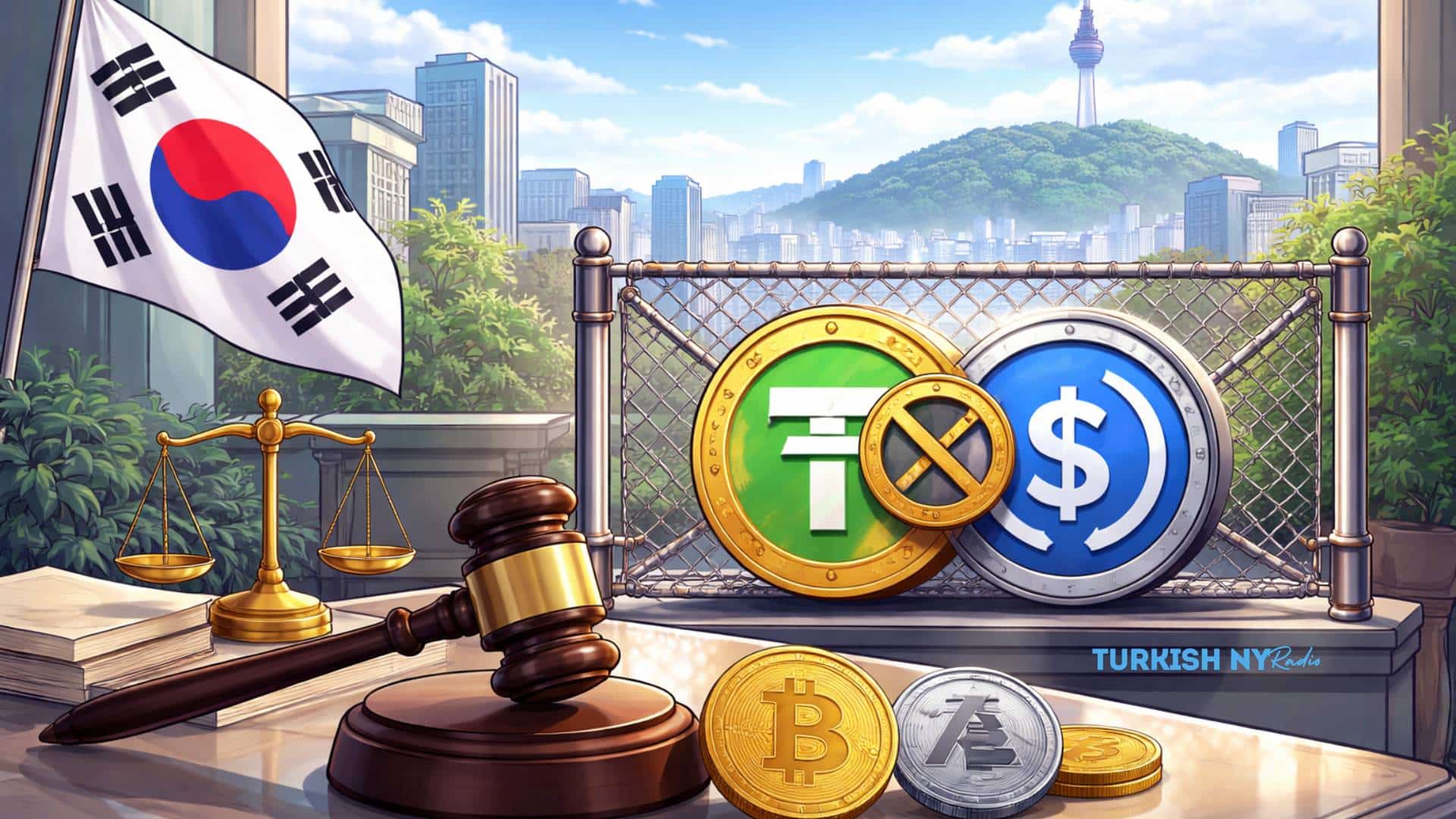
South Korea Moves to Block USDT and USDC From Corporate Trading

Jonathan Swift by Jonathan Swift
9 March 2026
in Economy, Business, Cryptocurrency
Reading Time: 4 mins read
0
South Korea Moves to Block USDT and USDC From Corporate Trading

This article was first published on TurkishNY Radio.

South Korea is moving closer to opening parts of its crypto market to corporate participants, but the door does not appear ready to swing wide for dollar-backed stablecoins. Local reporting says regulators are drafting corporate trading guidelines that would leave out USDT and USDC, even as listed firms and professional investors gain a path into selected digital assets.


Table of Contents

Toggle
    • YOU MAY BE INTERESTED
    • SBF Pardon Request Revives FTX Token Speculation as FTT Rallies
    • Crypto Tax Relief Debate Raises Big Questions for Bitcoin and Stablecoin Payments
  • Why South Korea Is Holding Back Stablecoins
  • South Korea Stablecoin Rules Reflect a Careful Opening
  • Conclusion
  • Frequently Asked Questions
    • Glossary of Key Terms

YOU MAY BE INTERESTED

SBF Pardon

SBF Pardon Request Revives FTX Token Speculation as FTT Rallies

9 June 2026
Crypto tax relief

Crypto Tax Relief Debate Raises Big Questions for Bitcoin and Stablecoin Payments

9 June 2026

That makes this story bigger than a narrow policy tweak. It is quickly turning into a test of how South Korea wants crypto to grow: inside a controlled framework, under local rules, and with as little friction as possible around foreign-exchange oversight.

Why South Korea Is Holding Back Stablecoins

The draft framework suggests South Korea stablecoin rules are being shaped by old-fashioned financial plumbing as much as by crypto policy. Under the country’s foreign-exchange regime, cross-border payments are supposed to move through licensed banks.

Stablecoins are not yet recognized as approved external payment instruments, which means allowing companies to hold and use them could create a route around the existing controls. That concern sits at the center of the current debate, and it explains why South Korea stablecoin rules look stricter for USDT and USDC than for major tokens such as Bitcoin and Ethereum.

South Korea Moves to Block USDT and USDC From Corporate Trading

South Korea Stablecoin Rules Reflect a Careful Opening

What makes this important is the timing as South Korea has been preparing a broader legal structure for digital assets, while regulators also try to bring more formal oversight to crypto activity after a series of market shocks and operational failures.

ADVERTISEMENT

Recent comments from officials show a pattern: crypto may be allowed to grow, but only at a pace authorities can supervise. That is the backdrop for South Korea stablecoin rules today. They are not simply anti-crypto. They are part of a wider strategy that favors gradual access, tighter controls, and fewer surprises in a market that still carries reputational and systemic risk.

There is also a monetary angle that cannot be ignored. The Bank of Korea has already signaled that if stablecoins are to expand, authorities would rather begin with won-based products issued by heavily regulated banks. Senior Deputy Governor Ryoo Sang-dai said,

“It is desirable to first allow banks, which are under a high level of regulations, to issue (won-based stablecoins) and gradually expand to the non-bank sector with the experience.”

South Korea Moves to Block USDT and USDC From Corporate Trading

The market implication is simple enough. South Korea stablecoin rules may slow stablecoin adoption at the corporate level, but they do not shut the crypto story down. Instead, they redraw the map. Bitcoin and Ethereum remain closer to the center of the approved lane, while USDT and USDC sit outside it for now.

That creates a more selective market structure, one where compliance and local monetary priorities carry as much weight as innovation. South Korea stablecoin rules, in that sense, are less about fear and more about control. That may frustrate some firms, but it also tells investors exactly where Seoul wants the next phase of crypto to go.

Conclusion

South Korea is not closing the curtain on digital assets. It is adjusting the script. By ringfencing corporate crypto access while keeping dollar stablecoins on the sidelines, policymakers are signaling that expansion will happen, but only on terms they believe fit the country’s financial system. That makes South Korea stablecoin rules one of the clearest policy stories in Asia right now, because they show how regulation can welcome crypto and restrain it at the same time.

Frequently Asked Questions

What are South Korea stablecoin rules?
They refer to the reported draft approach that may exclude USDT and USDC from corporate crypto trading guidelines.

Why would USDT and USDC be excluded?
Because current foreign-exchange law does not clearly recognize them as approved payment tools for cross-border use.

Does this mean South Korea is banning crypto for companies?
No. The reported framework still points to controlled corporate access for selected digital assets.

Glossary of Key Terms

Stablecoin: A crypto asset designed to hold a steady value, often near $1.

USDT: A dollar-backed stablecoin issued by Tether.

USDC: A dollar-backed stablecoin issued by Circle.

Foreign-exchange controls: Rules that govern how money moves across borders.

Corporate crypto trading guidelines: Proposed rules for how companies may buy, hold, or trade digital assets in a regulated setting.

Sources

Reuters

Crypto Briefing

Disclaimer: This article is for informational purposes only and does not constitute financial, legal, or investment advice. Regulatory proposals can change before formal adoption.


Tags: South KoreastablecoinUSDCusdt
ShareTweetSharePinSend
Previous Post

Top Layer 1 Blockchains: What to Look For Before You Trust a Network

Next Post

SEC Crypto Pressure Eases as Justin Sun Invests $75M in Trump-Linked DeFi Project

Jonathan Swift

Jonathan Swift

A crypto journalist with an understanding of blockchain technology. Skilled in simplifying complex topics for diverse audiences, from beginners to experts. Because I believe in words as they are the children of mind.

SIMILAR NEWS

SBF Pardon
Cryptocurrency

SBF Pardon Request Revives FTX Token Speculation as FTT Rallies

9 June 2026
Crypto tax relief
Cryptocurrency

Crypto Tax Relief Debate Raises Big Questions for Bitcoin and Stablecoin Payments

9 June 2026
FCA crypto rules
World

UK Crypto Regulations Advance as FCA Proposes 10% Crypto ETN Allocation for Retail Funds

9 June 2026

Leave a Reply Cancel reply

Your email address will not be published. Required fields are marked *

Search

No Result
View All Result
DMCA
PROTECTED

Categories

  • Business
  • Cryptocurrency
  • Economy
  • en
  • News
  • Politics
  • World

Recent Posts

  • SBF Pardon Request Revives FTX Token Speculation as FTT Rallies
  • Crypto Tax Relief Debate Raises Big Questions for Bitcoin and Stablecoin Payments
  • UK Crypto Regulations Advance as FCA Proposes 10% Crypto ETN Allocation for Retail Funds
  • World Cup Prediction Markets Hit $2B as Spain and France Lead Trader Odds
  • Tokenized Bonds Hong Kong Gain Momentum as HKMA Launches New Expert Group
TurkishNY Radio

Site Navigation

  • Home
  • About Us
  • Terms and Conditions
  • Privacy Policy
  • Disclaimer
  • Contact

TurkishNY Radio

Banner 1
Banner 2
No Result
View All Result
  • Home
  • Cryptocurrency
  • Business
  • Economy
  • tr Türkçe
  • en English

  • English