• Home
  • About Us
  • Terms and Conditions
  • Privacy Policy
  • Disclaimer
  • Contact
6 June Saturday, 2026
  • tr Türkçe
  • en English
TurkishNY Radio
No Result
View All Result
  • Home
  • Cryptocurrency
  • Business
  • Economy
  • Home
  • Cryptocurrency
  • Business
  • Economy
No Result
View All Result
  • tr Türkçe
  • en English
TurkishNY Radio
No Result
View All Result
Bitcoin Bitcoin (BTC) $61,644.15 ↑ 1.46%
Ethereum Ethereum (ETH) $1,593.63 ↑ 1.86%
Tether USDt Tether USDt (USDT) $1.00 ↓ -0.02%
BNB BNB (BNB) $579.40 ↑ 1.20%
USDC USDC (USDC) $1.00 ↓ 0.00%
XRP XRP (XRP) $1.12 ↑ 2.93%
Solana Solana (SOL) $63.78 ↑ 1.29%
TRON TRON (TRX) $0.32 ↑ 1.21%
Hyperliquid Hyperliquid (HYPE) $57.89 ↓ -1.85%
Dogecoin Dogecoin (DOGE) $0.08 ↑ 3.27%
UNUS SED LEO UNUS SED LEO (LEO) $9.41 ↓ -2.25%
Stellar Stellar (XLM) $0.21 ↑ 8.80%
Canton Canton (CC) $0.17 ↑ 10.96%
Zcash Zcash (ZEC) $378.93 ↑ 2.82%
Cardano Cardano (ADA) $0.16 ↑ 4.42%
Chainlink Chainlink (LINK) $7.58 ↑ 3.75%
Monero Monero (XMR) $294.65 ↓ -3.58%
Dai Dai (DAI) $1.00 ↓ -0.01%
World Liberty Financial USD World Liberty Financial USD (USD1) $1.00 ↑ 0.03%
Toncoin Toncoin (TON) $1.70 ↑ 13.35%
Ethena USDe Ethena USDe (USDe) $1.00 ↓ -0.02%
Bitcoin Cash Bitcoin Cash (BCH) $220.03 ↑ 4.29%
MemeCore MemeCore (M) $3.08 ↑ 7.80%
Hedera Hedera (HBAR) $0.08 ↑ 2.52%
Litecoin Litecoin (LTC) $41.92 ↓ -2.38%
Sui Sui (SUI) $0.75 ↑ 7.92%
Avalanche Avalanche (AVAX) $6.77 ↑ 2.94%
PayPal USD PayPal USD (PYUSD) $1.00 ↓ 0.00%
Shiba Inu Shiba Inu (SHIB) $0.00 ↑ 2.92%
Cronos Cronos (CRO) $0.06 ↑ 3.20%
Tether Gold Tether Gold (XAUt) $4,299.09 ↓ -0.01%
Global Dollar Global Dollar (USDG) $1.00 ↓ 0.00%
NEAR Protocol NEAR Protocol (NEAR) $1.86 ↓ -4.97%
Bittensor Bittensor (TAO) $202.84 ↑ 5.42%
PAX Gold PAX Gold (PAXG) $4,307.71 ↓ -0.16%
Humanity Humanity (H) $0.70 ↑ 20.40%
World Liberty Financial World Liberty Financial (WLFI) $0.06 ↑ 0.98%
DeXe DeXe (DEXE) $20.64 ↑ 5.32%
Mantle Mantle (MNT) $0.52 ↑ 0.54%
Ripple USD Ripple USD (RLUSD) $1.00 ↑ 0.01%
Aster Aster (ASTER) $0.63 ↑ 2.04%
Ondo Ondo (ONDO) $0.34 ↑ 2.15%
Polkadot Polkadot (DOT) $0.96 ↑ 1.91%
Uniswap Uniswap (UNI) $2.53 ↑ 4.62%
Worldcoin Worldcoin (WLD) $0.45 ↑ 5.36%
OKB OKB (OKB) $70.34 ↑ 1.55%
USDD USDD (USDD) $1.00 ↑ 0.02%
Pi Pi (PI) $0.13 ↑ 4.05%
Internet Computer Internet Computer (ICP) $2.35 ↑ 4.74%
Sky Sky (SKY) $0.06 ↓ -4.38%
Bitget Token Bitget Token (BGB) $1.84 ↑ 0.65%
Pepe Pepe (PEPE) $0.00 ↑ 2.82%
Ethereum Classic Ethereum Classic (ETC) $6.93 ↑ 2.76%
United Stables United Stables (U) $1.00 ↑ 0.04%
Aave Aave (AAVE) $62.32 ↑ 3.84%
Ethena Ethena (ENA) $0.09 ↑ 0.96%
Cosmos Cosmos (ATOM) $1.67 ↑ 2.06%
Render Render (RENDER) $1.64 ↑ 0.78%
Morpho Morpho (MORPHO) $1.69 ↑ 2.67%
KuCoin Token KuCoin Token (KCS) $6.28 ↑ 2.85%
Polygon (prev. MATIC) Polygon (prev. MATIC) (POL) $0.08 ↑ 3.81%
Algorand Algorand (ALGO) $0.09 ↑ 1.68%
Kaspa Kaspa (KAS) $0.03 ↓ -0.60%
Quant Quant (QNT) $68.24 ↑ 5.69%
币安人生 币安人生 (币安人生) $0.82 ↑ 21.64%
Stable Stable (STABLE) $0.03 ↑ 9.68%
Venice Token Venice Token (VVV) $16.14 ↓ -8.95%
JUST JUST (JST) $0.08 ↑ 1.83%
GateToken GateToken (GT) $6.24 ↑ 0.52%
Audiera Audiera (BEAT) $2.27 ↑ 26.96%
siren siren (SIREN) $0.86 ↑ 21.87%
XDC Network XDC Network (XDC) $0.03 ↑ 1.51%
Filecoin Filecoin (FIL) $0.75 ↑ 3.97%
Flare Flare (FLR) $0.01 ↑ 3.16%
Aptos Aptos (APT) $0.67 ↑ 3.25%
Injective Injective (INJ) $5.28 ↑ 4.38%
Midnight Midnight (NIGHT) $0.03 ↑ 2.87%
Pump.fun Pump.fun (PUMP) $0.00 ↑ 6.97%
Arbitrum Arbitrum (ARB) $0.08 ↑ 3.75%
Jupiter Jupiter (JUP) $0.15 ↓ -0.11%
TrueUSD TrueUSD (TUSD) $1.00 ↓ -0.02%
Nexo Nexo (NEXO) $0.76 ↑ 2.51%
Artificial Superintelligence Alliance Artificial Superintelligence Alliance (FET) $0.21 ↑ 6.48%
EURC EURC (EURC) $1.15 ↓ -0.13%
Dash Dash (DASH) $33.11 ↑ 6.59%
Pudgy Penguins Pudgy Penguins (PENGU) $0.01 ↑ 7.77%
VeChain VeChain (VET) $0.00 ↑ 2.77%
PancakeSwap PancakeSwap (CAKE) $1.23 ↑ 6.47%
OFFICIAL TRUMP OFFICIAL TRUMP (TRUMP) $1.61 ↑ 1.13%
Bonk Bonk (BONK) $0.00 ↑ 1.63%
Terra Classic Terra Classic (LUNC) $0.00 ↑ 15.98%
Virtuals Protocol Virtuals Protocol (VIRTUAL) $0.56 ↑ 3.45%
Lighter Lighter (LIT) $1.39 ↓ -0.97%
Kite Kite (KITE) $0.19 ↑ 9.22%
Sei Sei (SEI) $0.05 ↑ 2.59%
First Digital USD First Digital USD (FDUSD) $1.00 ↑ 0.02%
Stacks Stacks (STX) $0.19 ↑ 6.29%
Sun [New] Sun [New] (SUN) $0.02 ↑ 1.33%
LayerZero LayerZero (ZRO) $0.91 ↓ -4.95%
Aerodrome Finance Aerodrome Finance (AERO) $0.33 ↑ 2.48%
Home News

South Korean Stock Market Crash Triggers Circuit Breaker After 8% Plunge

Areeba Rashid by Areeba Rashid
5 March 2026
in News, Cryptocurrency, Economy
Reading Time: 5 mins read
0
KOSPI

This article was first published on TurkishNY Radio.

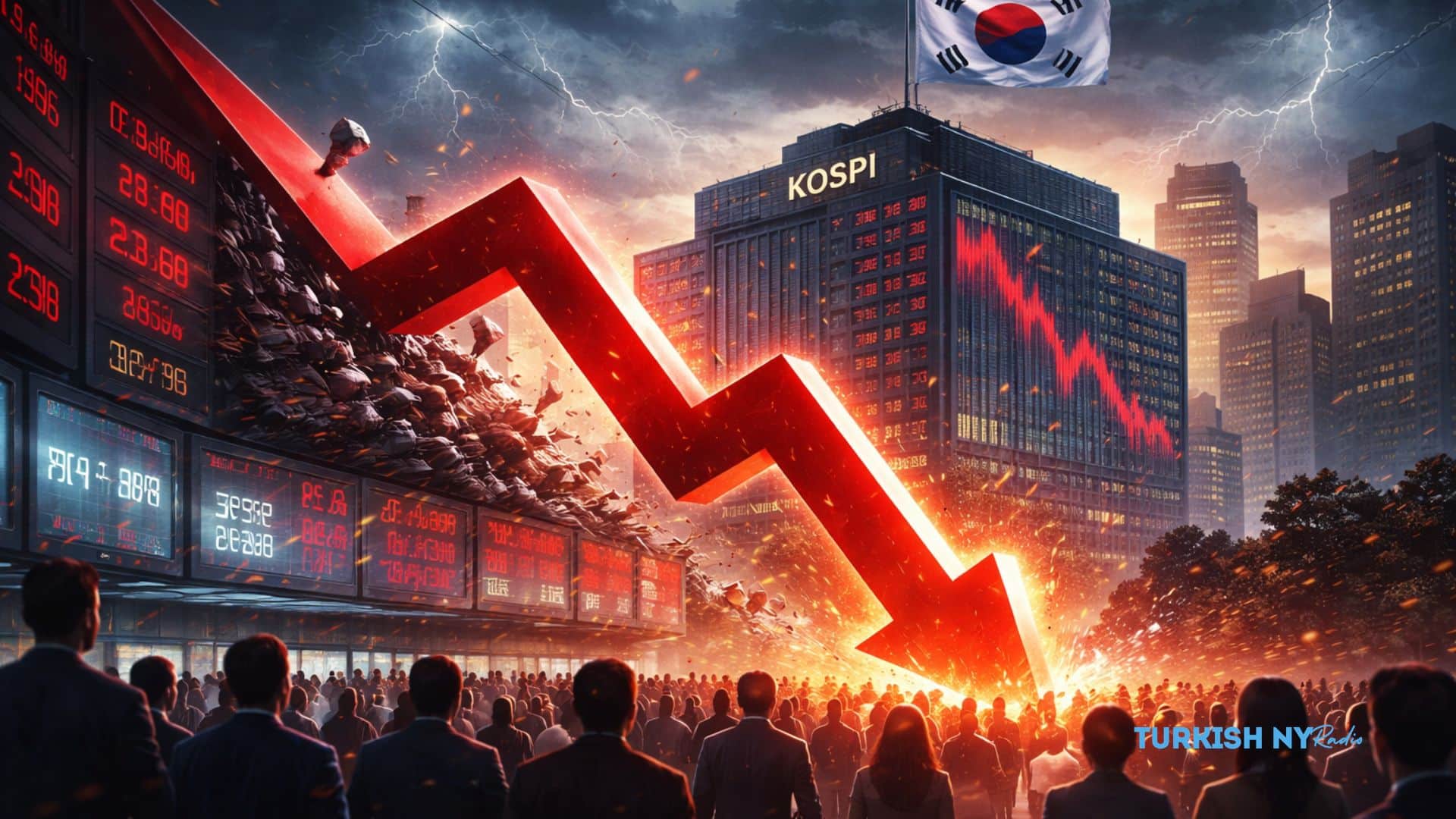
The South Korean stock market crash has caught the attention of global investors after the country’s stock exchange index fell by over 8% within a short period of time.


Table of Contents

Toggle
    • YOU MAY BE INTERESTED
    • How to Buy USDC in 2026: Complete Guide to Buying, Storing and Using Digital Dollars Safely
    • How to Buy TRX Safely: A Clear 2026 Guide for TRON Users
  • South Korean Stock Market Crash Triggers Circuit Breaker Halt
  • Circuit Breaker Activated to Calm Markets
  • Iran Conflict Adds Pressure to Global Equities
  • Margin Debt Amplifies Market Losses
  • AI Boom Previously Drove Market Rally
  • Analysts Warn of Uncertain Market Outlook
  • Economic Risks Add to Market Concerns
  • Government Policy Under Scrutiny
  • Conclusion
  • Appendix Glossary of key terms
  • Frequently Asked Questions About South Korean stock market crash
    • 1- What caused the South Korean stock market crash?
    • 2- Why was trading halted?
    • 3- What is a circuit breaker in stock markets?
    • 4- How does the crash affect global markets?
      • References 

YOU MAY BE INTERESTED

How to Buy USDC

How to Buy USDC in 2026: Complete Guide to Buying, Storing and Using Digital Dollars Safely

6 June 2026
How to Buy TRX Safely: A Clear 2026 Guide for TRON Users

How to Buy TRX Safely: A Clear 2026 Guide for TRON Users

6 June 2026

The South Korean stock market crash happened at a time when the country’s stock exchange had been performing remarkably over the past few months.

South Korean Stock Market Crash Triggers Circuit Breaker Halt

As a result of the stock exchange index falling by over 8%, the stock exchange suspended trade on the stock exchange. The halt happened after the stock exchange index fell by over 8%. The halt is meant to help investors analyze the situation before trade can resume.

Several factors contributed to the South Korean stock market crash. The factors include geopolitical tensions, inflation, and margin debt levels.

The chances of a South Korean stock market crash have a great potential to affect investor sentiments across Asia and even globally. This is because South Korea is one of the key economies in the Asian continent.
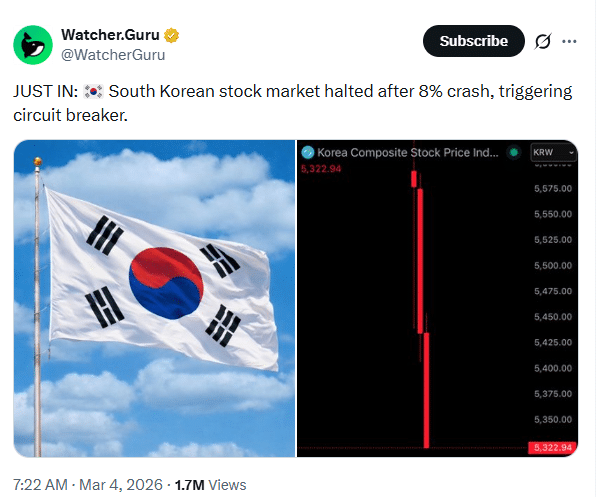
South Korean Stock Market Crash
Source: X

At a time when there is increased volatility in the South Korean stock exchange market, investor sentiments across the world are affected. This is because fund managers across the world invest their funds accordingly.

Circuit Breaker Activated to Calm Markets

The exchange activated a circuit breaker after the market plunged past the critical level. During a South Korean stock market crash, this mechanism pauses trading for a short period.

The goal is to slow panic selling. It also prevents automated trading systems from accelerating losses. Once trading resumes, investors often reassess prices and risks.

Iran Conflict Adds Pressure to Global Equities

Geopolitical tensions have also contributed to the market’s decline. The ongoing conflict with Iran has made investors fear an increase in oil prices. This could impact inflation and economic growth.

These issues have impacted stock exchanges across the globe. The South Korean stock market crash has resulted because of global investors’ cautious attitude.

Margin Debt Amplifies Market Losses

One major reason behind the sharp fall is record levels of margin debt. Many retail investors had borrowed money to buy stocks during the recent rally.

When markets dropped, these leveraged positions faced forced liquidation. This triggered additional selling pressure. As a result, the South Korean stock market crash accelerated quickly.

AI Boom Previously Drove Market Rally

Earlier in the year, the Korean stock market showed impressive gains. The optimism of investors regarding the prospects of artificial intelligence helped boost the stock market.

South Korea is known to be one of the biggest manufacturers of semiconductor chips in the world. The companies that specialize in the technology sector showed impressive gains in the stock market. The Kospi stock exchange index showed gains of almost 50% before the decline in the stock market.

Analysts Warn of Uncertain Market Outlook

The current state of the stock market is hard to predict, according to market experts. The rapid fluctuations in the stock prices have made it hard to forecast the market in the short term.

According to An Hyungjin, the chief executive of Billionfold Asset Management in Seoul, the stock market has been showing extreme moves. According to him, the stock market has seen cautious investors as bids in the market begin to dwindle. The stock market crash in Korea has seen a sudden shift from optimism to fear among the investors.

Economic Risks Add to Market Concerns

Economic uncertainty has also added pressure on Korean stocks. The assumption is that the Bank of Korea may choose to hike interest rates to curb inflation.

Energy imports are one sector in which the Korean economy may feel the pinch. The Korean economy has to rely heavily on energy imports, and any rise in oil prices is a matter of concern.

These are the factors that led to the South Korean stock market crash and may be responsible for its performance in the near future.

Government Policy Under Scrutiny

Government policies may also be one of the factors that contribute to the stability or lack of stability in the stock exchange market. The South Korean government, led by President Lee Jae Myung, has been encouraging investment in the stock exchange market. 
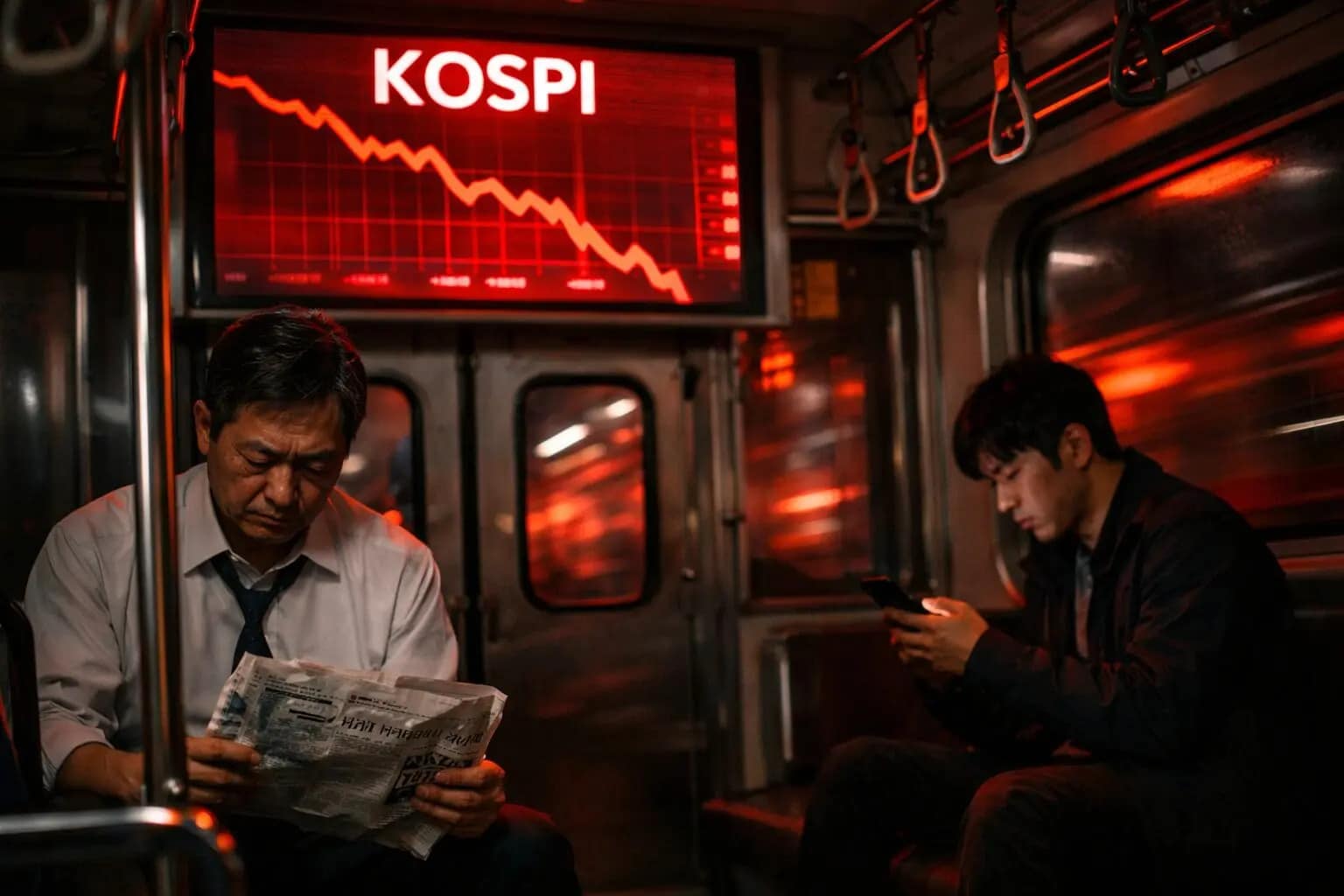
Stock market crash

The government has been encouraging people to invest in the stock exchange market instead of investing in real estate. However, the South Korean stock market crash has raised questions regarding the government’s intervention in the market if the situation persists.

ADVERTISEMENT

Conclusion

The South Korean stock market crash is a clear indicator that markets can change in a very short period. High levels of optimism, fueled by the demand for technology and investors’ leverage, can easily turn into fear if there are market risks.

Appendix Glossary of key terms

Circuit Breaker: It is a system that is used by stock exchanges to stop trading in a market when a sharp decline is noted.

Kospi Index: It is a key stock index of the Korean stock market.

Margin Debt: It is money borrowed by an investor from a broker for investing in stocks or any other security.

Market Volatility: It is a sudden and unpredictable fluctuation in financial markets.

Sell-Off: It is a sudden and wide-scale sale of stocks that results in a sharp decline in their prices.

Frequently Asked Questions About South Korean stock market crash

1- What caused the South Korean stock market crash?

The crash was driven by geopolitical tensions, high margin debt, and rising inflation concerns.

2- Why was trading halted?

Trading stopped because the exchange triggered a circuit breaker after the index dropped more than 8%.

3- What is a circuit breaker in stock markets?

It is a system in which trading is halted during high volatility in the market.

4- How does the crash affect global markets?

South Korea is one of the biggest technology and manufacturing centers in the world. Large fluctuations in the stock market have a global effect on investors.

References 

Coinomedia

Bloomberg

Tags: asian stock market volatilityglobal market volatilitykospi crashkospi selloffmargin debt crisissouth korea circuit breakersouth korean stock market crash
ShareTweetSharePinSend
Previous Post

Kraken Secures Federal Reserve Account, Bringing Faster USD Settlement

Next Post

APEMARS Stage 10 Shows 5,923% ROI, Emerging as the Best Crypto to Buy Now While SHIB and Snek Gain Momentum

Areeba Rashid

Areeba Rashid

SIMILAR NEWS

How to Buy USDC
Economy

How to Buy USDC in 2026: Complete Guide to Buying, Storing and Using Digital Dollars Safely

6 June 2026
How to Buy TRX Safely: A Clear 2026 Guide for TRON Users
News

How to Buy TRX Safely: A Clear 2026 Guide for TRON Users

6 June 2026
image 181
Sponsored Article

Regret Missing Bitcoin and Litecoin? Don’t Miss APEMARS – Next 100x Crypto With $515K+ Raised and 916% ROI Potential

5 June 2026

Leave a Reply Cancel reply

Your email address will not be published. Required fields are marked *

Search

No Result
View All Result
DMCA
PROTECTED

Categories

  • Business
  • Cryptocurrency
  • Economy
  • en
  • News
  • Politics
  • Sponsored Article
  • World

Recent Posts

  • How to Buy USDC in 2026: Complete Guide to Buying, Storing and Using Digital Dollars Safely
  • How to Buy TRX Safely: A Clear 2026 Guide for TRON Users
  • Regret Missing Bitcoin and Litecoin? Don’t Miss APEMARS – Next 100x Crypto With $515K+ Raised and 916% ROI Potential
  • June 8 Wave Is Coming: Why Moo Deng, Toshi, and APEMARS Are Capturing Interest – Best Crypto Presale to Buy Now Ends in 6 Hours
  • Top 10 Cryptos to Watch Before the Next Market Rally: APEMARS Takes #1 Spot as the Best Crypto Presale to Buy – Presale Ends in 6 Hours
TurkishNY Radio

Site Navigation

  • Home
  • About Us
  • Terms and Conditions
  • Privacy Policy
  • Disclaimer
  • Contact

TurkishNY Radio

Banner 1
Banner 2
No Result
View All Result
  • Home
  • Cryptocurrency
  • Business
  • Economy
  • tr Türkçe
  • en English

  • English