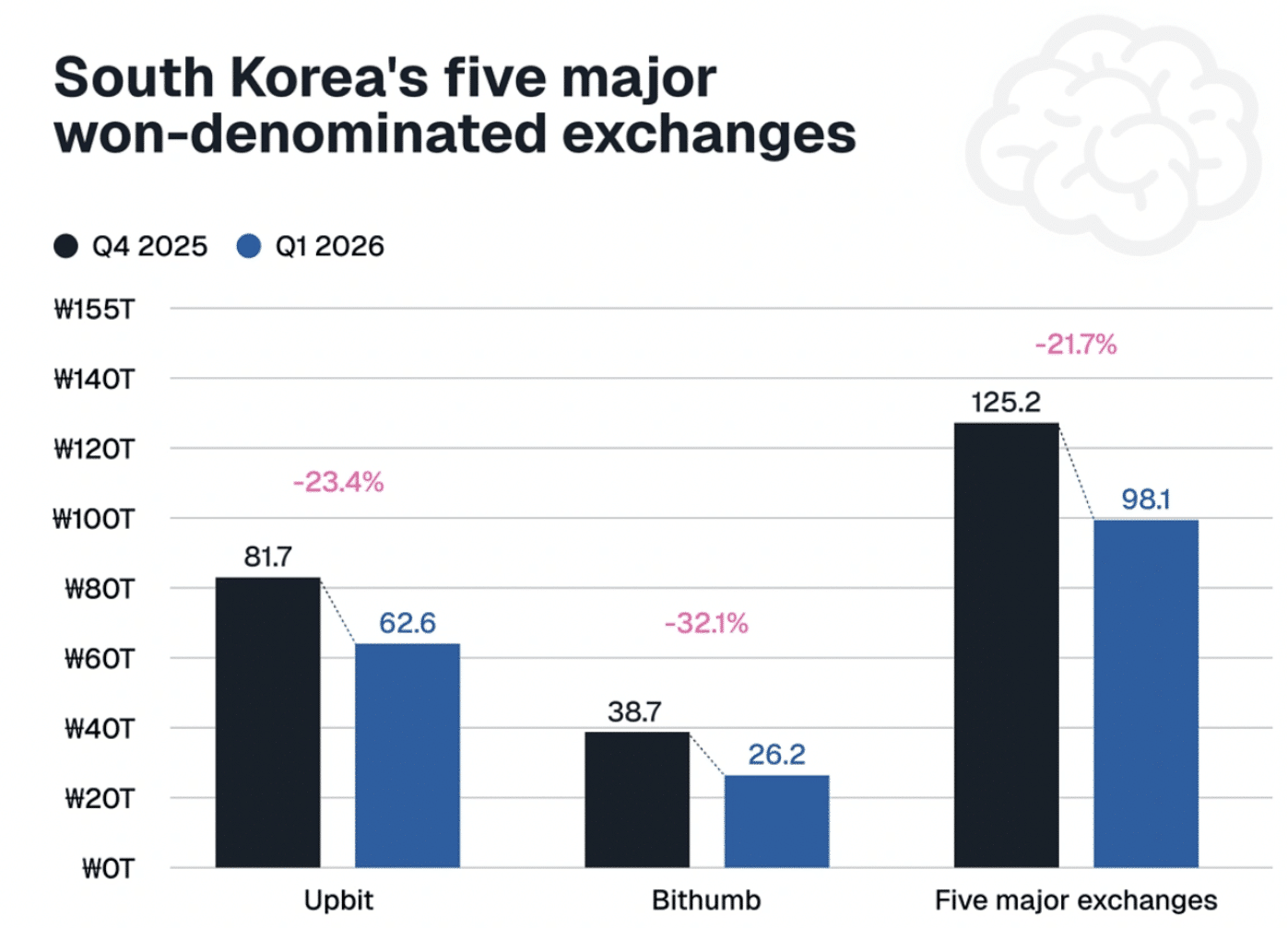
South Korea’s crypto sector is showing signs of a sharp slowdown, but the numbers point to a market in transition rather than a full retreat. Average monthly trading volume across the country’s five main won-based exchanges fell from ₩125.2 trillion in Q4 2025 to ₩98.1 trillion in Q1 2026, marking a 21.7% quarterly drop.
The pullback comes at a sensitive time for the South Korea crypto market, which has long been known for active retail traders, fast-moving altcoin demand, and strong local exchange liquidity. Yet the latest decline suggests that traders are becoming more selective as global risk appetite weakens, local regulation tightens, and capital moves toward more stable financial products.


South Korea Crypto Market Faces a Volume Reset
The South Korea crypto market has not lost its relevance, but it is clearly losing some of the speculative heat that defined earlier cycles. Upbit and Bithumb remain dominant, together with other major won-based platforms, but activity has slowed across the exchange landscape.
A drop from ₩125.2 trillion to ₩98.1 trillion is not a small correction. It shows that traders are pulling back from rapid-fire spot trading, especially in a quarter when the wider crypto market also struggled. Global crypto market value fell in Q1 2026, while centralized exchange activity weakened as investors became more defensive.
For Korean traders, that defensive mood has a local flavor. Equity markets have drawn fresh attention, helped by strong demand for AI-linked semiconductor stocks. When investors see clearer momentum in shares tied to chips, data centers, and artificial intelligence, crypto has to work harder to win capital.
Why Retail Traders Are Stepping Back
Retail fatigue is one of the biggest signals behind the slowdown. The South Korea crypto market still has a large user base, but many casual traders appear less willing to chase short-term rallies after months of weak price action.
This matters because Korea’s crypto culture has often been retail-led. Local traders have helped create deep liquidity in altcoins, fast price moves, and what many call the “kimchi premium” during heated periods. When that crowd becomes cautious, trading volume drops quickly.
There is also a trust factor as investors are watching exchange operations, listing quality, custody standards, and regulatory moves more closely. In a mature market, users do not only ask whether an asset can pump. They ask whether the venue is safe, whether liquidity is reliable, and whether regulation could change the rules overnight.
Stablecoins Add a New Layer to Korea’s Crypto Shift
The South Korea crypto market is also seeing growing interest in stablecoin infrastructure. This is important because stablecoins often act as the plumbing of digital finance. They support settlement, hedging, payments, and institutional movement between assets.
Won-linked stablecoins are becoming part of the policy debate, and that could shape how Korea competes in Asia’s digital asset race. If stablecoins develop under clear rules, they may help keep liquidity onshore and give institutions a safer route into blockchain-based finance.
Still, stablecoins are not a magic fix as regulators must balance innovation with consumer protection, reserve quality, and financial stability. A rushed framework could create risk, while a slow one could push activity offshore. That is the tightrope Korea now has to walk.

Regulation Could Decide the Next Phase
The South Korea crypto market is moving into a more regulated era. Policymakers are working toward clearer digital asset rules, including stronger oversight for exchanges and stablecoin-related activity.
That shift may reduce speculative volume in the short run. Traders who thrived on looser conditions may lose interest. But stronger rules could also attract banks, asset managers, and payment firms that need legal clarity before entering the sector.
In plain terms, less noise could make room for deeper money. That is not as exciting as a sudden altcoin rally, but it may be healthier for long-term market structure.
Key Indicators Traders Should Watch
Volume remains the first indicator. If won-based exchange volume keeps falling below ₩98.1 trillion in coming quarters, it may show deeper retail weakness. If it stabilizes, the South Korea crypto market may be finding a new base.
Stablecoin activity is another key signal, especially daily volume, issuer quality, and institutional usage. Exchange market share also matters because high concentration can help liquidity but may raise regulatory concerns.
Bitcoin dominance, altcoin turnover, and capital flows into Korean equities should also be watched. Together, they show whether crypto is competing well against other risk assets.
Conclusion
The decline in South Korea’s crypto trading volume is a warning, but not a collapse. The market is becoming less impulsive and more infrastructure-driven. Retail traders are stepping back, institutions are watching more closely, and regulators are preparing the next rulebook.
For the South Korea crypto market, the real test is whether lower volume becomes a sign of fading demand or a cleaner foundation for regulated growth. Right now, the answer sits somewhere in the middle.
Frequently Asked Questions
Why did South Korea’s crypto trading volume fall?
It fell as retail traders became cautious, global crypto activity weakened, and investors moved toward equities, stablecoins, and safer assets.
Is the South Korea crypto market still important?
Yes. The South Korea crypto market remains one of Asia’s most active digital asset hubs, even with lower Q1 2026 volume.
Could regulation help Korean crypto exchanges?
Clear rules could reduce risky trading but may attract larger institutional players over time.
Glossary of Key Terms
Trading Volume: The total value of crypto bought and sold during a period.
Stablecoin: A crypto asset designed to track a fiat currency such as ₩ or $1.
Retail Trader: An individual investor trading with personal funds.
Liquidity: How easily an asset can be bought or sold without large price moves.
Sources
Disclaimer: This article is for informational purposes only and does not offer financial advice. Cryptocurrency trading carries high risk, and readers should do independent research before making investment decisions.