• Home
  • About Us
  • Terms and Conditions
  • Privacy Policy
  • Disclaimer
  • Contact
15 June Monday, 2026
  • tr Türkçe
  • en English
TurkishNY Radio
No Result
View All Result
  • Home
  • Cryptocurrency
  • Business
  • Economy
  • Home
  • Cryptocurrency
  • Business
  • Economy
No Result
View All Result
  • tr Türkçe
  • en English
TurkishNY Radio
No Result
View All Result
Bitcoin Bitcoin (BTC) $65,549.27 ↑ 1.57%
Ethereum Ethereum (ETH) $1,717.18 ↑ 2.37%
Tether USDt Tether USDt (USDT) $1.00 ↑ 0.01%
BNB BNB (BNB) $613.83 ↑ 0.37%
USDC USDC (USDC) $1.00 ↓ -0.01%
XRP XRP (XRP) $1.18 ↑ 3.19%
Solana Solana (SOL) $71.13 ↑ 3.97%
TRON TRON (TRX) $0.32 ↑ 0.74%
Hyperliquid Hyperliquid (HYPE) $66.52 ↑ 9.64%
Dogecoin Dogecoin (DOGE) $0.09 ↑ 1.32%
UNUS SED LEO UNUS SED LEO (LEO) $9.80 ↑ 0.66%
Zcash Zcash (ZEC) $493.91 ↑ 15.71%
Cardano Cardano (ADA) $0.18 ↑ 6.02%
Stellar Stellar (XLM) $0.19 ↑ 2.09%
Monero Monero (XMR) $340.69 ↑ 0.96%
Canton Canton (CC) $0.16 ↑ 2.85%
Chainlink Chainlink (LINK) $8.20 ↑ 3.26%
Dai Dai (DAI) $1.00 ↓ -0.01%
Toncoin Toncoin (TON) $1.76 ↑ 2.34%
Ethena USDe Ethena USDe (USDe) $1.00 ↓ -0.01%
World Liberty Financial USD World Liberty Financial USD (USD1) $1.00 ↓ -0.03%
Bitcoin Cash Bitcoin Cash (BCH) $214.31 ↑ 4.86%
MemeCore MemeCore (M) $2.91 ↓ -2.10%
Hedera Hedera (HBAR) $0.08 ↑ 2.65%
Litecoin Litecoin (LTC) $44.91 ↑ 1.55%
Sui Sui (SUI) $0.79 ↑ 4.09%
NEAR Protocol NEAR Protocol (NEAR) $2.39 ↑ 12.92%
Bittensor Bittensor (TAO) $270.32 ↑ 0.96%
Shiba Inu Shiba Inu (SHIB) $0.00 ↑ 0.26%
Avalanche Avalanche (AVAX) $6.76 ↑ 1.33%
PayPal USD PayPal USD (PYUSD) $1.00 ↓ 0.00%
Cronos Cronos (CRO) $0.06 ↑ 0.35%
Global Dollar Global Dollar (USDG) $1.00 ↑ 0.01%
Tether Gold Tether Gold (XAUt) $4,319.00 ↑ 2.45%
Worldcoin Worldcoin (WLD) $0.59 ↑ 17.13%
PAX Gold PAX Gold (PAXG) $4,330.16 ↑ 2.42%
World Liberty Financial World Liberty Financial (WLFI) $0.06 ↑ 2.79%
Mantle Mantle (MNT) $0.57 ↑ 1.92%
Ondo Ondo (ONDO) $0.38 ↑ 4.96%
Aster Aster (ASTER) $0.63 ↓ -0.35%
Polkadot Polkadot (DOT) $1.00 ↑ 3.23%
Ripple USD Ripple USD (RLUSD) $1.00 ↑ 0.01%
Uniswap Uniswap (UNI) $2.62 ↑ 3.31%
DeXe DeXe (DEXE) $18.97 ↑ 6.34%
OKB OKB (OKB) $75.22 ↑ 1.29%
Pi Pi (PI) $0.13 ↑ 1.10%
Internet Computer Internet Computer (ICP) $2.54 ↑ 0.96%
USDD USDD (USDD) $1.00 ↓ -0.01%
Sky Sky (SKY) $0.06 ↓ -0.44%
Bitget Token Bitget Token (BGB) $1.80 ↑ 0.92%
Audiera Audiera (BEAT) $4.36 ↓ -28.00%
Pepe Pepe (PEPE) $0.00 ↑ 2.49%
Ethereum Classic Ethereum Classic (ETC) $7.25 ↑ 1.64%
Aave Aave (AAVE) $72.94 ↑ 9.88%
Cosmos Cosmos (ATOM) $1.97 ↑ 1.23%
United Stables United Stables (U) $1.00 ↓ -0.02%
Morpho Morpho (MORPHO) $1.98 ↑ 1.47%
Humanity Humanity (H) $0.34 ↑ 7.45%
KuCoin Token KuCoin Token (KCS) $7.13 ↑ 2.34%
Render Render (RENDER) $1.83 ↑ 2.57%
Kaspa Kaspa (KAS) $0.03 ↑ 3.56%
Algorand Algorand (ALGO) $0.09 ↑ 2.92%
Quant Quant (QNT) $68.74 ↓ -0.11%
Stable Stable (STABLE) $0.04 ↓ -0.14%
Polygon (prev. MATIC) Polygon (prev. MATIC) (POL) $0.08 ↑ 2.42%
Ethena Ethena (ENA) $0.09 ↑ 2.63%
Venice Token Venice Token (VVV) $16.06 ↓ -1.96%
GateToken GateToken (GT) $6.86 ↑ 1.65%
币安人生 币安人生 (币安人生) $0.68 ↑ 2.30%
Flare Flare (FLR) $0.01 ↑ 0.35%
JUST JUST (JST) $0.08 ↑ 2.99%
Filecoin Filecoin (FIL) $0.80 ↑ 2.90%
XDC Network XDC Network (XDC) $0.03 ↑ 1.76%
Jupiter Jupiter (JUP) $0.19 ↑ 10.39%
Aptos Aptos (APT) $0.68 ↑ 1.96%
Pump.fun Pump.fun (PUMP) $0.00 ↑ 4.66%
Midnight Midnight (NIGHT) $0.03 ↑ 2.09%
Arbitrum Arbitrum (ARB) $0.09 ↑ 3.79%
Injective Injective (INJ) $5.21 ↑ 1.07%
Nexo Nexo (NEXO) $0.81 ↑ 1.02%
TrueUSD TrueUSD (TUSD) $1.00 ↓ 0.00%
Dash Dash (DASH) $38.76 ↑ 8.62%
Artificial Superintelligence Alliance Artificial Superintelligence Alliance (FET) $0.21 ↓ -0.21%
OFFICIAL TRUMP OFFICIAL TRUMP (TRUMP) $1.99 ↓ -3.09%
PancakeSwap PancakeSwap (CAKE) $1.39 ↑ 2.81%
EURC EURC (EURC) $1.16 ↑ 0.41%
VeChain VeChain (VET) $0.01 ↑ 1.10%
Pudgy Penguins Pudgy Penguins (PENGU) $0.01 ↑ 3.02%
Virtuals Protocol Virtuals Protocol (VIRTUAL) $0.65 ↑ 2.20%
Lighter Lighter (LIT) $1.68 ↑ 5.84%
Bonk Bonk (BONK) $0.00 ↑ 4.46%
Terra Classic Terra Classic (LUNC) $0.00 ↑ 0.66%
Sei Sei (SEI) $0.06 ↑ 2.81%
Aerodrome Finance Aerodrome Finance (AERO) $0.39 ↑ 8.08%
LayerZero LayerZero (ZRO) $1.07 ↑ 14.48%
Curve DAO Token Curve DAO Token (CRV) $0.24 ↑ 2.18%
Kite Kite (KITE) $0.20 ↑ 3.05%
Stacks Stacks (STX) $0.19 ↑ 0.92%
First Digital USD First Digital USD (FDUSD) $1.00 ↓ -0.01%
SKYAI SKYAI (SKYAI) $0.33 ↓ -9.31%
Home Cryptocurrency

Shared Multisig Is Becoming the Smarter Way to Protect Bitcoin in 2025

Jonathan Swift by Jonathan Swift
13 December 2025
in Cryptocurrency, en
Reading Time: 5 mins read
0
Bitcoin ETF Girişleri Birikim Sinyalleri Güçlenirken Artıyor

This article was first published on TurkishNYR.

Most crypto losses are painfully ordinary: a device fails, and a backup disappears. One private key is exposed as in a single-key setup, which can be the end of the story. That is why shared multisig is back in focus for people comparing Bitcoin wallets.


Table of Contents

Toggle
    • YOU MAY BE INTERESTED
    • How a Seed Phrase Helps Protect Crypto From Hackers and Theft
    • How Ethereum Staking Works, Why It Pays Rewards, and Where the Real Risks Sit
  • How shared approvals work in practice
  • What enforces the rule on-chain
  • Why PSBT improved the multisig experience
  • Key indicators that separate strong setups from weak ones
  • The downsides that deserve honest airtime
  • Conclusion
  • Frequently Asked Questions
    • Glossary of key terms
      • References

YOU MAY BE INTERESTED

Seed phrase

How a Seed Phrase Helps Protect Crypto From Hackers and Theft

14 June 2026
How Ethereum Staking Works, Why It Pays Rewards, and Where the Real Risks Sit

How Ethereum Staking Works, Why It Pays Rewards, and Where the Real Risks Sit

14 June 2026

Multisig is shared control: multiple private keys are tied to the same wallet, and a rule is set for spending. A common rule is 2-of-3, meaning 3 keys exist and any 2 can approve a spend for broadcast. Some shared designs allow up to 6 participants with different thresholds such as 1-of-2 or 3-of-4.

How shared approvals work in practice

In many setups, any key holder can initiate a transaction request. In a 2-of-3 arrangement, the initiator is treated as an implicit approval, so only 1 additional participant needs to sign. Stricter rules need more approvals, which slows spending but can block both theft and rash decisions.

This is the point where Bitcoin wallets stop being simple storage tools and start acting like a policy engine. A small business can require 2 approvals for every outgoing payment. A family can split responsibility so one lost key does not automatically mean lost funds.

What enforces the rule on-chain

Multisig is enforced by Bitcoin Script as the network can validate m-of-n signatures using the OP_CHECKMULTISIG opcode.  Developer documentation also notes that the most common use of Pay to Script Hash (P2SH) has been the standard multisig script.
Shared Multisig Is Becoming the Smarter Way to Protect Bitcoin in 2025

That matters because the chain enforces the policy. No company can override it. It also means Bitcoin wallets need reliable signing and recovery flows, because the blockchain will not correct mistakes.

Why PSBT improved the multisig experience

PSBT, the Partially Signed Bitcoin Transaction format, standardized how transaction data and partial signatures can be packaged and shared across tools and signers. The standard was designed so that signers can remain offline, because the bundle can carry the information needed for signing and verification.

For multisig, PSBT also supports collecting signatures separately and later combining them into a final transaction. This is a big reason modern Bitcoin wallets can support shared signing without turning it into a weekend project.

Key indicators that separate strong setups from weak ones

For Bitcoin wallets, multisig support is only the start. The first indicator is key separation. If all keys live on one device, the setup still fails like a single-key wallet during theft or damage.

The second indicator is signer clarity. A good tool shows recipients, amounts, and fees clearly before any signature is added. PSBT guidance describes showing addresses, values, and the transaction fee so a signer understands the intent before signing.
Bitcoin wallets

The third indicator is recovery discipline. Shared custody adds moving parts, so testing a small receive and a small spend is part of responsible setup. Clear documentation for who holds which key, and how recovery works, is not optional.

Another indicator is fee control. When the network is busy, fees can rise fast, and a rigid sender can end up with a transaction that sits unconfirmed. Bitcoin wallets that offer fee customization and clear fee previews help avoid that trap, especially for time-sensitive payments.

A final indicator is how clearly the software communicates finality. Bitcoin settles by confirmations, so Bitcoin wallets should show confirmation depth, the exact destination address, and a clean summary that can be reviewed by every signer before approval.

The downsides that deserve honest airtime

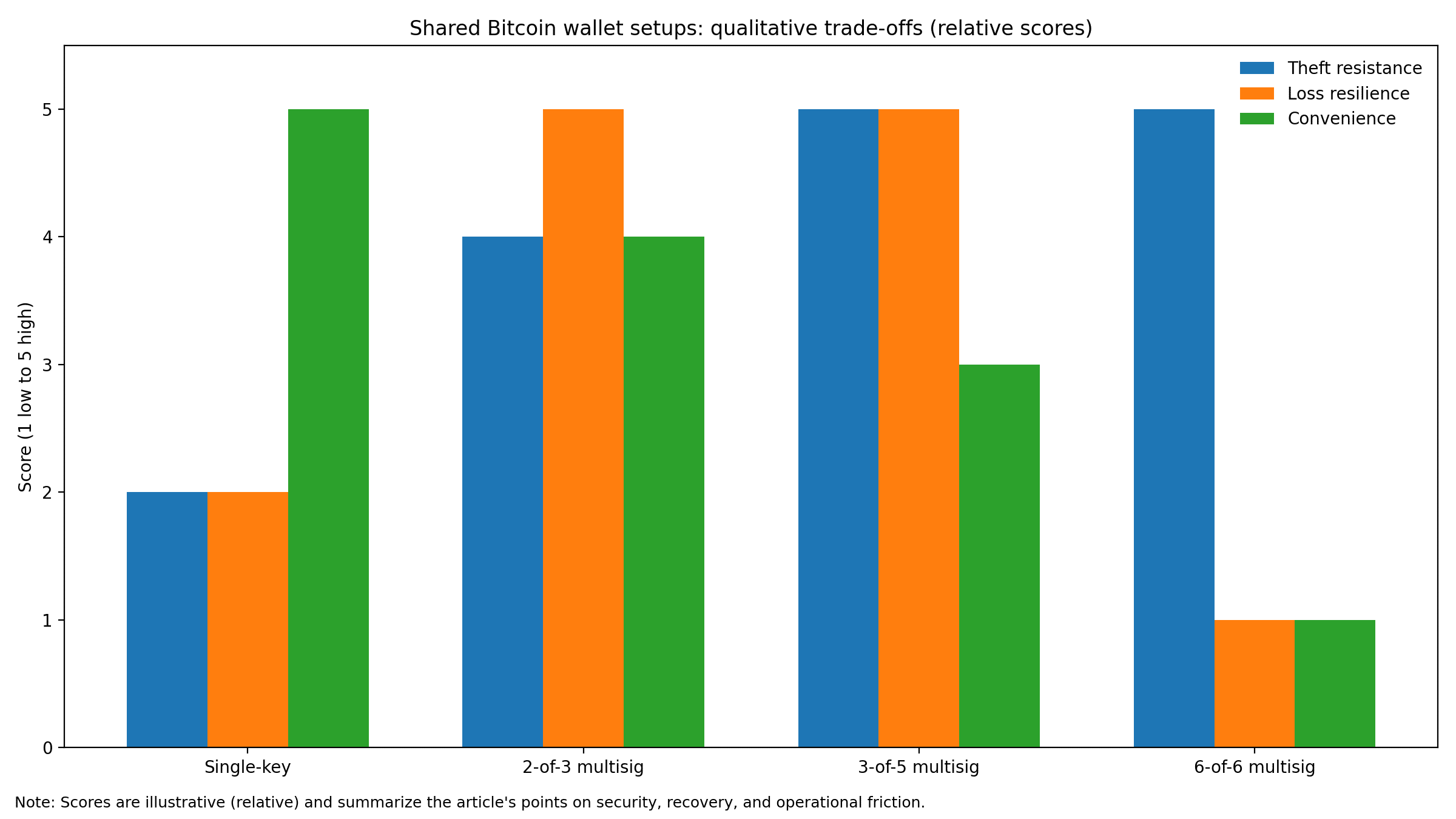
Shared custody is not always safer by default. A strict 6-of-6 rule can increase loss risk: if even 1 participant loses a key, funds can become inaccessible.

There are also practical costs. In shared custody, Bitcoin wallets become a small team project, and the wrong teammate can become the weak link. Participants need basic device security skills. Spending takes longer because approvals must be collected. And once a shared wallet is created, some implementations cannot be modified, so replacing a participant can require creating a new wallet and moving funds.

Conclusion

Shared multisig is a practical answer to the most common self-custody failure mode: a single key that becomes a single disaster. With a thoughtful threshold and well-separated keys, it reduces loss risk and makes theft harder, while keeping control on-chain.

As PSBT-based signing spreads, the gap between strong security and day-to-day usability keeps shrinking. For long-term holders, Bitcoin wallets built around shared control are starting to look like the sensible middle ground between convenience and resilience.

Frequently Asked Questions

What does 2-of-3 mean in multisig?

It means 3 keys exist and any 2 signatures are required to authorize a spend.

How many participants can a shared wallet have?

ADVERTISEMENT

Some shared designs allow up to 6 participants with customizable approval thresholds.

Can a shared wallet be changed after setup?

Some implementations cannot be modified, so changing participants can require creating a new wallet and moving funds.

Why is PSBT important for multisig?

PSBT standardizes how unsigned and partially signed transactions move between signers and tools, including offline signing and signature combining.

Is multisig enforced by the network or by a company?

The rule is enforced by on-chain script that validates multiple signatures.

Glossary of key terms

Multisig: A wallet design that requires multiple signatures to spend funds, commonly described as m-of-n.

Participant: A person or device holding 1 of the private keys in a shared wallet.

PSBT: A standardized format for partially signed transactions that can be passed between tools until fully signed and ready to broadcast.

UTXO: A spendable transaction output that becomes an input in a new transaction; PSBT workflows reference identifying UTXOs to spend.

P2SH: A transaction type that pays to a script hash; it has commonly been used to support multisig scripts.


References

Bitcoincom

Bitcoin Developer Documentation

Tags: bitcoinbitcoin walletsbtcmultisigwalletWallets
ShareTweetSharePinSend
Previous Post

Everyone Wants the Next 100x Meme Coin, but Apeing Might Be the Only Door Left as Pepe Holds Strong and Bonk Heats Up

Next Post

Crypto Whales Rush In Fast: Apeing Titled Best Upcoming Crypto Presale 2026, While ADA and  SUI Skyrocket

Jonathan Swift

Jonathan Swift

A crypto journalist with an understanding of blockchain technology. Skilled in simplifying complex topics for diverse audiences, from beginners to experts. Because I believe in words as they are the children of mind.

SIMILAR NEWS

Seed phrase
Cryptocurrency

How a Seed Phrase Helps Protect Crypto From Hackers and Theft

14 June 2026
How Ethereum Staking Works, Why It Pays Rewards, and Where the Real Risks Sit
News

How Ethereum Staking Works, Why It Pays Rewards, and Where the Real Risks Sit

14 June 2026
How to Buy Ethereum (ETH) in 2026
Cryptocurrency

How to Buy Ethereum (ETH) in 2026: A Beginner’s Guide

13 June 2026

Leave a Reply Cancel reply

Your email address will not be published. Required fields are marked *

Search

No Result
View All Result
DMCA
PROTECTED

Categories

  • Business
  • Cryptocurrency
  • Economy
  • en
  • News
  • Politics
  • World

Recent Posts

  • How a Seed Phrase Helps Protect Crypto From Hackers and Theft
  • How Ethereum Staking Works, Why It Pays Rewards, and Where the Real Risks Sit
  • How to Buy Ethereum (ETH) in 2026: A Beginner’s Guide
  • How To Buy Bitcoin Safely as BTC Adoption Turns Practical
  • Binance Wallet Subscription Draws $557M for Tokenized SpaceX Exposure
TurkishNY Radio

Site Navigation

  • Home
  • About Us
  • Terms and Conditions
  • Privacy Policy
  • Disclaimer
  • Contact

TurkishNY Radio

Banner 1
Banner 2
No Result
View All Result
  • Home
  • Cryptocurrency
  • Business
  • Economy
  • tr Türkçe
  • en English

  • English