


SEC crypto regulation is gaining new momentum after the release of a memorandum from the SEC Crypto Task Force. The document detailed a meeting with DeFi firm Term Finance.
At the same time, a Senate battle highlights sharp political divisions. These divisions continue to shape the future of digital asset oversight in the United States.


Term Finance Model Under SEC Review
The Sept. 15 memo revealed that Term Finance presented its model for fixed-rate lending. This relies on overcollateralized assets and smart contracts for non-custodial execution. SEC officials used legal tests to examine whether the loans resemble securities.
While lawmakers on Capitol Hill debated how to share authorship of the market structure bill, together, these developments highlight how SEC crypto regulation remains at the heart of both technical and political discussions.
Also Read: SEC Streamlines Crypto ETF Listings: Is Bitcoin on the Road to $150K?
SEC Crypto Regulation Examines DeFi Lending
During the meeting, Term Finance explained how its tri-party repurchase structures function and how the platform secures loans with collateral. SEC staff questioned whether these structures fit into existing definitions of securities under federal law.

By applying established frameworks, SEC crypto regulation seeks to create clarity for new decentralized financial models that do not fit neatly into traditional categories.
Application of the Howey and Reves Tests
According to the memo, the Reves test was applied to determine if Term Finance’s loans operate as exempt notes, while the Howey test was used to assess whether protocol tokens might be treated as securities.
Term Finance asked whether retail participation or secondary markets could influence classification, and raised questions about whether interfaces contribute to the “efforts of others” prong in the Howey analysis.
Risk management emerged as a central theme during the talks. Term Finance pointed to its use of overcollateralization requirements, decentralized price oracles, and real-time auditability.
These measures, the firm argued, align with the investor protection principles that are central to SEC crypto regulation. Regulators responded by emphasizing the importance of compliance and transparency, especially when platforms operate without intermediaries.
Interest in Regulatory Sandbox Programs
Term Finance also expressed interest in working with the SEC through regulatory sandbox programs and ongoing reassessments. Such initiatives, the firm argued, would allow companies to test new products while reducing the risk of misclassification.
For regulators, sandbox programs offer a pathway to monitor innovation closely while ensuring SEC crypto regulation remains consistent with investor protection standards.
Broader Outreach by the SEC Task Force
The SEC Crypto Task Force, led by Commissioner Hester Peirce, has been actively engaging with the industry through meetings, roundtables, and public forums. These events have focused particularly on early-stage crypto startups.
A public roundtable scheduled for Oct. 17 will address issues of privacy and financial surveillance. This broader outreach shows how SEC crypto regulation is being shaped not just by enforcement but also by open dialogue.
Senate Democrats Push for Bipartisan Authorship
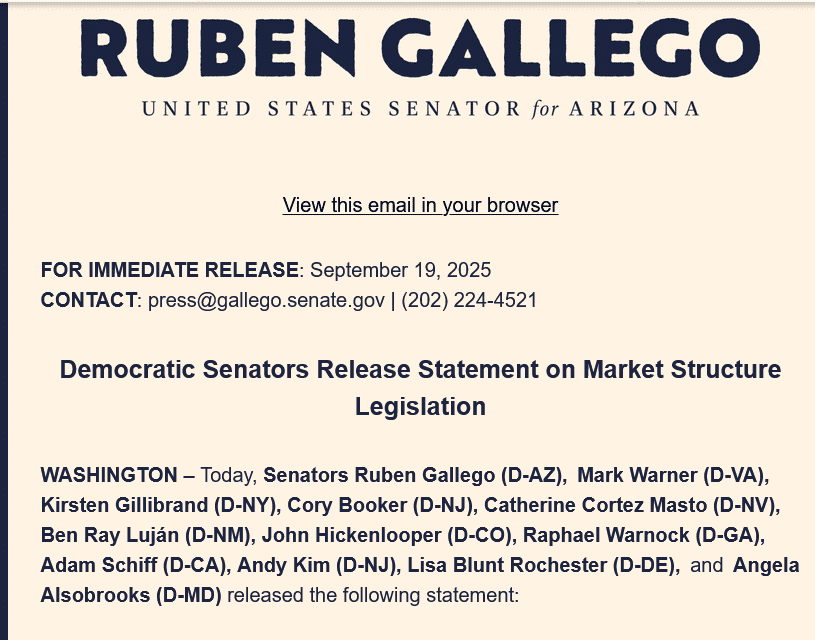
As regulators engage with firms, lawmakers are fighting to the hilt on a crypto market structure bill. Twelve Senate Democrats sent a letter to Republicans demanding that the bill be jointly written by both parties, saying that an effort with so many different components will need input by both sides.
Their request is illustrative of the fear that unilateral authorship would delegitimize, and shows how SEC crypto regulation has been sucked down into a partisan sinkhole.


Competing Legislative Proposals
The Clarity Act, supported by Republicans and already approved in the House, would require the SEC and CFTC to create a Joint EAG for Regulations Parity. The Democratic plan, meanwhile, would extend CFTC oversight to spot markets in non-security tokens.
While leaving SEC crypto regulation responsible for securities-associated assets. The Democratic plan would also prevent lawmakers from starting or benefiting from crypto projects while they are in office, and calls for more funding for regulators.
Implications for Institutions and Markets
Both agree that there should be better rules for digital assets. Crypto advocates of regulatory SEC guidelines contend that such would protect consumers, promote innovation and push institutional adoption.
But critics say that overly severe regulations could send innovation overseas. Institutions need regulatory clarity which is not going to flip flop for larger amounts of capital to flow into the sector.
Conclusion
The observations are representative of a landmark moment for SEC crypto regulation, as evidenced by the recent SEC meeting with Term Finance and ongoing Senate debates. Regulators are experimenting with new models of DeFi within existing legal frameworks.
As legislators fight over how to split the balance of power between the SEC and the CFTC. The results of these conversations will determine how (or whether) firms in crypto can operate, how investors are shielded and how the United States positions itself within the global digital economy.
Also Read: SEC’s Crypto ETF Clash: New Rules Ignite Opportunity and Concern
Summary
A recent SEC memo specified discussions with DeFi firm Term Finance over fixed-rate lending, overcollateralized assets and the evaluation of smart contracts by using both Howey and Reves tests. The discussions focused on risk management, compliance and future sandbox programs for innovation.
Senate Democrats, meanwhile, sought bipartisan credentials for the crypto market structure bill. And they faced off against Republicans over regulatory authority.
Appendix Glossary of Key Terms
SEC Crypto Regulation: Oversight rules for crypto markets enforced by the U.S. SEC.
DeFi: Decentralized finance platforms using blockchain for financial services.
Overcollateralization: Requiring collateral that exceeds the loan value to reduce risk.
Smart Contract: A blockchain-based code that automates agreements.
Howey Test: A legal test to decide if a transaction is an investment contract.
Reves Test: A standard for deciding whether loans are securities.
Clarity Act: Republican-backed bill seeking joint SEC-CFTC oversight.
Frequently Asked Questions about SEC Crypto Regulations
1- What is the main goal of SEC crypto regulation?
It aims to classify digital assets, protect investors, and set compliance standards.
2- What did Term Finance present to the SEC?
A fixed-rate lending model using overcollateralized assets and smart contracts.
3- Which legal tests were applied in the review?
The Howey and Reves tests were used to assess securities classification.
4- Why are lawmakers divided on crypto regulation?
Democrats want bipartisan authorship of the market structure bill, while Republicans back the Clarity Act.