

This article was first published on TurkishNY Radio.
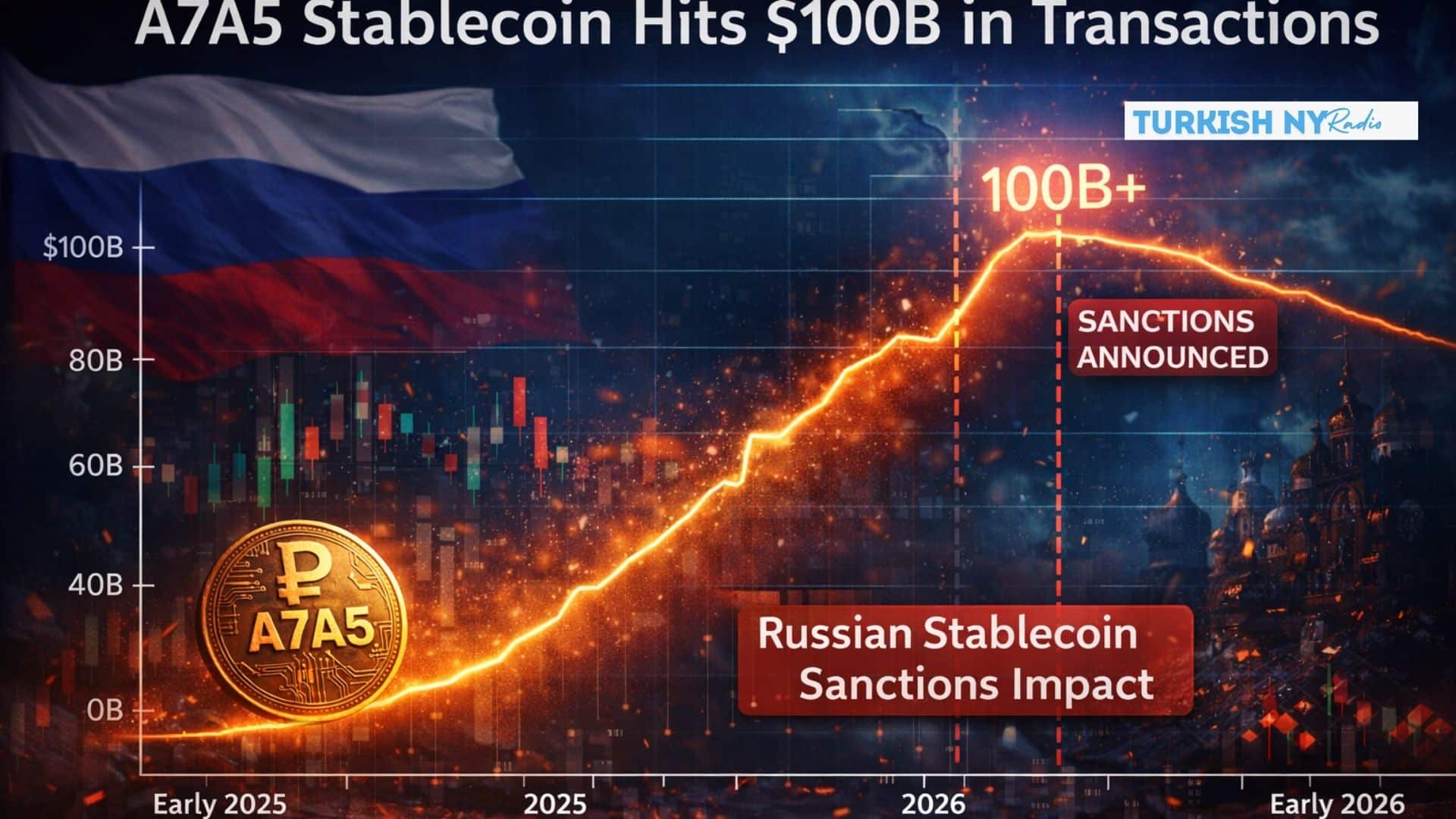
Russian stablecoin restrictions are under increased attention after blockchain analytics startup Elliptic revealed that a ruble-pegged stablecoin completed over $100 billion in payments in less than a year. The A7A5 token appeared secretly at the beginning of 2025 and expanded quickly before being slowed by enforcement pressure.


Elliptic’s findings offer a rare, data-driven look at how sanctioned-linked crypto instruments function in practice, rather than theory, and why Russian stablecoin sanctions remain difficult to enforce despite public blockchains.
Elliptic Data Shows Concentrated, High-Value Flows
According to Elliptic’s analysis, A7A5 reached the $100 billion mark through large, repeated transfers between a relatively small number of wallets, rather than broad retail use. The stablecoin’s total market capitalization remained modest, around $500 million, suggesting the same funds moved repeatedly across the network.
“This pattern is consistent with settlement and treasury-style usage, not consumer payments,” Elliptic researchers noted in the report. That distinction matters, as Russian stablecoin sanctions are primarily designed to disrupt institutional and cross-border financial activity.
Also read: Russia Crypto Regulation Tightens as Moscow Exchanges Prepare for 2026 Trading Rollout
How A7A5 Was Structured
A7A5 is marketed as a ruble-pegged stablecoin which is allegedly backed 1:1 by reserve funds held at Promsvyazbank, a Russian bank now subject to Western sanctions. The coin ran on publicly accessible blockchains, enabling analysts to track movements while also posing enforcement issues.
Elliptic identified A7A5’s primary role as a bridge asset, enabling conversions between rubles and globally liquid stablecoins such as USDT. This bridging function placed the token squarely in the crosshairs of Russian stablecoin sanctions discussions among regulators.


Impact of Sanctions on Activity
Elliptic’s data shows that transaction volumes peaked before sanctions pressure intensified in mid-2025. After that, activity dropped precipitously. Daily on-chain trade has dropped from approximately $1.5 billion daily to around $500 million, and the recent issuance seems to have ceased.
This delay demonstrates that Russian stablecoin restrictions may have a significant impact on consumption, even when commodities are on open blockchains. However, the timing also highlights a persistent challenge: enforcement often follows scale, not precedes it.
Platform Restrictions and Compliance Response
As regulatory risks increased, several crypto platforms took defensive action. Access to A7A5 was restricted on multiple decentralized exchange interfaces, reflecting broader compliance concerns tied to Russian stablecoin sanctions.
A compliance executive at a European crypto firm, speaking generally, explained the approach: “Public blockchain data doesn’t eliminate liability. If a token is clearly linked to sanctioned infrastructure, platforms will disengage.”
Why This Case Matters Beyond Russia
The A7A5 episode is not only about Russia. It underscores how non-dollar stablecoins can function as specialized settlement tools outside traditional banking rails. Russian stablecoin sanctions may have delayed A7A5, but the amount handled prior to compliance indicates how rapidly such networks can expand.
For regulators, the message is clear: sight does not imply control. For the cryptocurrency business, the case emphasizes the importance of clearer rules for fiat-linked tokens that exist in areas of elevated risk.
Conclusion
Russian stablecoin sanctions succeeded in curbing A7A5’s activity, but only after the stablecoin had already facilitated massive transaction volumes. Elliptic’s report shows both the power and the limits of sanctions enforcement in a blockchain environment. As regulators refine their strategies, A7A5 stands as a concrete example of how crypto can reshape cross-border finance before policy catches up.
Also read: The Role of BRICS in Global Crypto Adoption
Summary
Elliptic data indicated that the ruble-pegged stablecoin A7A5 completed more over $100 billion in transactions in a year, highlighting Russian stablecoin sanctions. The token was mostly utilized for big settlement transfers, rather than payments to retailers. Although sanctions subsequently decreased quantities and ceased issuance, the case demonstrates how non-dollar stablecoins may grow quickly, complicating enforcement operations and regulation timing.
Glossary of Key Terms
Stablecoin: Is a crypto created to monitor the worth of the real currency.
A7A5: Is a stablecoin tied to the ruble that will be introduced in 2025.
Elliptic: Is a blockchain intelligence business focusing on money laundering and sanctions investigation.
On-chain data: Refers to the details of transactions that are recorded immediately on a blockchain.
Sanctions enforcement: Legal restrictions that limit cash transactions related to specified individuals or nations.
FAQs for Russian stablecoin sanctions
1. What should be the main source of this document?
These results are coming from Elliptic, a blockchain analytics startup.
2. Did A7A5 often utilized by clients?
No. Elliptic data suggests that consumption was centered in high-value transfers.
3. Did penalties completely shut down A7A5?
No, however activity has reduced dramatically, and fresh issuance looks to have suspended.
4. Why are authorities concerned with stablecoins like A7A5?
They enable cross-border exchange of value outside of traditional financial networks.
5. How does this affect future regulation?
Imagine more examination of fiat-linked stablecoins associated with sanctioned companies.