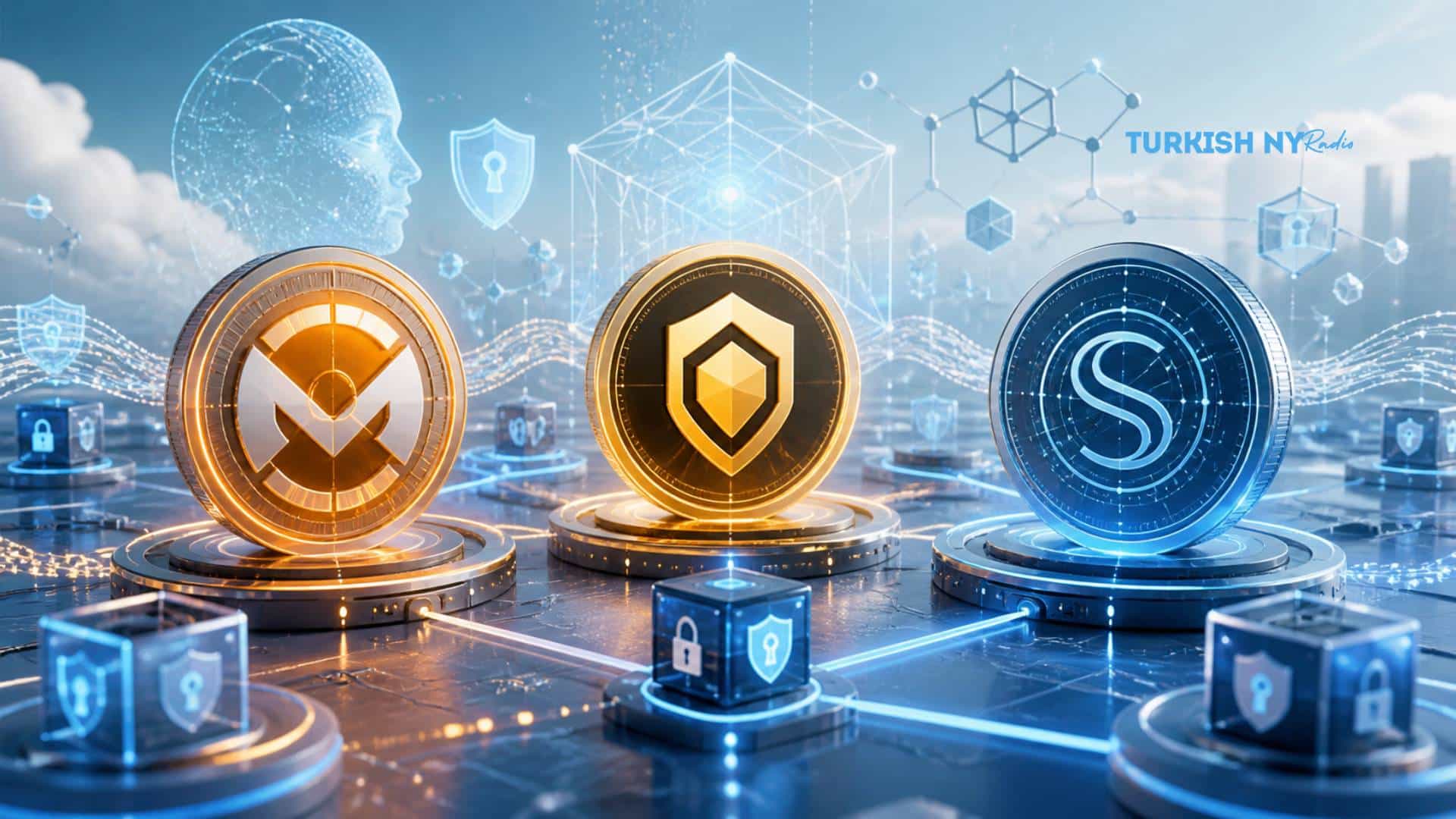
Privacy has become one of crypto’s hardest questions because public blockchains reveal more than most people expect. A wallet address can expose balances, trading habits, counterparties, and timing. For traders, builders, institutions, and ordinary users, that creates a real tradeoff: open verification on one side, financial exposure on the other. This is where privacy-focused Layer-1 Networks enter the frame. Monero, Zcash, and Secret Network each protect user data at the base-chain level, yet their designs are very different.
Why Privacy-Focused Layer-1 Networks Matter
Public ledgers brought trustless settlement to finance, but they also made financial behavior easy to map. Anyone can follow a wallet, connect deposits to exchanges, study token flows, and build a profile from open data.


Privacy-focused Layer-1 Networks aim to keep blockchain verification while reducing unnecessary exposure. Some hide sender, receiver, and amount by default. Some let users choose between public and private transfers. Others focus on private smart contracts, where application data stays encrypted while code still runs on-chain. The question is simple: how much privacy can a blockchain offer without breaking compliance, liquidity, usability, or trust?
Monero: Default Privacy as the Core Design
Monero is the clearest example of privacy as a default setting rather than an optional feature. Its design hides the sender, receiver, and transaction amount through ring signatures, stealth addresses, and Ring Confidential Transactions. The project’s materials describe these 3 tools as the foundation of Monero’s confidential and untraceable transaction model.
This default approach matters. When privacy is optional, private users may stand out from the crowd. Monero tries to avoid that by making privacy normal for every transaction.
For privacy-first Layer-1 Networks, Monero is often treated as the purest model. Its strength is fungibility, meaning one coin is not easily treated as “tainted” because its visible history is limited. Its weakness is also clear: regulated platforms struggle with assets that cannot provide transparent transaction trails. That pressure became visible when Monero trading pairs were removed by a major global exchange in February 2024, with regulatory requirements listed among the review factors.
Zcash: Optional Shielding and Zero-Knowledge Proofs
Zcash takes a different path. It supports transparent addresses, which work more like Bitcoin, and shielded addresses, which protect transaction details. Shielded Zcash transactions can encrypt sender, receiver, and amount, while still letting the network verify validity through zero-knowledge proofs.
The key technology behind Zcash is zk-SNARKs, a proof system that lets one party prove something is true without revealing the underlying information. Zcash’s Network Upgrade 5 introduced Orchard and the Halo 2 proving system, removing the need for a new trusted setup while improving the architecture for private digital payments.
Zcash’s model gives users flexibility, which can help with exchange support and onboarding. Yet the same flexibility creates a practical issue. If many users remain in transparent mode, the shielded pool may not deliver the same crowd effect as a private-by-default chain. For Layer-1 Networks, that is the old privacy dilemma in a new jacket: choice is user-friendly, but uneven use can weaken privacy guarantees.
Secret Network: Privacy for Smart Contracts
Secret Network focuses less on private payments alone and more on programmable privacy. It is built around “Secret Contracts,” a form of private smart contract where inputs, outputs, and contract state can stay encrypted. Its documentation says private data is encrypted at input, state, and output, and that Secret Contracts are based on CosmWasm while adding private metadata possibilities.
This makes Secret Network different from Monero and Zcash. Instead of asking only whether a transfer is private, it asks whether decentralized applications can use sensitive data without exposing it to the world. That could matter for private DeFi positions, sealed-bid auctions, identity tools, gaming logic, AI data flows, and business agreements that should not sit in plain view.
Among privacy-focused base chains, Secret Network is the application-layer candidate. Its tradeoff is that private computation introduces trust and infrastructure questions, especially around trusted execution environments. It is a different design suited for different use cases.
Key Indicators for Evaluating Privacy Cryptos
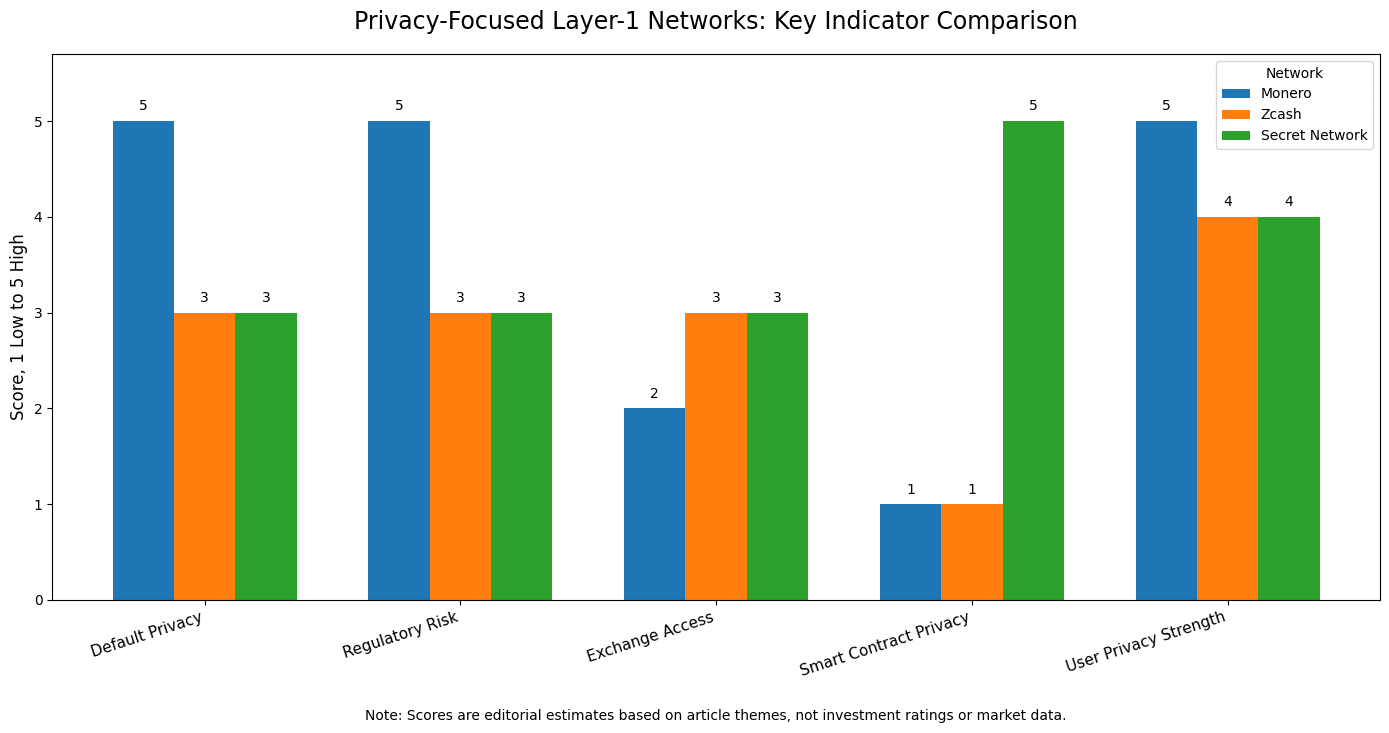
Investors and researchers should not judge privacy coins by price action alone. For Layer-1 Networks, the first indicator is the privacy model itself. Is privacy mandatory, optional, or application-specific? Mandatory privacy can improve anonymity sets, while optional privacy can support broader access but may reduce privacy in practice.
The second indicator is liquidity. A token may have strong technology, yet weak exchange access can create wider spreads and harder exits. Regulatory treatment is the third indicator because privacy assets sit close to anti-money-laundering debates. The fourth is developer activity, since strong cryptography without usable wallets can leave a network stuck in the lab.
Security history, decentralization, validator or miner distribution, wallet support, transaction fees, supply structure, and real usage also matter. In privacy-focused Layer-1 Networks, adoption should be examined carefully because inflated social attention does not always equal meaningful demand.
Regulation: The Pressure Point No Investor Can Ignore
Privacy is not illegal by nature as people use privacy every day through passwords, banking portals, business contracts, and private messaging. Still, crypto privacy creates a harder challenge because blockchain settlement can move value across borders without the same visibility that compliance teams expect.
That is why Layer-1 Networks built around privacy often face a narrower path to mainstream access. Exchanges, custodians, and payment firms need to satisfy local rules, and some may avoid assets that make monitoring difficult. This does not remove the demand for privacy. It simply means privacy networks live with a higher compliance discount than many public-ledger assets.
Monero vs Zcash vs Secret: The Real Difference
Monero is best understood as private digital cash. Zcash is closer to selective privacy with advanced zero-knowledge cryptography. Secret Network is private computation for applications. All 3 belong in the broader discussion of private Layer-1 Networks, but they solve different problems.
A user who values default transactional privacy may study Monero first. A user who wants private transfers with transparent compatibility may look at Zcash. A developer building data-sensitive decentralized applications may find Secret Network more relevant. The important point is that Layer-1 Networks should be judged by their intended job, not by a single privacy label.
Conclusion
Privacy is becoming less of a niche crypto concern and more of a practical infrastructure issue. Transparent chains are powerful, but they can expose too much. Monero, Zcash, and Secret Network show 3 different answers to that problem: default privacy, optional shielded payments, and encrypted smart contracts.
For investors, the opportunity is real, but so is the risk. Privacy-focused Layer-1 Networks sit at the intersection of cryptography, regulation, liquidity, and user rights. The strongest projects will be the ones that keep working when compliance pressure rises, users demand easier tools, and markets separate durable utility from noise.
Frequently Asked Questions
What are privacy-focused Layer-1 Networks?
They are base blockchains designed to protect user or application data directly at the protocol level. They can hide transaction details, support shielded transfers, or keep smart contract data encrypted.
Is Monero more private than Zcash?
Monero applies privacy by default, while Zcash offers both transparent and shielded transactions. This makes Monero stronger for default transactional privacy, while Zcash gives users more flexibility.
What makes Secret Network different?
Secret Network focuses on private smart contracts rather than only private payments. It allows applications to process encrypted data, which can support use cases beyond simple transfers.
Glossary of Key Terms
Ring Signatures
A Monero method that makes it hard to identify which participant signed a transaction.
Stealth Addresses
One-time destination addresses that help stop observers from linking payments to a recipient’s public address.
zk-SNARKs
Zero-knowledge proofs that allow Zcash transactions to be verified without revealing private transaction information.
Secret Contracts
Privacy-preserving smart contracts that can keep input, output, and state data encrypted.
Sources
Disclaimer
This article is for educational and informational purposes only. It is not financial, investment, legal, tax, or trading advice. Crypto assets are volatile, and privacy-focused assets may face added regulatory and liquidity risks. Readers should research independently and consult qualified professionals before making any financial decision.