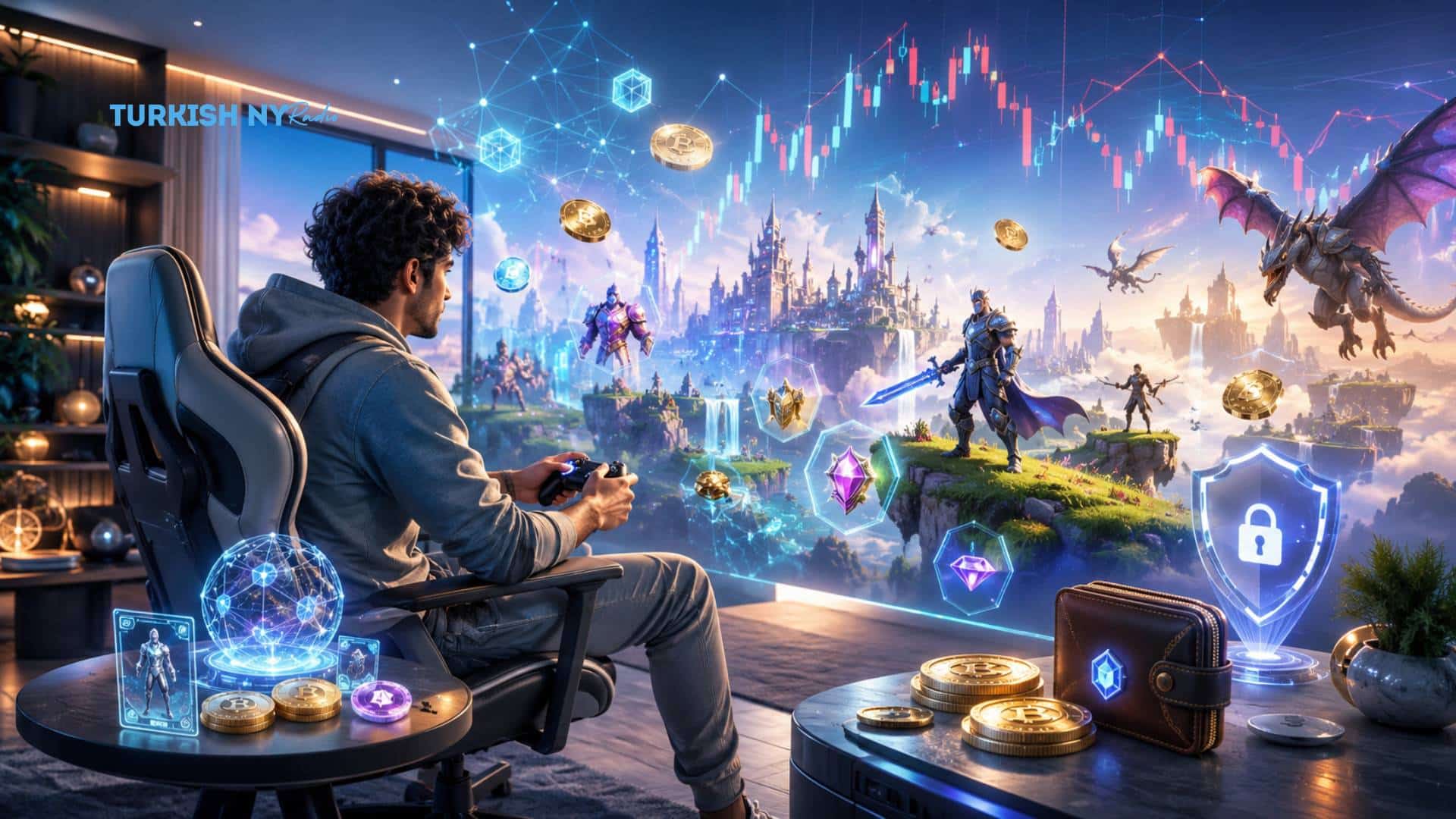
Play-to-earn crypto games have moved far beyond the early hype cycle. They are no longer just about cartoon monsters, quick token gains, or promises of income from a phone screen. The model now sits at the center of a larger debate about gaming, digital ownership, and the real value of blockchain assets.
For players, the pitch sounds simple: spend time in a game and earn tokens, NFTs, or digital items that may be traded outside the game. But the truth is more layered. Rewards can have value, yet that value depends on demand, liquidity, fees, token design, and whether the game itself is strong enough to keep people playing.

What Are Play-to-Earn Crypto Games?
Play-to-earn crypto games are blockchain-based games that reward players with digital assets, usually tokens, NFTs, or in-game items that can be held in a wallet or traded on supported markets. Unlike traditional games, where skins, coins, and items often stay locked inside one platform, Web3 games may allow players to control some of those assets directly.
A rare weapon, character, land plot, or token can exist on-chain, meaning ownership can be checked through blockchain records. In some cases, players can sell those assets to another user. In others, rewards can be swapped for crypto and later converted into fiat, depending on exchange access and local rules.
Still, “earn” is the word that causes the most confusion as a game may issue rewards, but rewards are not the same as profit. A player may spend money to buy an NFT, pay fees to move assets, or lose value if the reward token falls. The model can work, but it does not print money.
How the Earning Model Works
In most play-to-earn crypto games, players earn by completing tasks, winning battles, breeding characters, crafting items, staking game assets, joining tournaments, or selling NFTs. The structure varies from one title to another, but the basic loop is familiar. The game asks for time, skill, or capital, and it offers digital rewards in return.
The rewards usually fall into 3 main groups as tokens are the most common because they are easy to distribute and trade. NFTs represent unique or limited items such as characters, skins, land, cards, or weapons. Points are sometimes used as off-chain or semi-chain rewards before a token launch, although they may carry no guaranteed market value.
This is where players need to slow down as a token reward only has market value if buyers exist. An NFT only sells if someone wants it. A points campaign may lead nowhere if the team changes its plan. In traditional gaming, a player buys entertainment. In Web3 gaming, the player may also take market risk.
Why the Sector Still Attracts Attention
The idea behind play-to-earn crypto games remains powerful because it challenges an old gaming rule. For years, players spent money and time inside digital worlds without owning much beyond account access. Blockchain gaming tries to change that by giving players assets that can move beyond one closed system.
That is why developers, investors, and gaming communities still watch this sector closely. Digital ownership fits naturally with younger users who already buy skins, collectibles, and online status. If people are willing to pay for virtual items, the next question is whether those items should be tradable, portable, and owned more directly by the player.
There is also a global angle. In some markets, reward-based games gained attention because players saw them as a side income stream. That created fast adoption during earlier cycles, but it also exposed the weak side of the model. When token prices dropped, many players left. When the game was not fun without rewards, the economy started to crack.
The Key Indicators Players Should Check
The first major indicator is active users as a game with steady player activity has a better chance of supporting its economy than a game running on marketing alone. Wallet activity is useful, but it should not be taken at face value. One person can use several wallets, and bots can inflate numbers. Real retention matters more than a flashy user count.
The second indicator is liquidity, if a reward token trades on thin markets, players may not be able to sell without pushing the price down. Low liquidity is like a narrow exit door in a crowded room. It looks fine until everyone tries to leave at once.
Token supply is another key signal. If rewards are issued too quickly, inflation can hurt prices. Many play-to-earn crypto games struggle when the number of tokens entering the market is higher than the demand from new users, buyers, or in-game spending. A good game economy needs sinks, which are ways to remove or use tokens, not just distribute them.
Players should also study floor prices for NFTs, trading volume, developer updates, security audits, wallet requirements, and the history of reward changes. A project can look healthy on social media while its market data tells a different tale.
The Risk Behind “Free Money” Thinking
The biggest mistake is treating play-to-earn crypto games as guaranteed income. They are not wages. They are not bank products. They are not savings tools. They are games connected to volatile digital markets.
Reward values can fall for many reasons. The game may lose users. A token may face heavy selling. NFT demand may fade. Transaction fees may eat small profits. A bridge, wallet, or marketplace may become a security risk. In some cases, a project may change its rules, delay withdrawals, or shut down parts of its economy.
There is also the upfront cost problem. Some games require players to buy NFTs or tokens before they can start earning. If the asset price falls, the player may need a long time to recover the entry cost, assuming recovery is possible at all. That is why a simple question matters: would the game still be enjoyable if the reward token dropped 70%?
Why Good Gameplay Matters More Than Token Hype
A weak game cannot survive on token rewards forever. Players may arrive for earnings, but they stay for fun, competition, identity, and community. This is true in normal gaming, and it is even more true in Web3 gaming because financial incentives can attract users who leave quickly when rewards fade.
The stronger projects are likely to look less like “earn first” products and more like real games with optional blockchain layers. That means smoother onboarding, better design, lower fees, safer wallets, and rewards that support gameplay instead of replacing it.
For developers, the lesson is clear. Tokenomics cannot cover bad design. A reward system can bring early attention, but it cannot fix boring gameplay, poor balance, or a thin community. The market has learned that the hard way.
What Makes a P2E Economy Sustainable?
A sustainable model needs balance between rewards and demand. If players only sell tokens, the economy weakens. If the game gives users reasons to spend tokens inside the ecosystem, such as upgrades, crafting, entry fees, cosmetics, or tournament access, the system has more breathing room.
The best play-to-earn crypto games also need clear rules. Players should understand how rewards are calculated, when they can withdraw, what fees apply, and whether assets can be frozen or changed. Transparency builds trust because money is involved, even when the product is still a game.
Governance may also play a role, but it should not be treated as magic. Voting tokens do not automatically create a fair economy. A project still needs capable builders, strong risk controls, and honest communication when market conditions change.
Regulation, Taxes, and User Responsibility
Because rewards can carry value, users may face tax or reporting duties depending on where they live. A player who earns tokens, sells NFTs, or swaps assets may create taxable events. Rules vary by country, and in many places the guidance is still developing.
There are also consumer protection concerns. Some games market rewards in a way that feels close to investment promotion. That can invite regulatory attention, especially when users pay upfront to access earning systems. The safer approach is to treat these products as high-risk digital entertainment, not a stable income plan.
Security is another serious issue as players should use trusted wallets, protect seed phrases, avoid unknown links, and be careful with approvals. A single bad signature can drain assets. In crypto gaming, the enemy is not always inside the game. Sometimes it is a fake website, a phishing link, or a hacked account.
Conclusion: The Model Is Evolving, Not Disappearing
Play-to-earn crypto games are not dead, but the old version of the model has clearly matured. The next phase will likely be less about easy rewards and more about useful ownership, better gameplay, and healthier economies. That is a good thing. It forces the sector to compete on quality rather than noise.
For players, the smart move is simple as enjoy the game first, study the economy second, and never risk money that would hurt to lose. Rewards can be real, but so can losses. In the end, the projects that last will be the ones that make blockchain feel like a useful feature, not a shiny sticker placed on top of a weak game.
Frequently Asked Questions
What are play-to-earn crypto games?
They are blockchain-based games that may reward players with tokens, NFTs, points, or digital items. Some rewards can be traded or moved to a crypto wallet, depending on the game and supported platforms.
Can players make real money from P2E games?
Players can sometimes earn assets with market value, but profit is not guaranteed. Earnings depend on token prices, NFT demand, fees, time spent, liquidity, and the game’s long-term user activity.
Are P2E games safe for beginners?
They can be risky for beginners because users must understand wallets, private keys, market volatility, scams, and transaction fees. A beginner should start with small amounts and learn the basics before spending money.
Why do P2E tokens lose value?
P2E tokens often lose value when too many rewards enter the market and not enough users want to buy or spend them. Weak gameplay, falling activity, and poor token design can make the decline worse.
What should players check before joining a game?
Players should review active users, token supply, liquidity, NFT trading volume, withdrawal rules, developer history, wallet safety, and whether the game is enjoyable without rewards.
Glossary of Key Terms
Play-to-Earn
Play-to-earn is a gaming model where users can receive digital rewards for gameplay. These rewards may include crypto tokens, NFTs, or other tradable items.
NFT
An NFT is a unique digital asset recorded on a blockchain. In games, NFTs may represent characters, skins, land, cards, or weapons.
Tokenomics
Tokenomics means the design of a token economy, including supply, rewards, demand, utility, inflation, and how tokens enter or leave circulation.
Liquidity
Liquidity shows how easily an asset can be bought or sold without a large price move. Low liquidity can make it hard for players to cash out rewards.
Wallet
A crypto wallet is a tool that stores private keys and allows users to manage blockchain assets. Players use wallets to hold tokens, NFTs, and other digital items.
Gas Fee
A gas fee is the cost paid to process a blockchain transaction. High fees can reduce or erase small gaming rewards.
Floor Price
The floor price is the lowest listed price for an NFT in a collection. It is often used as a rough signal of market demand, although it can change quickly.
Sources
Disclaimer
This article is for educational and informational purposes only. It is not financial, investment, tax, or legal advice. Crypto assets, NFTs, and blockchain games carry high risk, and users should do their own research before spending money or connecting a wallet.