
A recent cybersecurity study found that AI crypto theft could soon grow into one of the most formidable online risks to blockchain users. Researchers from the University of California have discovered worrying evidence that rogue AI agent routers, which lie among artificial intelligence models and end users, have been employed to capture private keys, change blockchain-related data, and carry out illicit transactions. As machine learning grows more deeply linked with cryptocurrency technologies, experts warn that if no controls are in place, AI crypto theft will skyrocket.
Malicious AI Routers Become a Hidden Security Weak Point
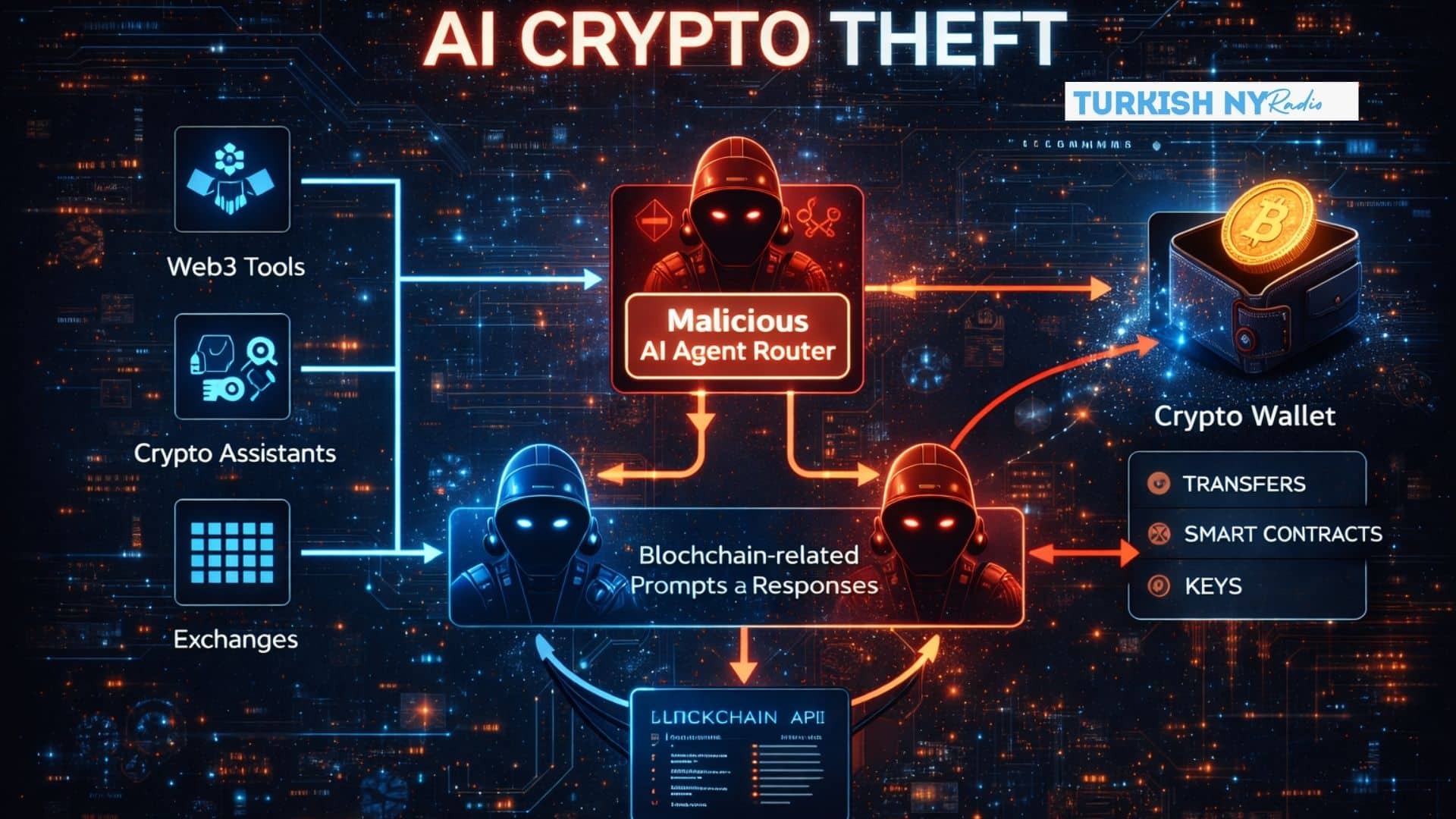
The research team examined hundreds of AI agent routers, many of which are used by developers and crypto-focused AI assistants. They discovered that some routers secretly logged sensitive wallet information or manipulated code returned to users. This exposed crypto wallets to AI crypto theft, creating opportunities for attackers to drain assets with little trace.


“Most users and even developers trust these routers blindly,” said one of the lead researchers. “But our findings show that AI crypto theft is no longer a theoretical threat, it is already happening.”

How the Attack Works
AI agent routers serve as middlemen, transferring instructions and replies among an app and the AI model. Yet, the data that goes through them frequently involves the following:
- blockchain private keys
- API credentials
- seed phrases
- smart-contract code
If a malicious router intercepts this data, AI crypto theft becomes trivial. Attackers can extract keys, alter contract logic, or inject malicious commands that users may not recognize until it is too late.
The study confirmed that at least one malicious router executed real-world AI crypto theft during testing by draining funds from a monitored ETH wallet. This discovery indicates that threat actors are actively exploiting these weaknesses rather than merely experimenting.
Evasion Tactics Make Detection Difficult
Some compromised routers used delayed-activation techniques to avoid suspicion. Instead of acting immediately, the malicious code waited through dozens of legitimate API calls before attempting AI crypto theft. This slow-burn strategy allows attackers to remain undetected for long periods.
“Our scans revealed that attackers are getting smarter,” another researcher said. “They know developers test these systems, so they design malware that activates only in specific conditions. That’s why AI crypto theft is so dangerous, users have no idea anything is wrong.”
Rising Risk as AI-Crypto Combination Grows
AI automation is becoming increasingly important for digital currency exchanges, Web3 tools, and individual trading assistants. As this pattern carries on, the risk of AI crypto theft may extend beyond developers to average users that rely on AI-powered companions to manage their portfolios, authenticate transactions, and generate intelligent contract codes.
Investigators propose for rigorous evaluation of AI responses, prohibiting the transmission of wallet keys through agents, and developing cryptographic authentication measures to ensure output integrity. Despite such controls, the threat of AI crypto theft will grow.
Conclusion
The most recent studies from the University of California reveal a fast growing cybersecurity sector. Malicious AI agent routers have already shown the potential to capture critical data and assist AI crypto theft, demonstrating that the problem is real and evolving. As AI gets more thoroughly integrated into crypto facilities the industry must give priority to security innovation to avoid widespread financial damage. Failure to act now could enable AI crypto theft to emerge as one of the most significant cybercrimes of the course of the next ten years.
Summary
A recent investigation from the University of California finds that rogue AI agent routers are facilitating a new wave of AI crypto theft. These routers may intercept private keys, change blockchain-related data, and even carry out illicit transactions. Through controlled examination, researchers identified real-world examples of monies being siphoned. As AI becomes more incorporated into crypto products, this vulnerability poses a threat to both developers and common users. Better security procedures and tested AI solutions are required to combat the rising threat of AI crypto theft.
Glossary of Key Terms
AI Agent Router: A gateway application that routes data among an AI model and a software program.
Private Key: A personal passcode that enables login to a bitcoin wallet.
Seed Phrase: A supplementary word used to recover a digital currency wallet.
Smart Contract: Autonomously executed code on a digital ledger that performs predetermined tasks.
Malware Injection: The illegal entry of dangerous information into the system or application.
FAQs for AI Crypto Theft
1. What is actually the definition of AI cryptocurrency theft?
AI crypto theft is defined as obtaining cryptocurrency using corrupted AI systems or middlemen, such as rogue AI agent routers.
2. How can rogue AI routers steal cryptocurrencies?
They acquire private keys or manipulate blockchain-associated data that passes through them, allowing illicit transactions.
3. Who found the threats?
Throughout testing, University of California investigators discovered rogue routers in the real world.
4. Will normal cryptocurrency users be affected?
Yes. Anyone who uses AI-powered tools to manage their wallets, code, or trade is at danger.
5. How can we avoid AI crypto theft?
Avoid transmitting sensitive wallet data via AI tools; instead, utilize reputable services, activate response authorization, and need cryptographic confirmation of authenticity.