Meta prediction market app plans have placed Mark Zuckerberg’s company back in a high-risk technology race.
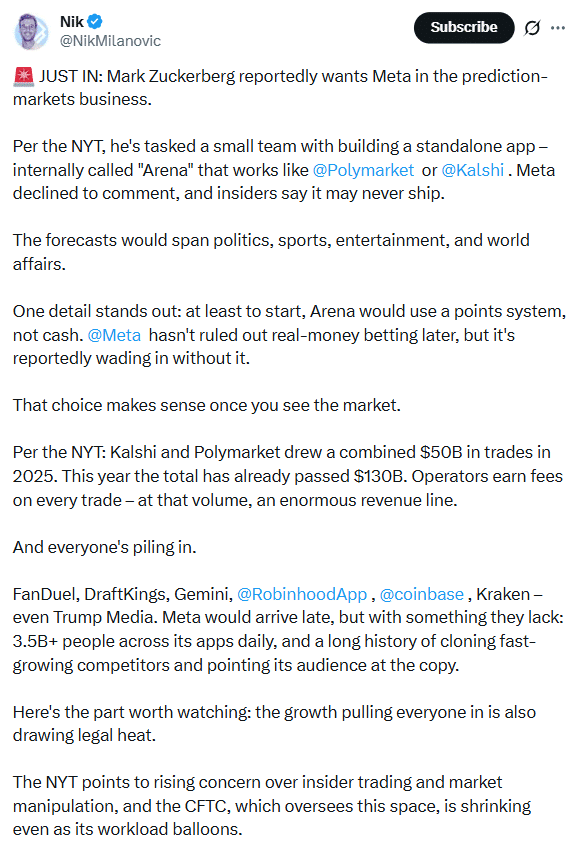
The reported project is called Arena inside Meta. It would let users forecast outcomes in politics, sports and world affairs. Users would rely on points instead of real money at first. The New York Times reported on June 23 that Zuckerberg directed a small team to build the product.


The move comes after Meta spent years and billions chasing the metaverse. Now the company appears to be studying a market with proven demand, strong user interest and heavy regulatory risk.
Meta Prediction Market App Tests Social Forecasting
The Meta prediction market app would mark a new push into social forecasting. It would not start as a direct rival to real-money platforms such as Kalshi or Polymarket. Instead, it would test whether Meta can turn public predictions into a social product.
The timing is important. Prediction markets have gained wider attention from investors, brokers and media groups. Users now trade or track outcomes across elections, sports, awards and world events.
The Meta prediction market app would use a points-first model. That design could reduce legal risk at launch. It would also fit Meta’s wider playbook.
Meta has often entered popular categories after others proved demand. Instagram Stories followed Snapchat’s format. Reels followed TikTok’s short-video rise. Threads entered a market long shaped by Twitter.
Meta’s advantage is scale. Its apps reach billions of daily users. That reach could give Arena a faster path to mass adoption than specialist prediction platforms.
Metaverse Losses Shape the Pivot
The reported project follows years of costly metaverse spending. Meta changed its name from Facebook in 2021 to signal its long-term focus on virtual worlds.
Reality Labs, the unit behind that effort, has posted huge operating losses. The division lost $17.7 billion in 2024 and $19.2 billion in 2025. Cumulative losses are now close to $90 billion.
That record makes Arena look like a different kind of bet. It needs software, identity tools, feeds, moderation and compliance. It does not require custom hardware or years of behavior change.
Forecast Shows Meta Tried Before
Meta has tested this idea before. In 2020, it launched Forecast, a points-based prediction product focused on current events.
The company shut it down in 2022. That came before prediction markets gained major momentum during the 2024 US election cycle. It also came before Kalshi’s legal win over the CFTC on election contracts.
Regulation Remains the Main Risk
Prediction markets are not simple social apps. They can look like financial markets when real money is involved.
Polymarket paid a $1.4 million CFTC penalty in 2022 over unregistered event contracts. Kalshi spent years fighting for the right to offer election contracts. The CFTC later dropped its appeal in 2025.
Regulators have also started watching insider trading risks. In April 2026, the CFTC filed its first insider-trading complaint tied to prediction market activity.
Distribution Could Be Meta’s Edge
A Meta prediction market app could spread through Instagram, Facebook, WhatsApp and Meta AI. Creators could ask followers to predict award shows. Sports groups could forecast match results. Political communities could track election expectations.
This social layer could make prediction markets easier for casual users. It could also create a large new audience for the category.
Yet reach can cut both ways. More users mean more attention. More attention brings more scrutiny.
Points May Limit Early Exposure
The Meta prediction market app may avoid some early legal pressure by using points. No-money forecasting is less risky than real-money event contracts.
But points still create incentives. Users may chase status, influence or visibility. That can push the product toward engagement instead of accuracy.
This matters because prediction markets work best when incentives reward better forecasts. If Arena becomes only a viral game, its value may weaken.
Trust Is the Hardest Test
Any Meta prediction market app that covers elections or public figures will face trust questions. Meta already has a long history with political content, misinformation and regulatory pressure.
Its failed Libra and Diem digital currency projects also matter. Policymakers opposed the idea of Meta controlling financial infrastructure used by billions.
Arena may avoid payments at first. But Meta’s reputation will still shape the debate.
Conclusion
The Meta prediction market app could become a smart pivot if Meta uses its scale carefully. Prediction markets already have users, demand and cultural momentum.
But the product could also create new regulatory and reputational problems. Arena sits at the center of social media, politics, markets and trust. That makes it a promising idea. It also makes it a dangerous one.
Appendix Glossary of Key Terms
Arena: The internal name for Meta’s reported prediction market app focused on politics, sports and world affairs.
Prediction Market: A platform where users forecast future events, often through points or financial contracts.
Event Contracts: Tradeable contracts based on the outcome of a future event, such as an election or sports result.
CFTC: The US Commodity Futures Trading Commission, which oversees certain derivatives and event-contract markets.
Polymarket: A prediction market platform known for crypto-based event markets and political forecasting.
Kalshi: A regulated US prediction market platform that offers event contracts on real-world outcomes.
Reality Labs: Meta’s division focused on metaverse, VR and AR projects, which has reported large operating losses.
Diem: Meta’s former digital currency project, previously called Libra, which shut down after regulatory pressure.
Frequently Asked Questions About Meta prediction Market App
1. What is the Meta prediction market app?
It is a reported Meta project called Arena. It would let users forecast outcomes using points.
2. What topics could Arena cover?
It could cover politics, sports, world affairs and public events.
3. Why would Meta use points?
Points may reduce early legal risk compared with real-money trading.
4. Why is regulation a concern?
Prediction markets can face financial rules when users trade event contracts.