


The mystery of the lost Bitcoin supply has emerged as one of the most defining drivers in the digital asset market.
With experts predicting that millions of BTC have been lost permanently owing to forgotten secret keys, missing hardware wallets, or catastrophic exchange failure, the scarcity thesis is gaining traction.


In a market with a fixed supply of 21 million coins, the loss of such a substantial chunk is more than simply an anecdote; it is a key driver of long-term value.
Billions in value are locked out of reach
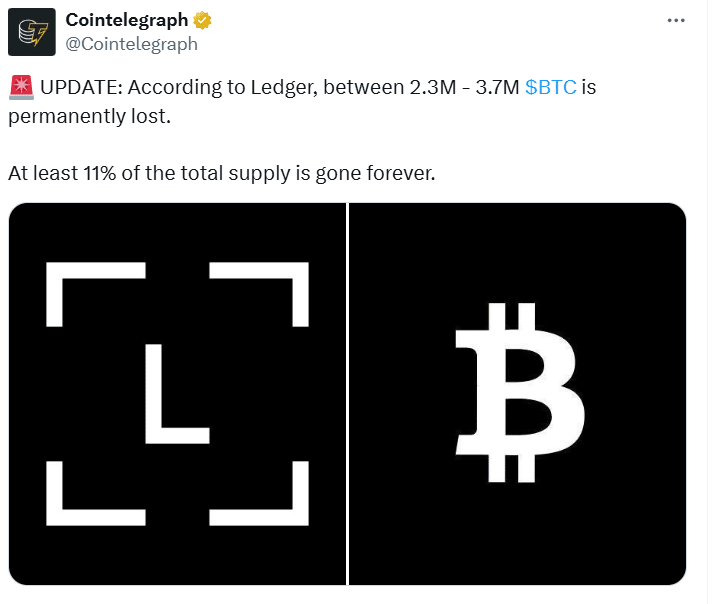
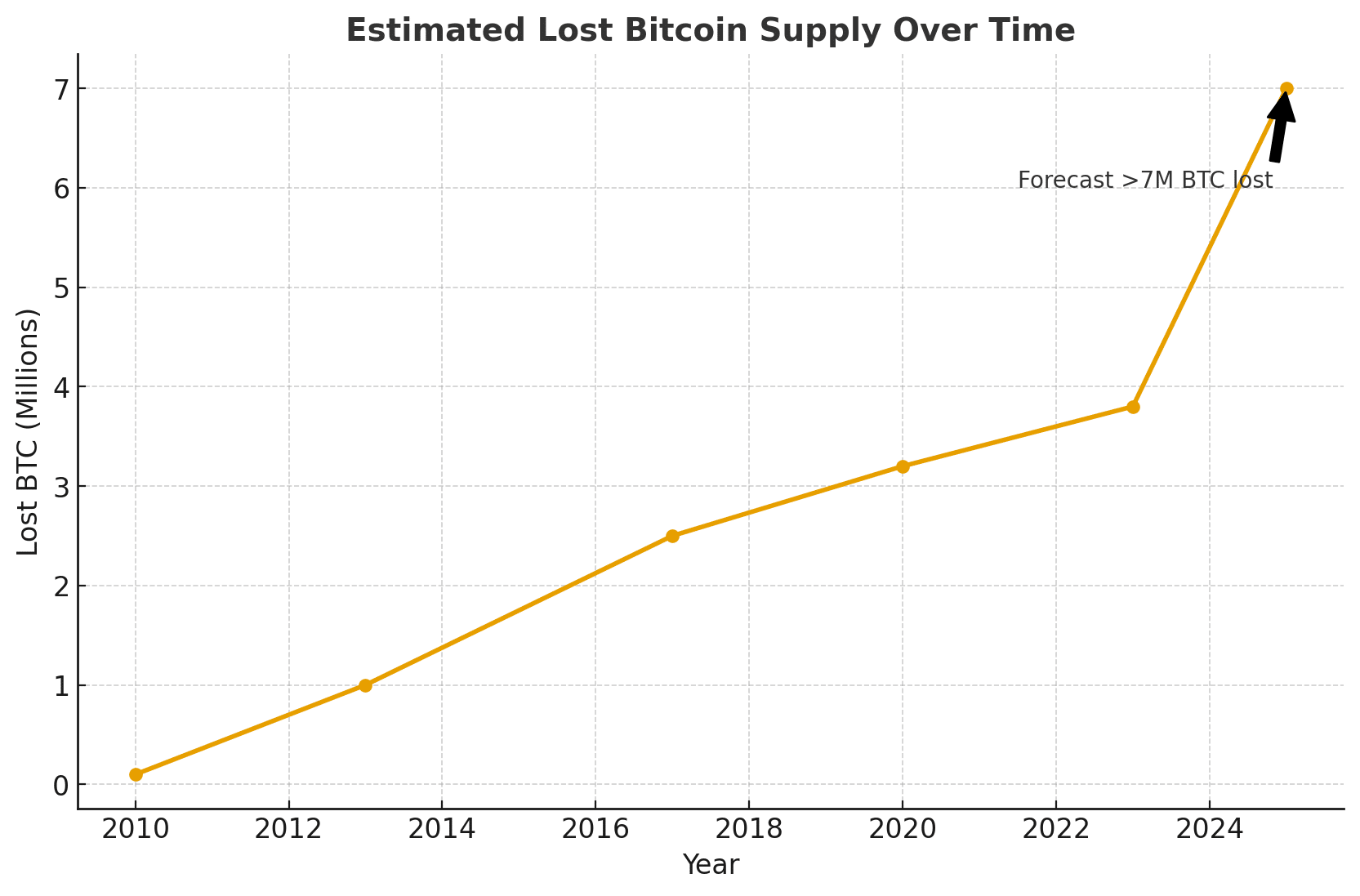
According to studies, between 2.3 million and 3.7 million BTC, or around 11 to 17 percent of total supply, are permanently unavailable. Some study shows that up to 4 million BTC may be stolen, while a more frightening projection predicts that more than 7 million coins will be missing by the end of 2025.
This quantity of lost Bitcoin supply might account for more than one-third of all coins produced.
Crypto market expert Rachel Lin said on X, “People speak about Bitcoin halving events, but the quiet halving has already occurred.
Every lost coin increases the asset’s scarcity, which markets have yet to adequately account for.” Her comment underscores rising investor anxiety that lost coins would exacerbate scarcity much quicker than most projections allow for.
Lessons from History: Mount Gox and Beyond
High-profile failures highlight the scope of the issue. The catastrophic Mt. Gox collapse alone resulted in the loss of over 750,000 BTC due to theft and mismanagement, accounting for roughly 7% of supply at the time.
When combined with individual examples of people destroying hard drives or misplacing wallets, the cumulative impact of lost Bitcoin supply continues to rise.
One well-known viral instance is that of James Howells, who in 2013 unintentionally tossed away a hard disk holding 8,000 BTC. He spent years seeking to recover it from a landfill. Such instances demonstrate how human mistakes, when expanded internationally, have major market-wide consequences.
Dormancy outpaces new supply
Another issue is that inactive coins, those that have never been transferred or accessed, are accumulating faster than new ones are mined. With 93% of Bitcoin now issued and yearly mining production down to roughly 164,000 BTC, the rate of lost Bitcoin supply is starting to outpace new currency generation.
Analysts fear that without fixes, future circulation may fall to levels that exacerbate volatility and make liquidity more difficult to maintain.
Financial expert Henry Wong said, “Scarcity is a characteristic of Bitcoin, but severe scarcity from lost coins threatens compromising its functioning as a means of trade. It’s a two-edged sword. His remark emphasizes the contradiction between appreciating value and retaining usefulness.
Scarcity and Future Value Proposition
While the loss of millions of coins presents operational issues, many investors see the trend as optimistic. Scarcity has generally pushed Bitcoin’s price upward during halving cycles, and the lost Bitcoin supply serves as an additional supply shock.
Some researchers claim that if one-third of the coins are gone, the genuine circulation limit may be closer to 14 million than 21 million, increasing its store-of-value appeal.
The long-term ramifications are substantial. Secure custody methods, estate planning for digital assets, and more open exchanges may reduce future losses, but the coins that have already been lost are unlikely to be recovered. In a fixed-supply system, each lost Bitcoin supply alters the asset’s economic model.
Conclusion
The enormity of the lost Bitcoin supply is astonishing, with millions of coins gone forever and trillions of dollars permanently locked up. This concealed scarcity reinforces Bitcoin’s image as digital gold while raising concerns about its future position as a practical currency.
Whether considered as a danger or an opportunity, one thing is sure: lost coins are no longer merely a technical footnote; they are a permanent part of the Bitcoin narrative.
FAQs for lost Bitcoin supply
How much Bitcoin has been lost?
Estimates range from 2.3 million to over 7 million BTC, accounting for 11 to 33 percent of the total supply.
Why does lost Bitcoin supply matter?
It reduces the effective circulating supply, increasing scarcity and potentially driving long-term price appreciation.
What causes Bitcoin to be lost?
Common causes include lost private keys, discarded hardware wallets, forgotten passwords, and collapsed exchanges.
Can lost Bitcoin ever be recovered?
In most cases, no. Without access to private keys, lost coins are permanently inaccessible.
Glossary of Key Terms
Lost Bitcoin Supply – BTC that is permanently inaccessible due to lost private keys, discarded devices, or exchange failures.
Circulating Supply – The portion of Bitcoin currently available for trading and transactions in the market.


Dormant Coins – Bitcoins that have not moved in years, often considered lost or permanently held.
Mt. Gox – A defunct crypto exchange whose 2014 collapse resulted in the loss of approximately 750,000 BTC.
Store of Value – An asset that retains purchasing power over time, a role Bitcoin increasingly fills due to its scarcity.