
• Home
  • About Us
  • Terms and Conditions
  • Privacy Policy
  • Disclaimer
  • Contact
15 July Wednesday, 2026
  • tr Türkçe
  • en English
TurkishNY Radio
No Result
View All Result
  • Home
  • Cryptocurrency
  • Business
  • Economy
  • Home
  • Cryptocurrency
  • Business
  • Economy
No Result
View All Result
  • tr Türkçe
  • en English
TurkishNY Radio
No Result
View All Result
Bitcoin Bitcoin (BTC) $65,379.95 ↑ 1.79%
Ethereum Ethereum (ETH) $1,931.37 ↑ 2.86%
Tether USDt Tether USDt (USDT) $1.00 ↑ 0.01%
BNB BNB (BNB) $581.32 ↑ 0.02%
USDC USDC (USDC) $1.00 ↑ 0.00%
XRP XRP (XRP) $1.13 ↑ 2.21%
Solana Solana (SOL) $78.09 ↑ 0.99%
TRON TRON (TRX) $0.33 ↑ 0.56%
Hyperliquid Hyperliquid (HYPE) $68.16 ↑ 4.88%
Dogecoin Dogecoin (DOGE) $0.07 ↑ 0.53%
Zcash Zcash (ZEC) $575.23 ↑ 8.24%
UNUS SED LEO UNUS SED LEO (LEO) $9.81 ↑ 2.80%
Stellar Stellar (XLM) $0.19 ↑ 2.15%
Chainlink Chainlink (LINK) $8.60 ↑ 3.34%
Monero Monero (XMR) $331.43 ↑ 0.67%
Cardano Cardano (ADA) $0.17 ↑ 1.14%
Canton Canton (CC) $0.14 ↑ 4.84%
Bitcoin Cash Bitcoin Cash (BCH) $234.57 ↓ -1.94%
Dai Dai (DAI) $1.00 ↓ -0.01%
Gram (prev. Toncoin) Gram (prev. Toncoin) (GRAM) $1.59 ↓ -2.22%
World Liberty Financial USD World Liberty Financial USD (USD1) $1.00 ↓ -0.02%
Ethena USDe Ethena USDe (USDe) $1.00 ↓ -0.01%
Litecoin Litecoin (LTC) $45.55 ↑ 2.26%
Global Dollar Global Dollar (USDG) $1.00 ↑ 0.01%
DeXe DeXe (DEXE) $36.75 ↓ -8.75%
Sui Sui (SUI) $0.76 ↓ -0.55%
Hedera Hedera (HBAR) $0.07 ↑ 1.64%
Avalanche Avalanche (AVAX) $6.70 ↑ 1.19%
PayPal USD PayPal USD (PYUSD) $1.00 ↓ -0.01%
NEAR Protocol NEAR Protocol (NEAR) $2.07 ↑ 1.68%
Cronos Cronos (CRO) $0.06 ↑ 0.44%
Shiba Inu Shiba Inu (SHIB) $0.00 ↑ 0.72%
Tether Gold Tether Gold (XAUt) $4,047.08 ↓ -0.91%
Uniswap Uniswap (UNI) $3.63 ↓ -1.51%
Bittensor Bittensor (TAO) $199.95 ↓ -1.78%
PAX Gold PAX Gold (PAXG) $4,047.33 ↓ -0.90%
World Liberty Financial World Liberty Financial (WLFI) $0.06 ↓ -1.58%
OKB OKB (OKB) $82.26 ↑ 1.05%
MemeCore MemeCore (M) $1.29 ↑ 5.39%
Aster Aster (ASTER) $0.63 ↑ 0.39%
Ondo Ondo (ONDO) $0.33 ↑ 6.04%
USDD USDD (USDD) $1.00 ↓ -0.13%
Ripple USD Ripple USD (RLUSD) $1.00 ↓ -0.01%
Aave Aave (AAVE) $96.97 ↓ -1.66%
Worldcoin Worldcoin (WLD) $0.41 ↓ -0.75%
Polkadot Polkadot (DOT) $0.86 ↑ 0.93%
Sky Sky (SKY) $0.06 ↑ 1.92%
Mantle Mantle (MNT) $0.43 ↑ 0.60%
Internet Computer Internet Computer (ICP) $2.21 ↓ -1.28%
Pepe Pepe (PEPE) $0.00 ↑ 0.62%
Bitget Token Bitget Token (BGB) $1.69 ↑ 0.85%
Ethereum Classic Ethereum Classic (ETC) $7.13 ↑ 1.06%
Morpho Morpho (MORPHO) $2.07 ↑ 2.67%
United Stables United Stables (U) $1.00 ↓ -0.04%
KuCoin Token KuCoin Token (KCS) $7.00 ↓ -0.69%
Stable Stable (STABLE) $0.04 ↑ 0.79%
Polygon (prev. MATIC) Polygon (prev. MATIC) (POL) $0.08 ↓ -0.25%
Pi Pi (PI) $0.08 ↑ 1.87%
JUST JUST (JST) $0.10 ↓ -0.69%
Cosmos Cosmos (ATOM) $1.58 ↑ 1.03%
Ethena Ethena (ENA) $0.08 ↑ 0.23%
Render Render (RENDER) $1.54 ↑ 1.14%
Audiera Audiera (BEAT) $2.58 ↑ 0.37%
Kaspa Kaspa (KAS) $0.03 ↑ 0.76%
Quant Quant (QNT) $65.37 ↑ 1.07%
Algorand Algorand (ALGO) $0.09 ↑ 0.35%
币安人生 币安人生 (币安人生) $0.75 ↓ -5.75%
GateToken GateToken (GT) $6.76 ↑ 0.61%
Jupiter Jupiter (JUP) $0.21 ↑ 1.68%
Pump.fun Pump.fun (PUMP) $0.00 ↑ 10.14%
Lighter Lighter (LIT) $2.56 ↑ 0.43%
Filecoin Filecoin (FIL) $0.79 ↑ 2.80%
Flare Flare (FLR) $0.01 ↑ 0.52%
XDC Network XDC Network (XDC) $0.03 ↑ 1.35%
Arbitrum Arbitrum (ARB) $0.09 ↓ -2.97%
Aptos Aptos (APT) $0.63 ↑ 0.35%
Venice Token Venice Token (VVV) $11.03 ↑ 0.11%
Injective Injective (INJ) $5.13 ↑ 2.15%
Aerodrome Finance Aerodrome Finance (AERO) $0.52 ↓ -0.11%
Nexo Nexo (NEXO) $0.77 ↑ 2.63%
TrueUSD TrueUSD (TUSD) $1.00 ↓ -0.01%
Midnight Midnight (NIGHT) $0.03 ↓ -1.12%
PancakeSwap PancakeSwap (CAKE) $1.43 ↑ 0.28%
Dash Dash (DASH) $34.91 ↑ 2.79%
EURC EURC (EURC) $1.14 ↑ 0.01%
VeChain VeChain (VET) $0.00 ↓ -0.01%
ether.fi ether.fi (ETHFI) $0.44 ↑ 8.11%
Virtuals Protocol Virtuals Protocol (VIRTUAL) $0.61 ↑ 4.40%
Pudgy Penguins Pudgy Penguins (PENGU) $0.01 ↑ 5.18%
Celestia Celestia (TIA) $0.41 ↑ 2.88%
OFFICIAL TRUMP OFFICIAL TRUMP (TRUMP) $1.58 ↑ 1.76%
Pyth Network Pyth Network (PYTH) $0.05 ↑ 1.60%
Artificial Superintelligence Alliance Artificial Superintelligence Alliance (FET) $0.16 ↑ 0.27%
Sei Sei (SEI) $0.05 ↓ -0.39%
SPX6900 SPX6900 (SPX) $0.38 ↓ -0.19%
Sun [New] Sun [New] (SUN) $0.02 ↓ -0.10%
First Digital USD First Digital USD (FDUSD) $1.00 ↑ 0.02%
Gnosis Gnosis (GNO) $128.05 ↑ 12.62%
Bonk Bonk (BONK) $0.00 ↓ -2.91%
Curve DAO Token Curve DAO Token (CRV) $0.22 ↓ -3.17%
Home World

Kalshi CFTC Michigan Dispute Puts Prediction Market Regulation in Focus

Sami Oliver by Sami Oliver
15 July 2026
in World, Cryptocurrency, en, News
Reading Time: 4 mins read
0
Kalshi news

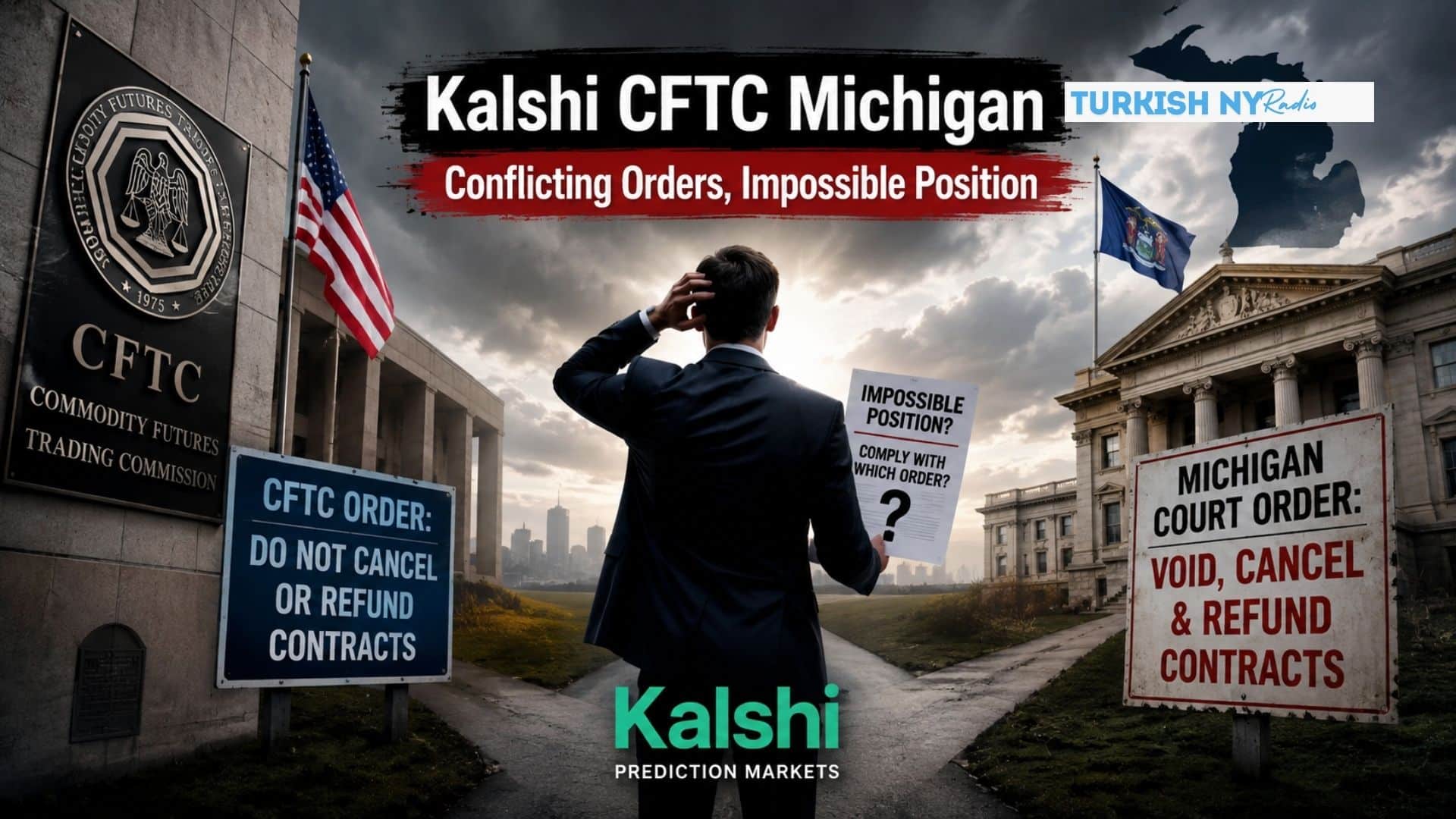
The Kalshi CFTC Michigan issue has emerged as one of the most contentious legal and regulatory conflicts in the prediction market business in the United States. Kalshi, a federally authorized predictions market exchange, claims it has been placed in an “impossible position” due to conflicting orders from the US Commodity Futures Trading Commission (CFTC) and a Michigan court. Although the state has ordered the business to invalidate and refund certain sports event agreements involving Michigan citizens, the CFTC has directed Kalshi not to pursue such measures.

The Kalshi CFTC Michigan case underscores the growing conflict between federal regulation of market predictions and state control over gaming laws. The conclusion may have far-reaching consequences for regulatory event contracts, traders, and the future of market predictions in the United States.


Table of Contents

Toggle
    • YOU MAY BE INTERESTED
    • UK Tokenization Roadmap Targets $44.15 Billion in Annual Output by 2035
    • Asia Crypto News: $122.5M Scam Bust, Japan Crypto Credit and Regional Regulation
  • The Regulatory Conflict Behind the Dispute
  • Why Kalshi Says It Is in an “Impossible Position”
  • Broader Implications for Prediction Markets
  • Conclusion
    • Summary
  • Glossary of Key Terms
  • FAQs for Kalshi CFTC Michigan
    • 1. What is the Kalshi CFTC Michigan dispute about?
    • 2. Why did Michigan take action against Kalshi?
    • 3. What exactly is the CFTC’s position?
    • 4. How does Kalshi claim that it is in an unsustainable position?
    • 5. For what reason is this instance significant?
    • Sources

YOU MAY BE INTERESTED

UK Tokenization Roadmap Targets $44.15 Billion in Annual Output by 2035

UK Tokenization Roadmap Targets $44.15 Billion in Annual Output by 2035

15 July 2026
Thai crypto scam

Asia Crypto News: $122.5M Scam Bust, Japan Crypto Credit and Regional Regulation

14 July 2026

The Regulatory Conflict Behind the Dispute

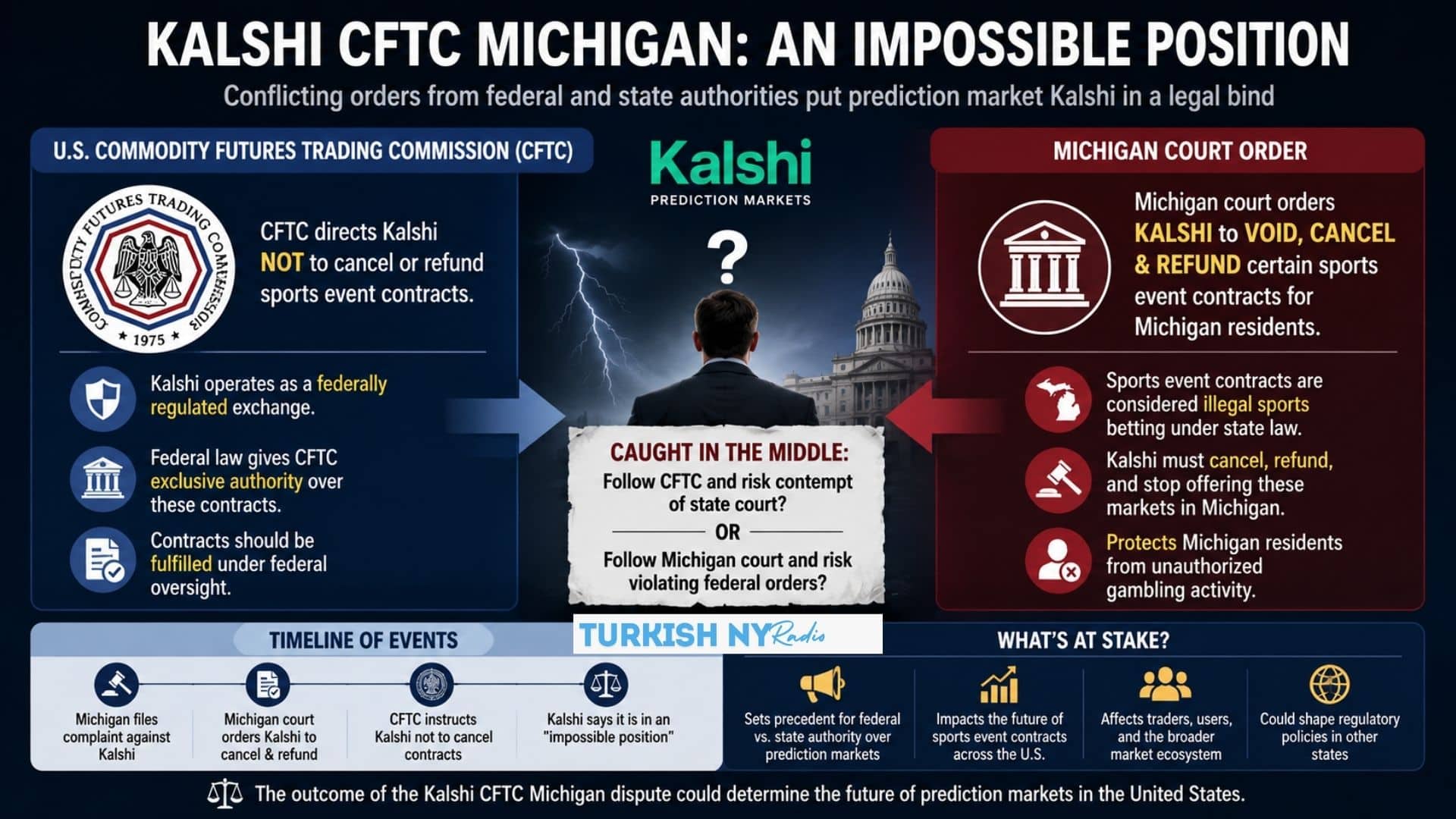
The Kalshi CFTC Michigan debate derives from conflicting conceptions of federal and state power. Kalshi is a federally authorized exchange governed by the Commodity Futures Trading Commission, which monitors derivatives and event contracts.

Yet, Michigan officials say that Kalshi’s sporting events and event contracts are similar to sports betting and so susceptible to state gaming regulations. As a result, a Michigan court ordered the company to cancel qualifying contracts, refund customers, and stop offering those markets to residents within the state.

At nearly the same time, the CFTC directed Kalshi not to unwind the contracts, maintaining that federally regulated exchanges should continue operating under federal oversight until the legal issues are resolved. This conflicting guidance has left the company unable to comply fully with both directives.
Kalshi CFTC Michigan

Why Kalshi Says It Is in an “Impossible Position”

According to Kalshi, the conflicting orders create an unprecedented compliance challenge. If the company follows the Michigan court’s instructions, it risks violating directives issued by its federal regulator. Conversely, complying with the CFTC could expose Kalshi to legal consequences in Michigan.

The Kalshi CFTC Michigan dispute illustrates the practical difficulties businesses face when state and federal authorities assert overlapping jurisdiction. Kalshi has maintained that it should not have to choose among breaching a court order and disobeying federal regulatory guidelines.

Legal professionals point out that such contradictions are unusual since federal authorities and local regulators often oversee enforcement activities. However, this scenario highlights the unpredictability surrounding markets for prediction involving sporting events.

Broader Implications for Prediction Markets

The Kalshi CFTC Michigan battle extends beyond one company. It raises more general considerations about why federally authorized prediction markets should be handled differently than regular sports betting providers.

Proponents of Kalshi believe that prediction markets are financial goods covered by federal law as opposed to gambling transactions overseen by state regulations. Critics argue that contracts based on athletic outcomes are closely related to sports betting and so belong under state authority.

The conclusion of the Kalshi CFTC Michigan issue has the potential to affect future regulatory policy in several states. If federal authority ultimately prevails, prediction market exchanges may gain stronger legal protection when offering similar contracts nationwide. If states succeed, exchanges could face different compliance requirements depending on where customers reside.

ADVERTISEMENT

The case is also being closely watched by investors, financial institutions, and market participants seeking greater regulatory clarity before expanding into event-based trading products.
Kalshi regulatory conflict

Conclusion

The Kalshi CFTC Michigan dispute represents a pivotal moment for the prediction market industry. With conflicting instructions from a federal regulator and a state court, Kalshi argues it has been placed in an untenable legal position that no regulated exchange should face.

As litigation continues, courts will likely determine whether federal oversight of prediction markets takes precedence over state gambling laws in cases involving sports-related contracts. Until then, the Kalshi CFTC Michigan case will remain a landmark regulatory challenge with significant implications for exchanges, regulators, and traders across the United States.

Summary

The Kalshi CFTC Michigan dispute centers on conflicting orders issued by a Michigan court and the U.S. Commodity Futures Trading Commission regarding sports event contracts. Michigan directed Kalshi to cancel and refund certain contracts, while the CFTC instructed the exchange not to do so. Kalshi argues these opposing directives leave it in an impossible legal position. The case could establish an important precedent for determining whether federal or state regulators have primary authority over prediction markets tied to sporting events.

Glossary of Key Terms

Kalshi: A legally authorized prediction market exchange where users may trade contracts based on upcoming occurrences.

CFTC (Commodity Futures Trading Commission): The United States government body in charge of regulating derivative and commodities markets.

Prediction Market: A trading system in which members exchange contracts depending on the probability of future events happening.

Sports Event Contracts: Financial agreements, with outcomes based on athletic events instead of regular securities.

Federal Jurisdiction: The legal power exerted by the United States federal government over specified restricted activities.

FAQs for Kalshi CFTC Michigan

1. What is the Kalshi CFTC Michigan dispute about?

It involves conflicting orders from the CFTC and a Michigan court regarding Kalshi’s sports-related event contracts.

2. Why did Michigan take action against Kalshi?

Michigan believes certain sports event contracts offered by Kalshi constitute unauthorized sports betting under state law.

3. What exactly is the CFTC’s position?

The CFTC contends that Kalshi is a federally authorized exchanges and should continue to obey federal regulatory obligations.

4. How does Kalshi claim that it is in an unsustainable position?

Therefore complying with Michigan’s court decision may contravene CFTC directions, and obeying the CFTC may contradict with the state court’s finding.

5. For what reason is this instance significant?

The verdict may influence how federal and state governments regulate prediction markets and impact the future of sports-oriented event contracts in the US.


Sources

  • CoinDesk
  • Yahoo Finance
Tags: CFTC vs Michigan KalshiCryptoNewsKalshiKalshi CFTC disputeKalshi CFTC MichiganKalshi legal battleKalshi Michigan lawsuitKalshi newsKalshi regulatory conflict
ShareTweetSharePinSend
Previous Post

UK Tokenization Roadmap Targets $44.15 Billion in Annual Output by 2035

Sami Oliver

Sami Oliver

SIMILAR NEWS

UK Tokenization Roadmap Targets $44.15 Billion in Annual Output by 2035
Cryptocurrency

UK Tokenization Roadmap Targets $44.15 Billion in Annual Output by 2035

15 July 2026
Thai crypto scam
World

Asia Crypto News: $122.5M Scam Bust, Japan Crypto Credit and Regional Regulation

14 July 2026
Why Some Bitcoin Investors May Be Waiting for a Drop to $42,429
Cryptocurrency

Why Some Bitcoin Investors May Be Waiting for a Drop to $42,429

14 July 2026

Leave a Reply Cancel reply

Your email address will not be published. Required fields are marked *

Search

No Result
View All Result
DMCA
PROTECTED

Categories

  • Business
  • Cryptocurrency
  • Economy
  • en
  • News
  • Politics
  • World

Recent Posts

  • Kalshi CFTC Michigan Dispute Puts Prediction Market Regulation in Focus
  • UK Tokenization Roadmap Targets $44.15 Billion in Annual Output by 2035
  • Asia Crypto News: $122.5M Scam Bust, Japan Crypto Credit and Regional Regulation
  • Why Some Bitcoin Investors May Be Waiting for a Drop to $42,429
  • Bitcoin Treasury Strategy Draws Analyst Debate Over Market Risks and Rewards
TurkishNY Radio

Site Navigation

  • Home
  • About Us
  • Terms and Conditions
  • Privacy Policy
  • Disclaimer
  • Contact

TurkishNY Radio

Banner 1
Banner 2
No Result
View All Result
  • Home
  • Cryptocurrency
  • Business
  • Economy
  • tr Türkçe
  • en English

  • English