

This article was first published on TurkishNY Radio.
The fight over prediction markets in the United States is becoming more serious after the Commodity Futures Trading Commission stepped in to support Kalshi in its legal dispute with Ohio regulators.


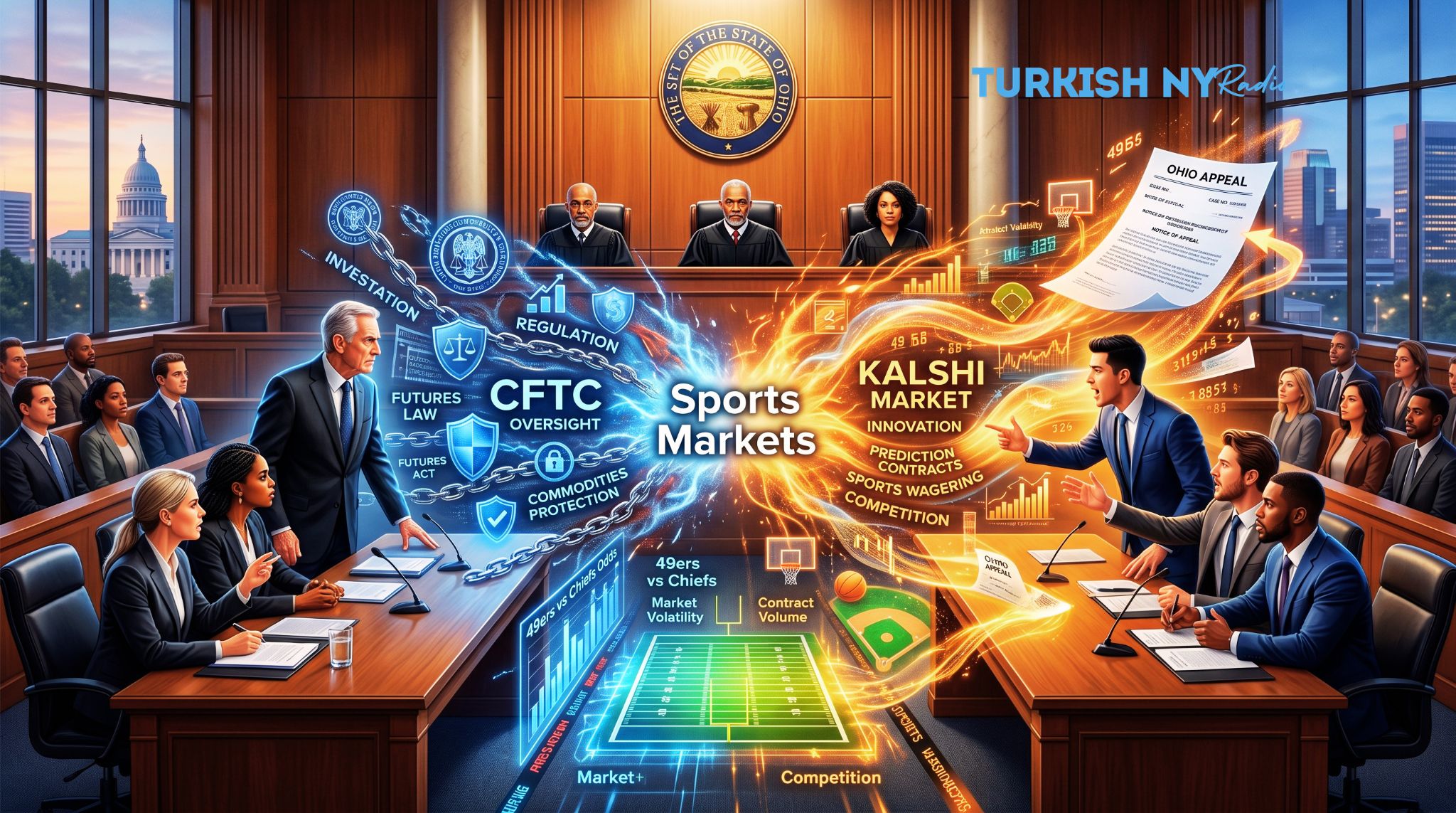
In a court filing submitted on May 12, the CFTC asked the U.S. Court of Appeals for the Sixth Circuit to uphold federal authority over Kalshi’s event contracts.
The agency argued that Ohio regulators went beyond their powers by treating federally regulated contracts as illegal sports gambling.
The case has become one of the most important legal tests for prediction markets, especially as platforms tied to crypto trading and blockchain-based forecasting continue to grow across the U.S.
CFTC Kalshi Ohio Appeal Fuels Legal Clash
The CFTC Kalshi Ohio appeal began after Ohio authorities ordered Kalshi to stop offering sports-event contracts in the state. Regulators claimed the products looked too similar to sports betting operations that require state gambling licenses.
Kalshi challenged the order in court, arguing its contracts are already supervised by the CFTC under federal commodities law. However, a district court denied the company’s request for immediate protection earlier this year, leading to the current appeal.
In its latest filing, the CFTC said the lower court interpreted federal authority too narrowly. The agency maintained that Congress gave the CFTC exclusive oversight over federally approved event contracts traded on registered exchanges.
CFTC Chairman Michael S. Selig criticized the Ohio decision directly.
“The CFTC will not allow overzealous state governments to undermine the agency’s longstanding authority over these markets,”
Selig said in the filing.
The CFTC Kalshi Ohio appeal now carries broader importance because several other states are attempting to challenge similar contracts.
CFTC Kalshi Ohio Appeal Draws More Scrutiny
The legal pressure surrounding prediction markets is no longer limited to Kalshi.
Over the past year, companies including Polymarket, Robinhood, Coinbase, and Crypto.com have all faced questions about whether sports and political event contracts should be treated as financial products or gambling activities.
State regulators argue that contracts tied to sports outcomes function similarly to traditional betting products.
Prediction market operators and federal regulators continue to argue the opposite, saying the contracts belong under derivatives law instead of state gambling frameworks.
The debate has become more visible as prediction markets attract larger trading volumes during elections, sports tournaments, and major economic events.
According to Kalshi’s public market data, sports-event contracts now represent a substantial portion of activity on the platform. That increase has pushed regulators to examine whether these products should remain under federal supervision alone.
CFTC Kalshi Ohio Appeal Could Affect Crypto Prediction Platforms
The CFTC Kalshi Ohio appeal may also influence the future of crypto-linked prediction markets.
Blockchain-based platforms such as Polymarket have gained significant attention over the past two years, especially during the U.S. election cycle. Some crypto users view prediction markets as an alternative source of real-time sentiment and market forecasting.
Research published by Prediction Arena earlier this year found that AI trading systems and automated forecasting models are becoming increasingly active across prediction market platforms.
At the same time, regulators remain concerned about consumer protections, market manipulation risks, and whether these products bypass existing state gambling laws.
A separate federal appeals ruling earlier this year already strengthened Kalshi’s position in New Jersey. In that case, the court sided with federal oversight for CFTC-supervised event contracts.
Still, the Ohio dispute shows the legal battle is far from settled.

Wider Industry Stakes Continue to Grow
The CFTC Kalshi Ohio appeal could eventually help define how prediction markets operate across the United States.
Several legal experts believe these cases may ultimately reach the U.S. Supreme Court because they involve federal preemption, derivatives law, and state gambling authority.
For crypto-related prediction platforms, the outcome may shape future growth, licensing requirements, and access across different states.
The CFTC’s latest filing also signals that the agency intends to defend its authority aggressively as more states challenge federally regulated event contracts.
Summary
- The CFTC has stepped in to support Kalshi in its legal fight with Ohio, saying the company’s prediction market contracts should be regulated at the federal level instead of being treated like sports betting.
- The CFTC Kalshi Ohio appeal is becoming an important case for the future of prediction markets tied to sports, politics, and crypto activity.
- Several states are questioning how these platforms should operate, while federal regulators continue defending their authority over the sector.
- The final decision could influence how prediction markets grow across the United States in the coming years.
Glossary of Key Terms
- Prediction Market
A platform where people trade on the outcome of future events, such as elections, sports games, or economic decisions, based on what they think will happen. - CFTC (Commodity Futures Trading Commission)
A U.S. government agency that oversees futures and derivatives markets to help ensure trading remains fair, transparent, and properly regulated. - Event Contract
A type of financial agreement linked to a real-world event, allowing traders to predict whether something will happen before a deadline. - Federal Oversight
When a national regulator, instead of individual states, is responsible for monitoring and enforcing rules for certain financial products or markets. - Sports Gambling Laws
Rules created by individual states to regulate sports betting activities, including licensing requirements, consumer protections, and operational restrictions. - Derivatives Market
A financial market where contracts gain value from another asset or event, such as commodities, stocks, interest rates, or predictions. - Amicus Brief
A document submitted to a court by someone not directly involved in a case to provide expert opinions or additional legal arguments. - Crypto Prediction Platform
A blockchain-based platform where users make predictions on future events using cryptocurrency instead of traditional payment systems.
FAQs About CFTC Kalshi Ohio Appeal
What is the CFTC Kalshi Ohio appeal about?
The case is about whether Kalshi’s sports prediction contracts should be treated as federally regulated financial products or as state-controlled sports betting activity.
Why is the CFTC backing Kalshi?
The CFTC says these contracts already fall under federal oversight and believes states should not create separate rules for federally approved prediction markets.
How could this impact crypto prediction platforms?
The decision may influence how crypto-based prediction platforms operate in the U.S., especially those offering event markets tied to sports, politics, or economic outcomes.
Could prediction market users face new restrictions?
Possibly. Depending on future court decisions, some states could tighten rules, add compliance requirements, or limit access to certain prediction market products.