






The current labor market is already in motion, and the future of work in Web3 is no longer an abstract slogan. Developers, designers, analysts, community managers, and even lawyers now find real, on-chain careers that exist across borders and time zones.
In this new environment, crypto networks behave like open job markets, and digital assets function as both payment rails and ownership stakes. The result is a work model that feels closer to an internet-native economy than a traditional corporate ladder.
At the same time, the future of work in Web3 brings real challenges. Income can be volatile, rules are still evolving, and not every project survives a full market cycle. For professionals who want to participate, the key is to understand how this ecosystem works, which signals really matter for crypto projects, and where the most sustainable roles are likely to appear.
Understanding the architecture behind the future of work in Web3
To understand the future of work in Web3, it helps to start with the basics. Web3 refers to an internet where users can own assets, identities, and data directly through cryptographic keys and blockchain networks. In this setting, labor is not tied to a single jurisdiction or employer. It is tied to protocols, tokens, and communities.
The future of work in Web3 depends heavily on public blockchains that support smart contracts. These chains host decentralized applications, DeFi platforms, NFT markets, and gaming ecosystems. Each of these verticals generates tasks: coding smart contracts, auditing security, creating content, managing communities, and analyzing on-chain data. The network itself acts like an always-on marketplace where talent and capital meet.
New job categories and the evolving talent stack
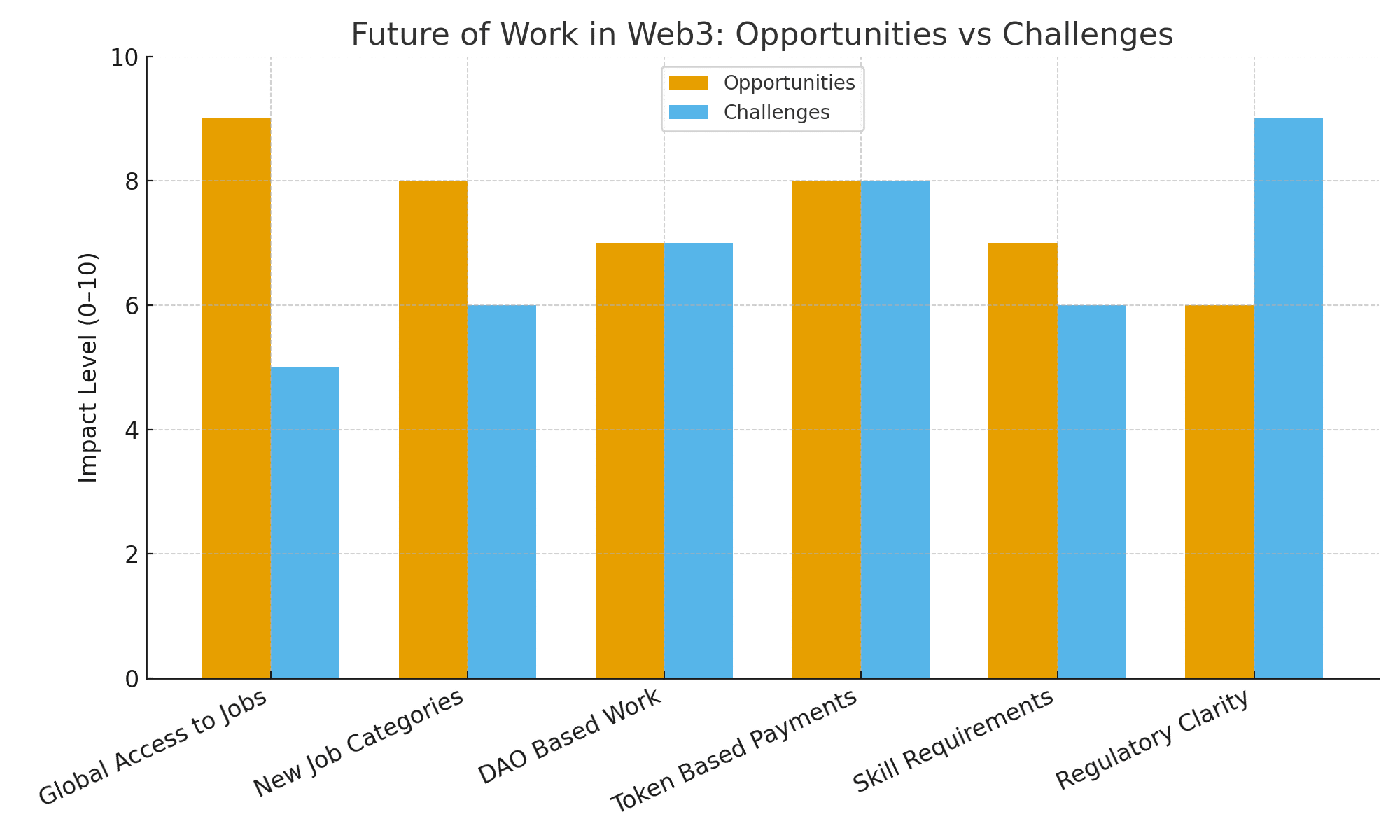
Recruiters who study the future of work in Web3 already see a very different job board from the one in traditional finance or technology. There are protocol engineers who write and review smart contracts, DeFi risk analysts who track liquidity pools, governance specialists who coordinate voting within decentralized organizations, and token economists who design incentive structures for communities.
The future of work in Web3 also opens doors for non-technical roles. Community leads, social media strategists, content editors, educators, event organizers, and partnership managers all find room in this expanding space. Many of these positions reward crypto literacy over formal titles. A person who understands how to read on-chain metrics, follow token flows, and evaluate treasury health can quickly become valuable, even without a traditional resume.
DAOs, remote work, and the organizational shift
Decentralized autonomous organizations sit at the center of the future of work in Web3. Instead of a hierarchical company, a DAO operates like a shared digital treasury with on-chain rules. Contributors propose tasks, complete them, and receive tokens in return. Voting systems help align decisions with community interests.
For many professionals, this structure reshapes daily work. There is more flexibility, but also more responsibility. Income may come from multiple DAOs at once, across different chains. The future of work in Web3 therefore looks more like a portfolio of contributions than a single full-time contract. This can be liberating for skilled contributors, but confusing for anyone who prefers a predictable career ladder and fixed salary.
Crypto indicators that matter for workers and builders
Serious contributors cannot ignore the financial side of this ecosystem. Token prices may draw headlines, but the future of work in Web3 is better understood through deeper crypto indicators.
Market capitalization reveals the relative size of a project and its potential influence on the broader ecosystem. Trading volume and liquidity show whether contributors can actually convert token earnings to more stable assets without heavy slippage. On-chain activity, such as transaction count and active addresses, helps reveal whether a network has genuine user demand or primarily speculative interest.
Total value locked in DeFi platforms is another important indicator, because it reflects how much capital trusts the protocol infrastructure. Developer activity, such as the number of commits, open source contributions, and audits, points to the strength of the technical community.
Regulatory signals, including approvals of compliant products and clear rules for token classifications, influence the long term viability of roles in that ecosystem. Anyone who is serious about the future of work in Web3 needs at least a working familiarity with these metrics.
Payments, benefits, and income volatility
Compensation is one of the most visible shifts within the future of work in Web3. Many contributors receive payment in native tokens, stablecoins, or a mix of both. Token-based pay can offer upside when a project succeeds, but it can also create very real downside when markets turn.

Stablecoins are often used to provide more predictable income, especially for core team members and key contractors. However, even with stable assets, there are questions around benefits such as health coverage, retirement planning, and legal protections.
At this stage, the future of work in Web3 still lacks the standardized benefit packages that exist in traditional employment. Professionals often need to build their own financial safety nets, rebalance their holdings, and plan for tax obligations across jurisdictions.
Regulation, compliance, and worker protection
Regulation will play a defining role in the future of work in Web3. As governments clarify how they treat tokens, stablecoins, and DeFi platforms, legal expectations around employment, contractor status, taxation, and consumer protection will become more concrete. This will influence how DAOs operate, how treasuries pay contributors, and how projects report financial information.
The future of work in Web3 depends on a balance. Strict rules can drive responsible projects to adopt better risk controls and transparency. However, heavy-handed regulation can push innovation offshore or into informal channels. Workers who want long term careers in this space benefit from jurisdictions that respect both innovation and investor protection, and from projects that willingly adopt strong governance and compliance practices.
Skills, education, and career paths in the future of work in Web3
Education is already adjusting to the future of work in Web3. Universities, private academies, and independent educators are starting to offer content on blockchain development, token design, crypto economics, and on-chain analysis. At the same time, self-directed learning remains powerful, since so much code and governance data is publicly available.
Successful professionals in the future of work in Web3 often combine technical literacy with communication skills. They may not all be full-stack developers, but they understand how smart contracts function, how wallets interact with networks, and how to explain complex topics in plain language. They cultivate reputations through public contributions, open source work, governance participation, and consistent engagement in community channels.
Global inclusion and geographic shifts
One of the most promising aspects of the future of work in Web3 is global inclusion. Anyone with a basic internet connection can contribute to open protocols, earn tokens, and build a track record. This breaks many of the old barriers tied to geography, degree status, or local job markets.
At the same time, this global reach introduces competition. Professionals in regions with lower living costs can submit very competitive bids for on-chain work. This can compress rates for certain tasks, especially entry-level roles. To stand out in the future of work in Web3, contributors increasingly need to demonstrate unique skills, strong reliability, and a clear understanding of crypto fundamentals.
A maturing, yet experimental labor market
Despite the volatility of digital asset markets, the direction of travel is clear. The future of work in Web3 is moving from an experimental side project for a small group of enthusiasts to a serious career path for technologists, creatives, and financial professionals. Some projects will fail, others will merge, and a few will mature into large, protocol-driven economies that support thousands of workers.
In this environment, the future of work in Web3 rewards those who stay informed, read the right indicators, and treat their involvement as a long-term professional journey rather than a quick win. Careful risk management, consistent learning, and thoughtful collaboration will matter just as much as raw technical talent.
Conclusion
The future of work in Web3 represents both a new frontier and a serious responsibility. It offers open access to global job markets, more flexible income models, and genuine ownership stakes through tokens and governance rights. It also brings risks that range from income volatility to regulatory uncertainty and project failure.
For workers, founders, and investors, the most sustainable path involves a realistic view of crypto indicators, a disciplined approach to personal finance, and a commitment to transparent, ethical behavior. If those pieces come together, the future of work in Web3 can support a healthier, more inclusive digital economy that outlives any single market cycle.
Frequently Asked Questions
1. What does the phrase “future of work in Web3” actually mean?
The phrase “future of work in Web3” describes how blockchain networks, digital assets, and decentralized organizations are changing how people earn income, hold ownership, and build careers across borders.
2. Which skills are most valuable in the future of work in Web3?
In the future of work in Web3, skills in smart contract development, security auditing, token economics, governance, and on-chain analysis are highly valuable, along with strong communication and community management abilities.
3. Is income in the future of work in Web3 too risky for most professionals?
Income in the future of work in Web3 can be volatile, especially when pay arrives in native tokens, but careful use of stablecoins, diversification, and basic risk management can reduce the most serious shocks.
4. How can professionals evaluate projects in the future of work in Web3?
Professionals can evaluate opportunities in the future of work in Web3 by studying market capitalization, liquidity, trading volume, total value locked, developer activity, community engagement, and the clarity of a project’s regulatory posture.
Glossary of Key Terms
Web3
A vision for the internet in which users control digital assets, identities, and data directly through blockchain networks and cryptographic keys.
DAO (Decentralized Autonomous Organization)
A digitally native organization that manages resources and decision making through on-chain rules, token-based voting, and transparent treasuries.
Smart Contract
Self-executing code stored on a blockchain that runs exactly as programmed, often used to manage financial transactions, governance processes, or application logic.
Market Capitalization
The total value of a crypto asset, calculated by multiplying its current price by its circulating supply, often used to compare the relative size of projects.
Total Value Locked (TVL)
The total amount of crypto assets deposited in a DeFi protocol, which reflects how much capital users are willing to commit to that platform.
Stablecoin
A digital asset that aims to maintain a stable value, often pegged to a fiat currency, and widely used in the future of work in Web3 as a more predictable form of compensation.
References