
The Federal Reserve reduced the policy rate by a quarter point to a 3.75% to 4.00% range, then asked everyone to cool the enthusiasm about what comes next. Chair Jerome Powell told reporters that a December cut is not a done deal.
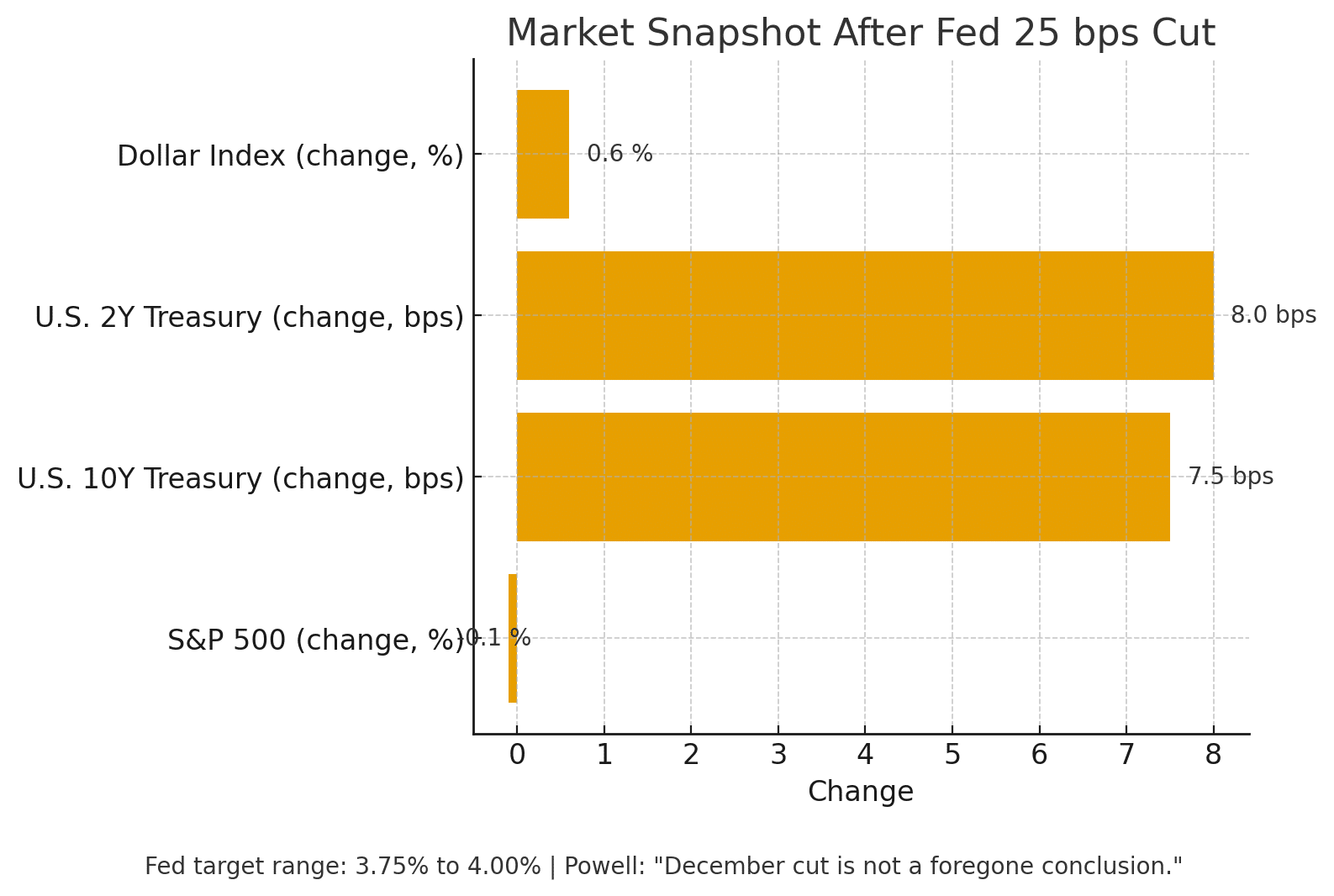
With parts of the government still shut and data feeds disrupted, the central bank is flying with fewer instruments and prefers to move carefully. Markets heard the message. Equities wobbled, Treasury yields climbed, and the dollar firmed as traders dialed back aggressive easing bets.


The Decision, The Vote, The Signal
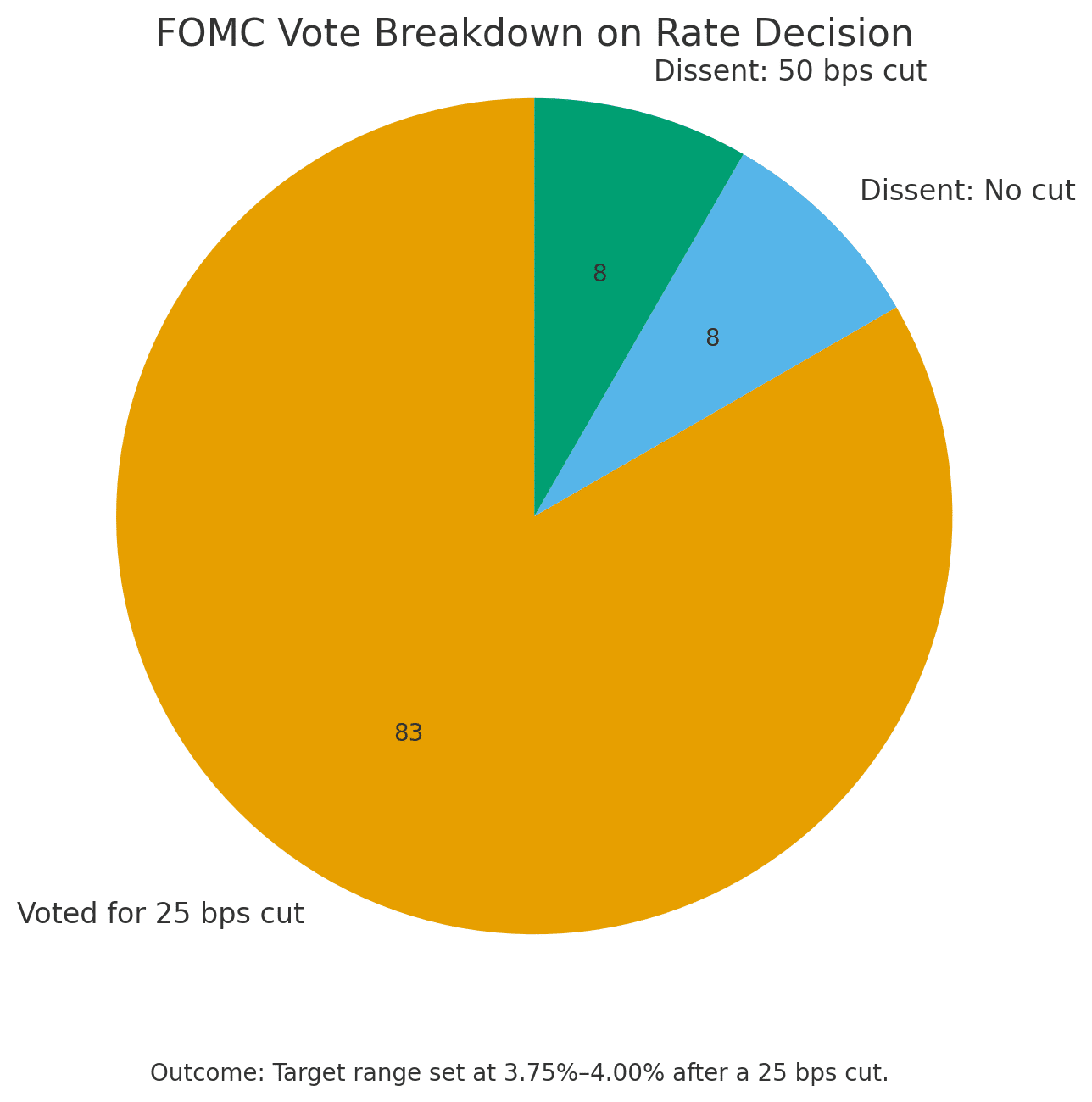
The Federal Open Market Committee voted to lower rates by 25 basis points. The vote was not unanimous, which underscored visible tension about the path ahead.
The committee recognized a softening labor market and the risks of acting on thinner data while parts of the government’s statistical machinery are offline. The policy statement kept flexibility at the center and avoided pre-committing to another move this year.
Powell’s message after the decision was direct. “A December cut is not a foregone conclusion,” he said, adding that the committee needs clearer evidence before it moves again. The line stuck because markets had penciled in a glide path of steady cuts into the year-end. When the Fed declined to validate that path, stocks lost altitude and bond yields rose.
Liquidity Gets a Cushion
Alongside the rate move, the Fed signaled limited Treasury purchases to ease emerging money-market strains. It also set out plans to end the balance-sheet runoff by December 1 to protect the plumbing of short-term funding and keep control over policy rates.


This is the quiet headline that could matter most for 2026. A slower or halted drawdown supports bank reserves and reduces the risk of money-market volatility at a sensitive moment for the economy.
Ending the runoff has a fiscal angle, too. The Treasury has leaned heavily on short-dated bills this year. A steadier reserve backdrop and a calmer bill market give the Treasury room to fund without crowding dealers or shocking auctions. That convenience is not the goal of monetary policy, but it is a useful by-product when market liquidity feels thin.
What Moved and Why
The first draft of market history looked like this: the Dow slipped, the S&P 500 finished near flat, and the Nasdaq outperformed. The dollar rose as traders trimmed expectations for a rapid easing cycle.
Long yields pushed higher, reflecting less faith in another quick cut and a touch more term premium. None of this was extreme, but it captured a simple shift. The Fed will ease when the data justify it, and the data are blurred by the shutdown.
Overseas, knock-on effects showed up quickly. The dollar index ticked higher, pressuring peers and weighing on risk appetite in parts of Asia and Europe. That pattern often appears when the Fed leans cautious after a move. It can fade fast if incoming evidence weakens, but with the data hose kinked, conviction is difficult.
The Job Market, Inflation, and the “Cuts Do Not Solve Everything” View
Powell’s guidance hinted at a deeper debate. If the goal is to prevent a sharp labor slowdown, rate cuts help at the margin, but they are not a cure-all.
Some Fed watchers read his tone as a reminder that the transmission of easier policy takes time and can be noisy when supply, immigration, and productivity are all moving parts. “Not a slam dunk” for December was more than a scheduling note. It suggested a willingness to wait for clearer signals that an easier policy will do more good than harm.
Inflation risks into 2026 complicate the story. Analysts point to unusually large tax refunds, shifting fiscal flows, and still-healthy corporate investment as potential sources of stickier demand.
That cocktail is not a forecast of rising inflation, but it is a reason for caution. Hence the preference to secure market plumbing, keep optionality, and avoid promising a path that the Fed may need to walk back.
A Futuristic Read: The 2026 prediction
Look one turn ahead. If the balance-sheet runoff ends and reserve balances stabilize, market microstructure improves. That helps the payment rails of the economy handle heavier digital throughput as AI-driven capex scales and cloud data centers continue to soak up financing.
With a sturdier funding base, credit channels can support mid-cap investment and housing without constant hiccups in repo or bill markets. The path is not linear, but the design is clear. The Fed wants a reserve regime that avoids 2019-style funding stress while it calibrates the policy rate with prudence.
For households, a gentler rate profile can ease mortgage resets and credit card APRs, though not immediately. For firms, the signal is stability. If wage growth cools without an unemployment spike, 2026 could look like a productivity story rather than a hard landing story.
The ceiling on that optimistic case remains the same. If the dollar holds firm and long yields refuse to fall, financial conditions will stay tight enough to check animal spirits.
What Matters Most For Readers Who Track Indicators
The headline rate is important, but three gauges deserve a front-row seat in the weeks ahead.
First, watch weekly jobless claims and continuing claims once they resume. These are early pressure points for the labor market and often turn before nonfarm payrolls.
Second, track core services inflation ex-housing. If that measure cools, it strengthens the case for gradual easing even with noisy headline prints.
Third, pay attention to the effective fed funds rate relative to administered rates in money markets. If the Fed’s liquidity steps keep spreads quiet, policy transmission stays orderly. Those mechanics are not glamorous, but they shape financing costs for everything from car loans to data center projects.
Why The Data Gap Changes Everything
The government shutdown does not just hinder economists who love spreadsheets. It harms the quality of decision-making. If payrolls, CPI components, or retail sales arrive late or in partial form, the Fed must infer more from markets, high-frequency private trackers, and anecdotes.
That raises the value of qualitative assessments from the Beige Book and external surveys, and it raises the cost of a mistake. The committee can hedge with liquidity support and a slower balance-sheet strategy. It cannot hedge with promises about the future when the dashboard is dim.
Markets Into Year-End: A Practical Map
What should investors expect if December is truly open? Think of a corridor rather than a single point. In the upper part of the corridor, inflation proves sticky and long yields refuse to fall. The Fed holds and signals patience.
In the middle, inflation continues to glide lower, the labor market cools without breaking, and a modest December move stays alive. In the lower part, growth data re-accelerate or weaken sharply, and the committee delays or shifts the size of cuts accordingly.
Positioning around that corridor already showed up. The dollar gained, curve bets shifted, and equity leadership swung toward firms with balance-sheet strength and secular earnings tailwinds. Those are textbook reactions to a central bank that refuses to pre-commit.
The Long View: Policy Architecture After QT
Ending the balance-sheet runoff looks tactical, but it is part of a larger regime choice. The Fed has moved toward an ample-reserves framework where the level of reserves is high enough that small shifts in demand do not throw money markets off balance.
That architecture matters for a world with heavier digital payment flows, more Treasury issuance, and capital-intensive AI infrastructure. The central bank can manage that world with a combination of administered rates, standing facilities, and a balance sheet that flexes when needed. The October decision fits that blueprint.
Conclusion
This was a cut with guardrails. The Fed eased, then reminded markets that patience is a policy, not a slogan. Liquidity support and an end to balance-sheet runoff reduce the risk of plumbing problems as the economy heads into 2026.
The door to December is open but not wide. The next steps depend on cleaner data and a clearer picture of the labor market. That is not thrilling as a headline, but it is the discipline that reduces policy error when visibility is low.
Frequently Asked Questions
Did the Fed promise another cut in December?
No. Chair Jerome Powell said a December cut is “not a foregone conclusion,” which means the committee will decide based on incoming evidence rather than a preset plan.
Why did stocks wobble if the Fed cut rates?
Markets had priced a series of cuts. When the Fed refused to validate that path, equities lost momentum, Treasury yields rose, and the dollar strengthened.
What is the significance of ending the balance-sheet runoff?
Halting the drawdown stabilizes bank reserves and helps keep money-market rates aligned with the policy rate. It reduces the odds of funding stress as the economy absorbs heavy Treasury issuance.
Is inflation still the main risk?
Inflation remains a central risk into 2026. Analysts caution that fiscal dynamics and resilient demand could limit the speed of disinflation, which is why the Fed is careful about promising rapid easing.
How does the shutdown affect policy decisions?
With key data delayed or incomplete, the Fed has less visibility. That raises the value of caution and strengthens the case for keeping options open between meetings.
Glossary of Key Terms
Ample-reserves framework
A monetary policy system in which the central bank maintains a level of bank reserves high enough that small shifts in demand do not push the policy rate around. It allows administered rates and standing facilities to steer money-market conditions more reliably. Ending balance-sheet runoff aligns with maintaining ample reserves.
Balance-sheet runoff
The process of shrinking the central bank’s asset holdings by allowing securities to mature without reinvestment. The Fed’s plan to end runoff near December 1 is meant to support market liquidity and rate control.
Policy transmission
The chain of effects that runs from a Fed decision to real-world borrowing costs, investment, jobs, and inflation. When markets are volatile or data are scarce, transmission becomes noisier, which raises the benefit of caution.
Term premium
An extra yield that investors demand for holding longer-dated bonds rather than rolling short-term instruments. It can rise when uncertainty about the policy path or inflation increases, pushing long yields higher after a meeting.
Standing facilities
Permanent tools such as the discount window or overnight reverse repo facility that help anchor short-term rates. In an ample-reserves world, these facilities reinforce rate control when funding pressures appear.
Market plumbing
Informal term for the set of institutions and mechanisms that move cash and collateral through the financial system. When the Fed fortifies liquidity with targeted purchases or ends runoff, it is tending to the plumbing.
Effective fed funds rate
The weighted average rate that banks charge one another for overnight loans of reserves. Keeping this rate within the target range is the operational goal of policy, and adequate reserves help hold it steady.