
The Copy Fail Linux vulnerability has turned an old kernel weakness into a fresh warning for the crypto industry. The issue does not break Bitcoin, Ethereum, or any blockchain protocol by itself. The real concern sits underneath the market, inside the Linux servers that help run exchanges, validators, wallets, custody platforms, mining pools, and cloud-based trading systems.
This flaw can let a low-level local user gain root access on affected machines, which is the digital equivalent of getting the master key to the building. For an industry built around private keys, uptime, and trust, that is not a small matter.


Copy Fail Linux Vulnerability Explained for Crypto Readers
The Copy Fail Linux vulnerability, tracked as CVE-2026-31431, is a local privilege escalation flaw in the Linux kernel’s cryptographic interface. Security researchers said the bug can allow an authenticated user with limited local access to gain root privileges on unpatched systems. That matters because root control gives an attacker deep power over a machine, including the ability to alter files, read sensitive data, disable security tools, or move further across a network.
The issue is tied to Linux kernel behavior inside cryptographic components, especially how data handling can lead to controlled writes into the page cache of readable files. Researchers also released public proof-of-concept material, which raised the risk level because attackers no longer need to discover the method from scratch.
Why Crypto Companies Should Care
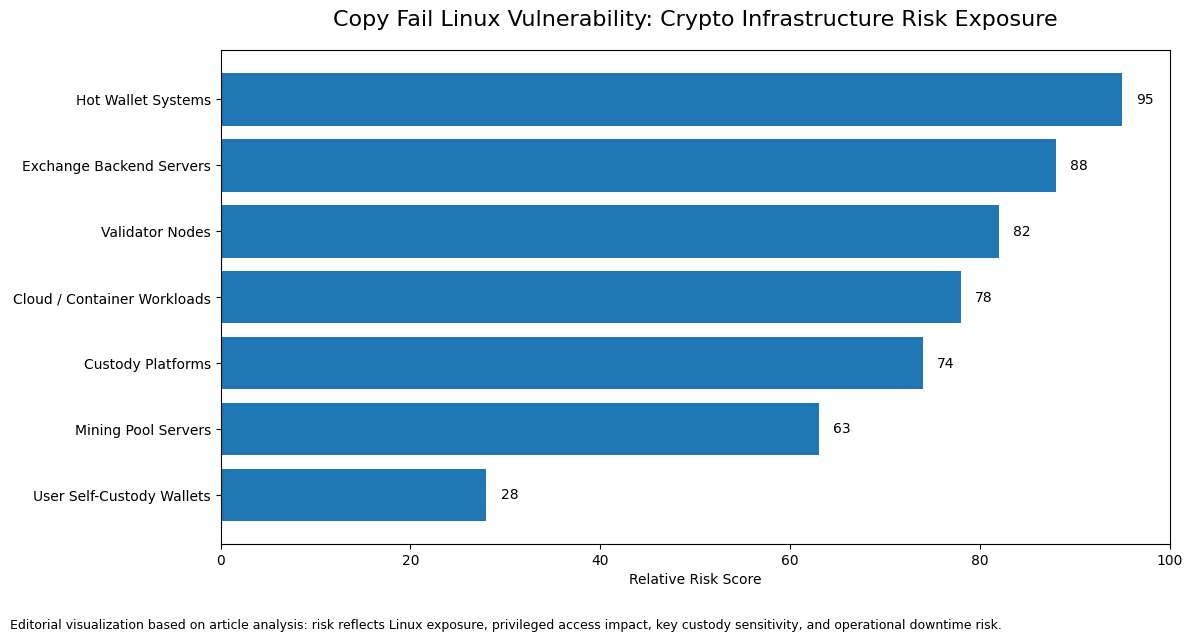
The Copy Fail Linux vulnerability is not a “crypto hack” in the usual sense. It does not drain a wallet through a smart contract bug, and it does not rewrite a blockchain ledger. Still, crypto firms are exposed because their business often depends on Linux-heavy infrastructure. Matching engines, hot-wallet systems, validator nodes, RPC endpoints, custody dashboards, analytics stacks, and Kubernetes clusters commonly run on Linux environments.
That is where the danger becomes practical. An attacker may first enter through a weaker door, such as stolen staff credentials, exposed SSH access, a vulnerable web app, or a compromised container. Once inside with limited privileges, this bug could help them climb to root. From there, the attacker may try to access key material, tamper with logs, interrupt withdrawals, manipulate backend services, or plant persistence tools for later use.
The Bigger Risk Is Trust, Not Just Code
Crypto markets run on confidence. When an exchange pauses withdrawals, a validator drops offline, or a custody platform reports “technical issues,” users rarely wait calmly for a postmortem. They move funds, ask questions, and sometimes assume the worst.
The Copy Fail Linux vulnerability therefore creates two risks at once. The first is technical compromise. The second is reputational damage. A platform may patch the flaw before any funds are lost, but if it fails to communicate clearly or monitor properly, the market may still punish it. In crypto, silence can create its own fire.
Key Indicators Crypto Teams Should Watch
For crypto security teams, the first indicator is patch status. Systems running affected Linux kernels should be identified quickly, especially production servers tied to wallets, validators, trading engines, custody operations, and cloud workloads. Major Linux distributions and vendors have issued guidance or patches, while security teams have been urged to apply fixes and harden exposed environments.

The second indicator is local access exposure. This flaw needs a foothold. That means companies should review who has shell access, which service accounts exist, what containers can do, and whether internal systems allow unnecessary user-level access. Crypto firms often focus on external attackers, but many serious incidents start with basic internal access that gets upgraded into something worse.
The third indicator is abnormal privilege behavior. Security teams should monitor for unusual setuid binary changes, suspicious Python execution, privilege jumps, unexpected root shells, and changes to security tooling. Cloud providers and infrastructure operators have also emphasized behavioral detection because the exploit pattern can be detected even when traditional file checks are not enough.
What Exchanges and Validators Should Do Now
The Copy Fail Linux vulnerability needs a boring but strict response: patch, reboot where required, verify, and keep records. Security teams should not assume that one package update solves every exposure. Cloud images, containers, backup servers, test machines, validator nodes, and forgotten internal boxes can all become weak links.
Crypto exchanges should prioritize hot-wallet infrastructure, withdrawal systems, admin dashboards, build servers, CI/CD pipelines, and employee-accessed jump boxes. Validators and staking operators should review node machines, signing environments, monitoring agents, and remote access rules. Custody firms should also separate signing systems from general-purpose Linux environments wherever possible, because private key exposure is a far different problem from a temporary outage.
A practical response also includes reducing SSH access, enforcing multi-factor authentication, rotating credentials after suspicious activity, reviewing sudoers files, removing unused local accounts, and watching logs for privilege escalation attempts. This is not glamorous work, but in security, the plumbing often saves the house.
What Regular Crypto Users Need to Know
For ordinary investors, the Copy Fail Linux vulnerability does not mean a private wallet is automatically at risk. A hardware wallet sitting offline is not exposed simply because Linux has a kernel flaw somewhere in the world. The risk is more indirect.
Users could be affected if a platform they rely on runs vulnerable infrastructure and fails to patch it. That could lead to downtime, delayed withdrawals, account security concerns, or in a severe case, compromise of platform systems. The sensible move is to use strong account security, avoid keeping unnecessary funds on exchanges, and watch official platform updates when major infrastructure flaws are disclosed.
Why Old Bugs Keep Returning
The Copy Fail Linux vulnerability is also a reminder that old code can become a new market risk. Linux is widely trusted because it is open, tested, and used everywhere, but that scale cuts both ways. A flaw in a deep kernel component can travel across cloud servers, enterprise platforms, developer machines, and crypto systems for years before it becomes public.
Crypto has seen this pattern before in other forms. The weak point is often not the chain itself, but the systems around it. Wallet interfaces, cloud permissions, bridges, admin keys, deployment scripts, and operational habits can decide whether a technical flaw becomes a financial event.
Conclusion
The Copy Fail Linux vulnerability should be treated as an infrastructure security event for the crypto sector, not a passing technical footnote. It affects the layer that many crypto businesses quietly depend on every day. Blockchains may be decentralized, but many services around them still run on ordinary servers, ordinary kernels, and ordinary access controls.
The clear path is patching, hardening, monitoring, and plain communication. Firms that act early reduce both technical and trust risk. Firms that wait may discover the hard way that in crypto, infrastructure hygiene is part of asset protection.
Frequently Asked Questions
What is the Copy Fail Linux vulnerability?
The Copy Fail Linux vulnerability is a Linux kernel local privilege escalation flaw tracked as CVE-2026-31431. It may let a user with limited local access gain root privileges on affected systems.
Does it directly hack crypto wallets?
No. It does not directly break blockchains or private wallets. The bigger concern is crypto infrastructure, such as exchanges, validators, custody systems, and cloud servers.
Why is root access dangerous?
Root access gives an attacker high-level control over a Linux machine. That can include reading sensitive files, changing system behavior, disabling security tools, or moving deeper into a network.
Should crypto users move funds?
Users should not panic, but they should avoid leaving unnecessary funds on platforms, use strong account security, and follow updates from services they depend on.
What should crypto companies do first?
They should identify affected Linux systems, apply kernel patches, reboot where needed, limit local access, review privileged accounts, and monitor for suspicious escalation activity.
Glossary of Key Terms
Linux Kernel
The core part of the Linux operating system that manages hardware, memory, processes, and system-level operations.
Local Privilege Escalation
A security flaw that lets someone with limited access gain higher permissions on the same machine.
Root Access
The highest level of control on a Linux system. A root user can make major changes across the machine.
Validator Node
A server that helps verify blockchain transactions and maintain network consensus.
Hot Wallet
A crypto wallet connected to the internet, often used by exchanges for faster deposits and withdrawals.
Patch
A software update that fixes a known bug or security weakness.
Sources
Disclaimer: This article is for educational and informational purposes only. It is not cybersecurity, financial, or investment advice. Crypto platforms and users should consult qualified security professionals before making operational decisions.