



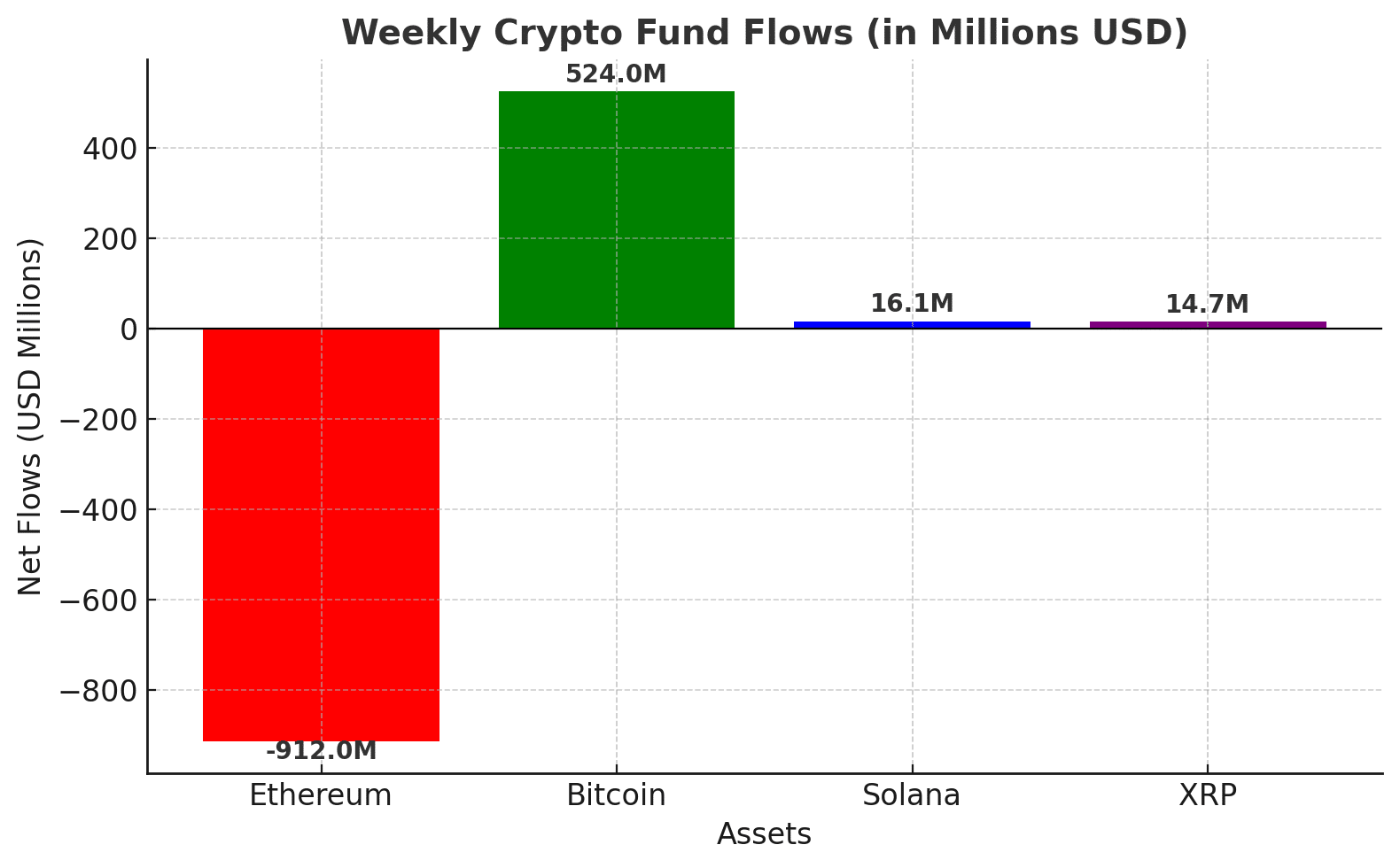
The cryptocurrency market is seeing a change as Ethereum outflows dominate the conversation, with roughly $912 million leaving Ethereum-linked goods in just one week.
While this is the seventh straight session of withdrawals, the situation has not been consistent throughout the industry. Bitcoin had a dramatic bounce, attracting over $524 million in inflows, while Solana and XRP quietly cemented their places as top altcoin achievers.


Ethereum outflows indicate investor caution
Ethereum outflows have made headlines this week, causing alarm among traders and experts alike. Institutional products linked to the asset saw $912 million in withdrawals, despite macroeconomic variables such as worse US job statistics and expected Federal Reserve rate reduction, which generally support risk-taking mood. The discrepancy has perplexed market watchers.
One expert said on X, “Ethereum’s lack of staking yield in ETF structures is causing concern. Investors are seeking elsewhere for rewards.”
This belief explains why Ethereum outflows remain, despite generally favorable conditions. The lack of income makes Ethereum-based ETFs less appealing, especially when compared to competitors that continue to draw funds.
Bitcoin, Solana, and XRP shine!
In contrast to Ethereum outflows, Bitcoin has regained its supremacy. According to data, the biggest cryptocurrency received $524 million in new inflows last week, highlighting its attractiveness as a safe haven during times of market turmoil.
Investors seeking stability appear to be strengthening their positions in Bitcoin, confident that its store-of-value story will hold up in the face of impending governmental changes.
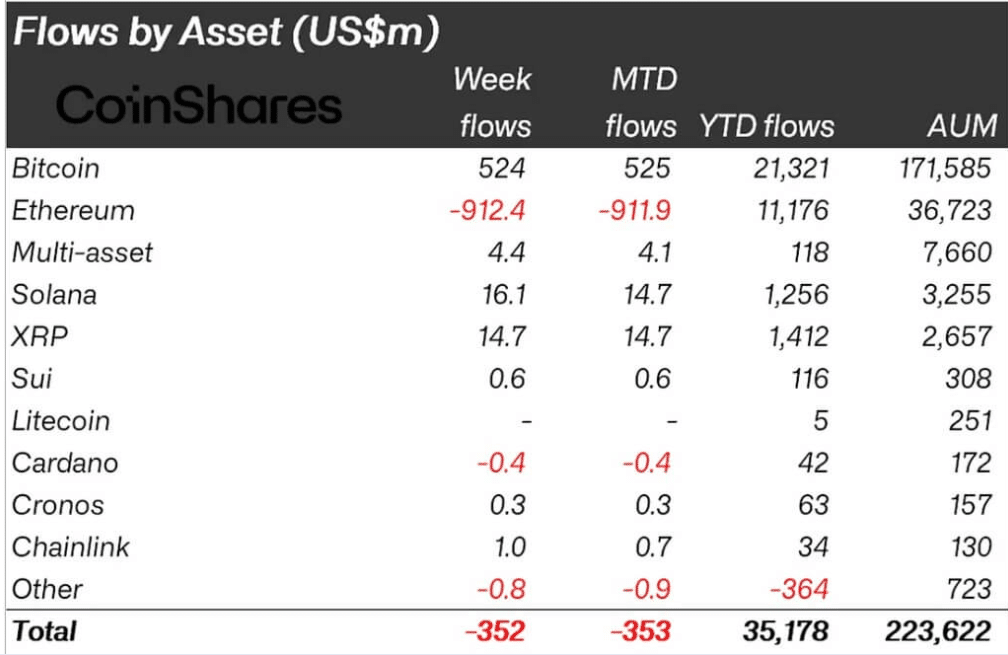
Altcoins have also gained popularity. Solana received $16.1 million in inflows, marking the 21st consecutive week of positive flows and increasing the year-to-date total to $1.16 billion.
XRP followed closely, with $14.7 million in weekly inflows, bringing its YTD total to $1.22 billion. These figures show a market rotation in which investors are progressively diversifying outside Ethereum, bolstering the notion that Ethereum outflows do not reflect weakness in the larger altcoin industry.
Global trends and regional flows
Ethereum outflows are not isolated to a single location. The United States topped the withdrawals, with over $440 million in outflows, demonstrating how domestic investors are driving the slump.
At the same period, Germany received $85.1 million in inflows, while Hong Kong contributed $8.1 million, demonstrating that regional viewpoints remain very different.
According to James Butterfill, a famous research head, overall weekly trading volumes decreased 27% despite persistent forecasts for Fed rate reduction.
“It’s a contradiction: the macro setup is supportive, but investor conviction is cooling,” he said. This paradox explains why Ethereum outflows remain an aberration in an otherwise positive macroeconomic context.
ETF structures are under scrutiny
Another source of Ethereum outflows is U.S.-based spot Ethereum ETFs. These products have seen $1 billion in withdrawals, erasing previous gains of $1.4 billion.
Analysts view the absence of staking yield as a fundamental issue impeding investor confidence. The problem highlights Ethereum’s particular dilemma, since competitors like Bitcoin benefit from simpler, more attractive ETF designs.


While ETF adoption was intended to help Ethereum expand, the opposite has occurred in the short term. With investors looking for income and transparency, Ethereum outflows continue to weigh severely on sentiment.
However, optimists believe that if fundamental changes are made, Ethereum may reclaim its place as an important institutional asset.
Conclusion
The endurance of Ethereum outflows, which have now reached over $912 million in a week, reveals both fundamental issues and changing investor preferences.
While Bitcoin grows and altcoins like Solana and XRP prosper, Ethereum finds itself in a difficult situation. Whether these Ethereum outflows are a momentary setback or a long-term trend will depend on ETF innovation, global legislation, and investor demand in the coming months.
FAQs for Ethereum outflows
Q1: Why are Ethereum outflows increasing?
Ethereum outflows are linked to structural issues in ETFs, including the absence of staking yield, which discourages investor participation.
Q2: How are Bitcoin, Solana, and XRP performing amid Ethereum outflows?
Bitcoin attracted over $500 million in inflows, while Solana and XRP saw strong weekly gains, highlighting a shift in investor focus.
Q3: Are Ethereum outflows limited to the U.S.?
No, Ethereum outflows are global, though the U.S. leads in withdrawals. Europe and Asia have shown more balanced inflows.
Q4: What could reverse Ethereum outflows?
Improved ETF structures with staking yield, positive regulatory clarity, and renewed investor confidence could stem Ethereum outflows.
Glossary
Inflows: Capital moving into an asset or investment product, signaling increased demand.
ETF (Exchange-Traded Fund): A financial product that tracks an asset like Ethereum or Bitcoin, allowing regulated exposure.
Staking Yield: Rewards earned by locking tokens in a proof-of-stake network, currently absent in Ethereum ETFs.
Safe-Haven Asset: An investment seen as secure during market volatility, such as Bitcoin or gold.
Trading Volumes: The total amount of assets exchanged during a given period, used to gauge market activity.