
The debate over crypto stock risk is gaining momentum after new market analysis suggested that buying shares of crypto-related companies may expose investors to more uncertainty than holding Bitcoin itself. Although financial institutions continue to increase their exposure to crypto equities, observers believe that these investments mix digital currency volatility with conventional company risks.
According to recent statistics from CryptoSlate, prominent financial companies invested millions of dollars in crypto equities in June, despite Bitcoin’s poorest monthly performance in years. The development poses an essential question: Are investors lowering their exposure by buying crypto equities, or are they taking on a whole new level of risk?


Crypto Stocks Provide More than just Bitcoin Price Sensitivity
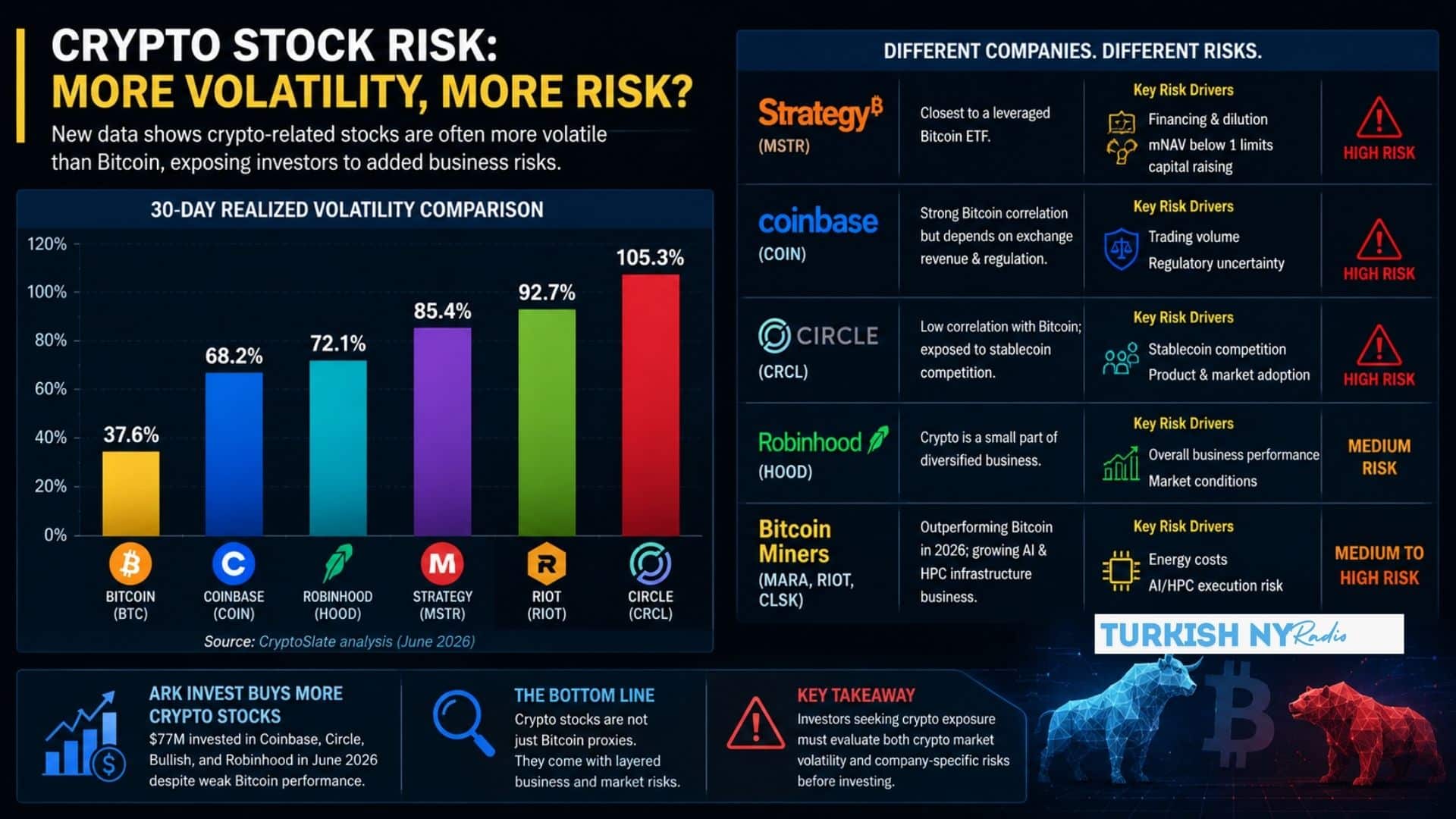
According to the latest data, numerous crypto-related equities have suffered substantially more volatility than Bitcoin in recent months. Bitcoin’s 30-day realized volatility stayed at 37.6%, but other publicly listed crypto businesses reported volatility ranging from 68% to more than 100%.
This rising difference implies that crypto stock risk goes beyond cryptocurrency price fluctuations. Investors face company-specific issues such as diminishing revenues, regulatory uncertainties, leadership choices, competitiveness, and capital-raising tactics.
Based to the paper, investors should no longer believe that every cryptocurrency stock is a straightforward proxy for Bitcoin holdings.

Different Companies Face Different Business Risks
Not all crypto companies respond to market conditions in the same way. Each business model creates its own version of crypto stock risk, making careful evaluation increasingly important.
Strategy remains the closest public-market alternative to holding Bitcoin because its treasury is heavily backed by the cryptocurrency. However, investors suffer dilution risks, financing charges, and corporate debt decision-making, which Bitcoin holders should avoid.
Coinbase continue to profit from greater trading activity during bull market periods, but its success is also dependent on exchange volumes, legislative alterations, and processing revenue.
Circle, despite being closely associated with stablecoins, demonstrated relatively low correlation with Bitcoin prices. Instead, investor sentiment has been shaped by competition within the stablecoin market, proving that crypto stock risk can emerge from entirely different sectors of the digital asset industry.
Meanwhile, Robinhood’s diversified business model has reduced some cryptocurrency-related volatility because crypto represents only one part of its overall revenue stream.
Institutional Investors Continue Buying
Despite these risks, institutional investors continue increasing their exposure to crypto equities. Asset manager ARK Invest reportedly purchased approximately $77 million worth of shares in companies including Coinbase, Circle, Bullish, and Robinhood during June.
The purchases suggest that professional investors still see long-term growth opportunities across the digital asset sector, even if crypto stock risk remains elevated.
Analysts note that institutions may value the operational growth potential of these companies rather than simply seeking exposure to Bitcoin’s price movements.
“Crypto equities should be viewed as operating businesses first and Bitcoin exposure second,” the report concluded, emphasizing that each company’s financial performance depends on unique business fundamentals.
Conclusion
The latest findings challenge the common belief that crypto-related stocks offer a safer alternative to owning Bitcoin. However, buyers frequently anticipate both bitcoin volatility and company-specific unpredictability.
Identifying crypto stock risk has become more critical as business investment floods into publicly traded cryptocurrency startups. Although some companies may outperform Bitcoin given the right conditions, their stock values are still influenced by operational effectiveness, financing techniques, competitive problems, and legislative developments.
Summary
The latest market analysis suggests that crypto stock risk may be greater than many investors expect. Although institutional investors continue to purchase crypto shares, these businesses confront both Bitcoin price volatility and business-specific obstacles. Different organizations react to market situations in different ways, so shareholders should examine each company separately rather than viewing crypto stocks as straight alternatives for Bitcoin holdings. Understanding crypto stock risk is becoming important as institutional investment in the sector grows.
Glossary of Key Terms
Bitcoin (BTC): The globe’s strongest currency by its market value.
Volatility: The extent to which a commodity’s price swings over time.
Crypto Stocks: Are freely traded firms whose operations are directly related to cryptocurrency or blockchain technology.
Stablecoin: A currency that is tied to another property in order to keep its value stable.
Institutional Investor: A major institution, such as a mutual fund or pension fund, that contributes a significant quantity of money.
FAQs for Crypto Stock Risk
1. What is crypto stock risk?
Crypto risk is the coupled risk of cryptocurrency market instability and specific business risks associated with investing in cryptocurrency-related equities.
2. For what reason are cryptocurrency stocks typically more volatile than Bitcoin?
Because investors must consider both online asset price fluctuations and company issues such as profits, legislation, competition, and financial choices.
3. Are cryptocurrency stocks a viable alternative to Bitcoin?
Not necessarily. Many experts believe that crypto stocks react differently since each firm operates in a distinct business environment.
4. Why are institutions still buying crypto stocks?
Numerous financial institutions believe these firms have long-term growth potential that go beyond Bitcoin’s price increase.
5. What information should investors examine before purchasing cryptocurrency stocks?
They should evaluate the company’s business strategy, financial health, regulatory environment, competitive advantage, and exposure to cryptocurrency markets.