


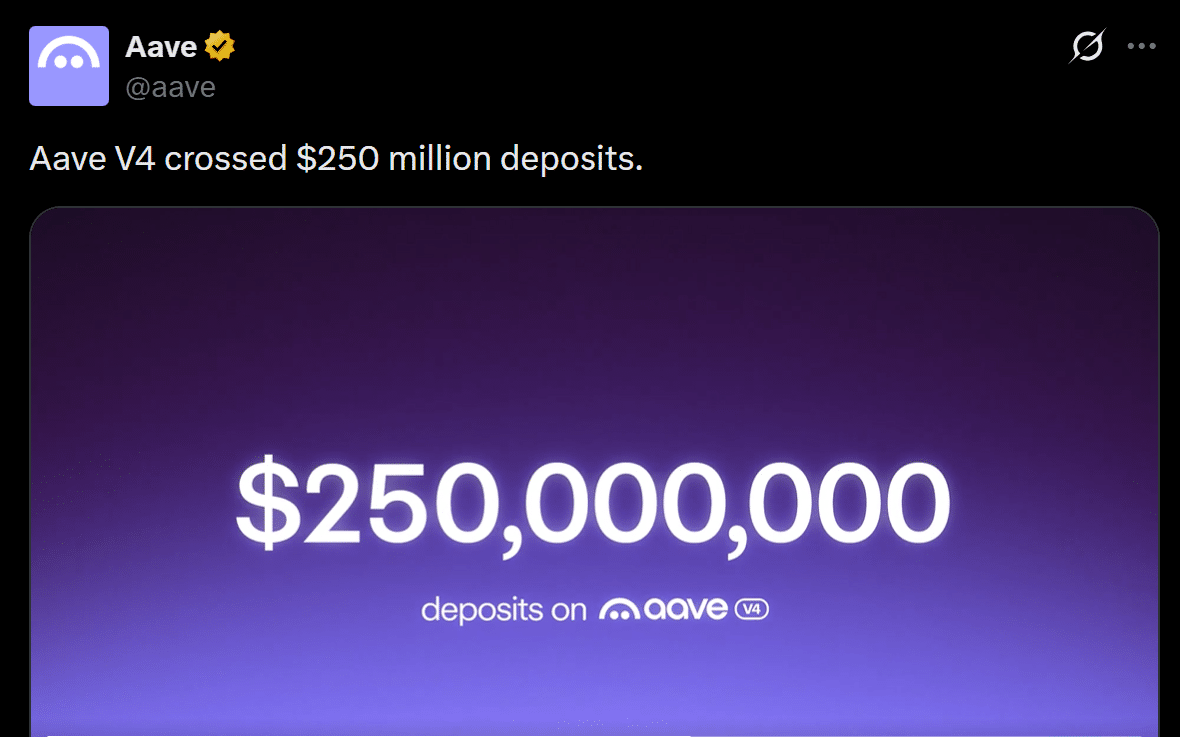
Aave V4 has quietly become one of the more talked-about developments in decentralized lending this year, and the latest figures give reason to pay attention. Deposits into the upgraded protocol have now pushed past 250 million dollars, a milestone that on paper signals renewed trust in the platform’s redesigned architecture.
But peel back the surface, and the picture is more layered than a single headline number suggests. Growth is happening, sure, though not all of it is the kind of growth that moves markets in a meaningful way.
What Is Actually Driving Aave V4 Deposits
A good chunk of the capital flowing into Aave V4 did not arrive fresh off an exchange or a wallet sitting on the sidelines. Instead, it came from users migrating existing positions out of Aave V3 and into the new system.
That is not necessarily a bad thing, since it shows confidence in the upgrade itself, but it does mean the 250 million dollar figure is partly a reshuffling of money that was already inside the Aave ecosystem rather than a genuine influx of outside capital.
Analysts tracking the protocol have pointed out that this distinction matters quite a bit going forward. If Aave V4 wants to be seen as the dominant lending venue rather than just a shinier version of what came before, it needs net new liquidity to keep outpacing the migration numbers.
The Bigger TVL Picture Tells a Mixed Story
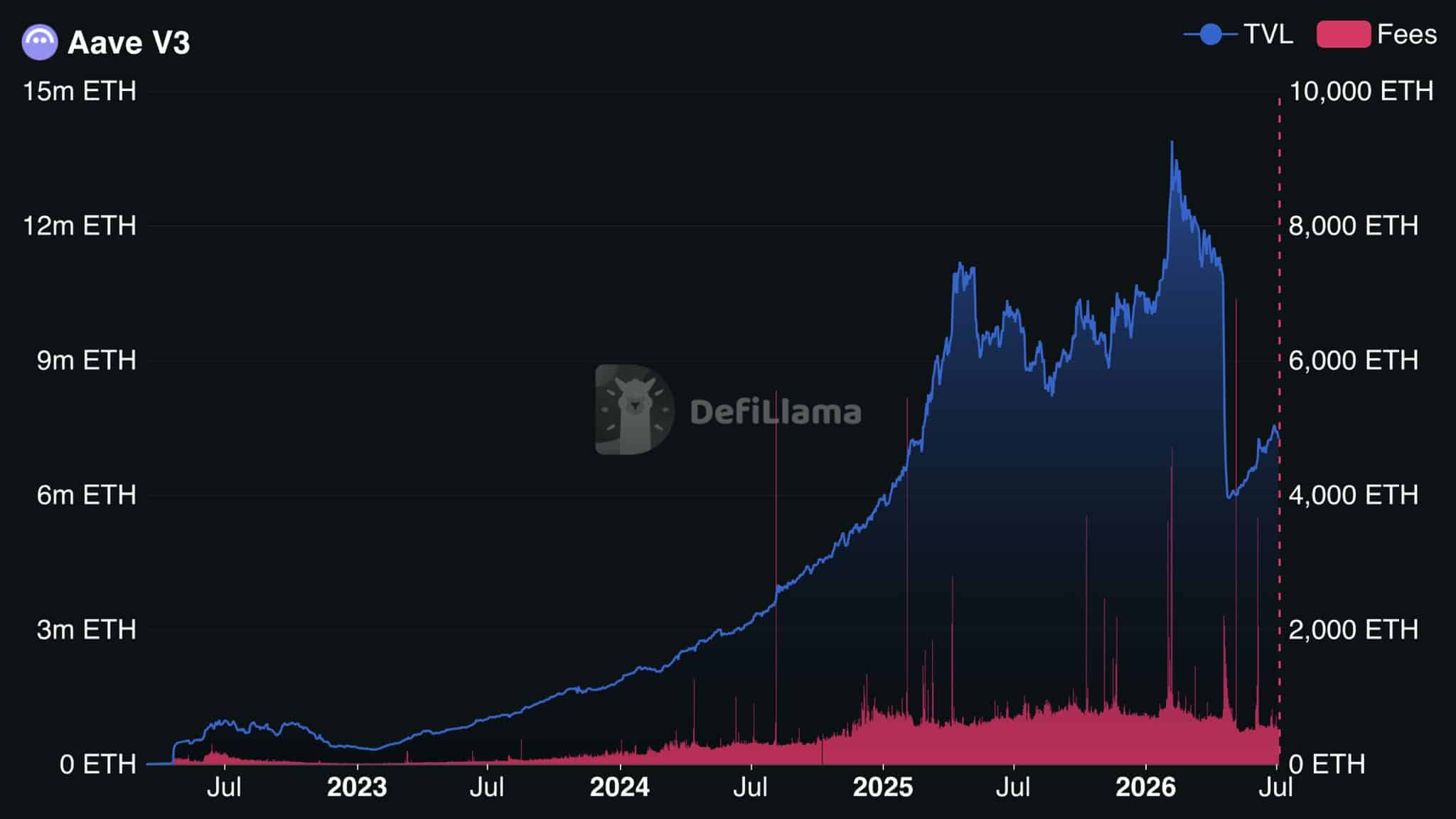
Total value locked across Aave paints a picture that is nowhere near as tidy as the V4 headline suggests. At its peak, the protocol’s TVL climbed to roughly 13.4 million ETH before the broader market downturn hit hard, wiping out a substantial portion of that figure almost overnight.
Since then, recovery has been steady but far from complete, with TVL now sitting around 7.4 million ETH, which is still close to half of where it once stood. Sentiment across the lending sector has undeniably improved in recent months, yet a good portion of the capital that left during the downturn simply has not returned. Withdrawals continue to chip away at fresh inflows too, which puts a cap on how quickly the platform can climb back toward its previous highs.
cbETH Emerges as a Quiet Bright Spot
One asset stands out amid the otherwise uneven recovery. Deposits of cbETH, a liquid staking token, have surged from around 18 to 20 million dollars in May to nearly 70 million dollars by early July.
That is not a small jump, and it hints at renewed appetite for liquid staking collateral across the broader DeFi landscape. This kind of demand tends to reinforce lending capacity even when the overall TVL trend remains sluggish, and it gives Aave a foothold of genuine momentum to build on while other parts of the balance sheet catch up.
Two Narratives Running Side by Side
The truth is that Aave right now is living two separate narratives at once. On one hand, Aave V4 hitting the 250 million dollar mark is a genuinely encouraging sign of product confidence and technical execution.
On the other, the wider liquidity recovery across the protocol remains a work in progress, propped up in part by strong demand for staking assets rather than a full comeback of capital that exited during the downturn. Whether Aave V4 can turn early enthusiasm into durable, organic growth will likely depend on how the next few months of deposit data unfold, particularly whether new liquidity keeps arriving once the migration wave from V3 tapers off.
Frequently Asked Questions
What is Aave V4?
It is the newest version of the Aave lending protocol, built with reworked risk parameters and improved capital efficiency.
Why does the 250 million dollar figure need context?
Because a large share of it reflects users moving funds from Aave V3 rather than entirely new deposits.
What is cbETH?
It is a liquid staking token representing staked ETH on Coinbase, usable elsewhere in DeFi while still earning staking rewards.
Has Aave’s TVL fully recovered?
No, current TVL near 7.4 million ETH remains well below the prior peak of 13.4 million ETH.
Glossary of Key Terms
TVL (Total Value Locked): The total dollar value of assets deposited in a protocol at a given time.
Liquid Staking Token: A token representing staked crypto that can still be traded or used elsewhere while earning staking rewards.
Capital Efficiency: How effectively a protocol allows deposited assets to be used for lending or borrowing without idle waste.
Net New Liquidity: Fresh capital entering a protocol, as opposed to funds simply shifted from one internal product to another.
Disclaimer: This article is for informational purposes only and does not constitute financial or investment advice.
Sources