
The crypto market is starting to look less one-sided. After months of Bitcoin-led momentum, analysts are now watching early signs that capital may be rotating back into smaller crypto assets. The shift is not confirmed yet, and that point matters.
Still, three indicators are catching attention: more Binance-listed altcoins reclaiming their 200-day moving average, stronger altcoin trading volume on centralized exchanges, and a firmer TOTAL2 market structure, which tracks the crypto market outside Bitcoin. Together, they suggest that the next phase of market risk appetite may be forming quietly rather than arriving with a loud breakout.


Altcoin Season Starts With Market Breadth, Not Hype
The altcoin season is easy to throw around, but the real signal comes from breadth. A healthy altcoin rally is not built on 2 or 3 tokens pumping for a day. It usually needs wider participation, stronger volume, and proof that buyers are willing to hold positions beyond short-term speculation.
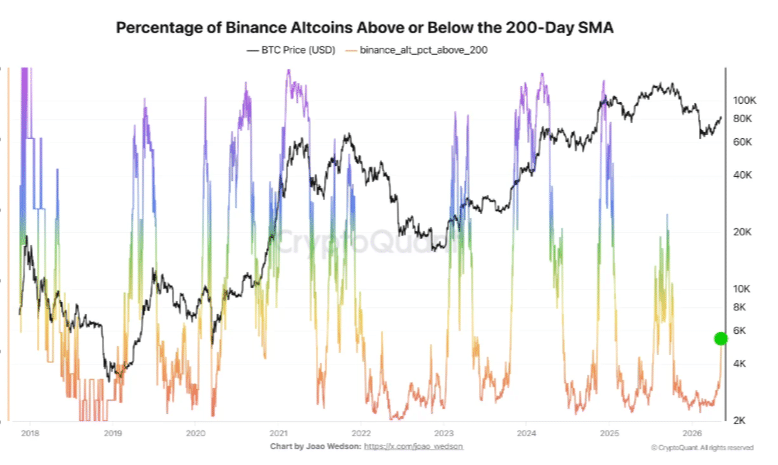
That is why the latest Binance-linked data matters. Around 21% of altcoins listed on Binance have reclaimed their 200-day moving average, up from only about 2% in February. The 200-day moving average is one of the clearest long-term trend filters in crypto. When an asset trades above it, traders often read that as a sign that the market is moving out of a weak phase and into early recovery.
Still, 21% is not enough to call a full altcoin season. In stronger cycles, analysts often look for 60% to 80% of altcoins trading above that level before calling it a broad rotation. The current reading looks more like the first green shoot after a dry spell, not a full harvest.
Volume Is Starting to Tell a Different Tale
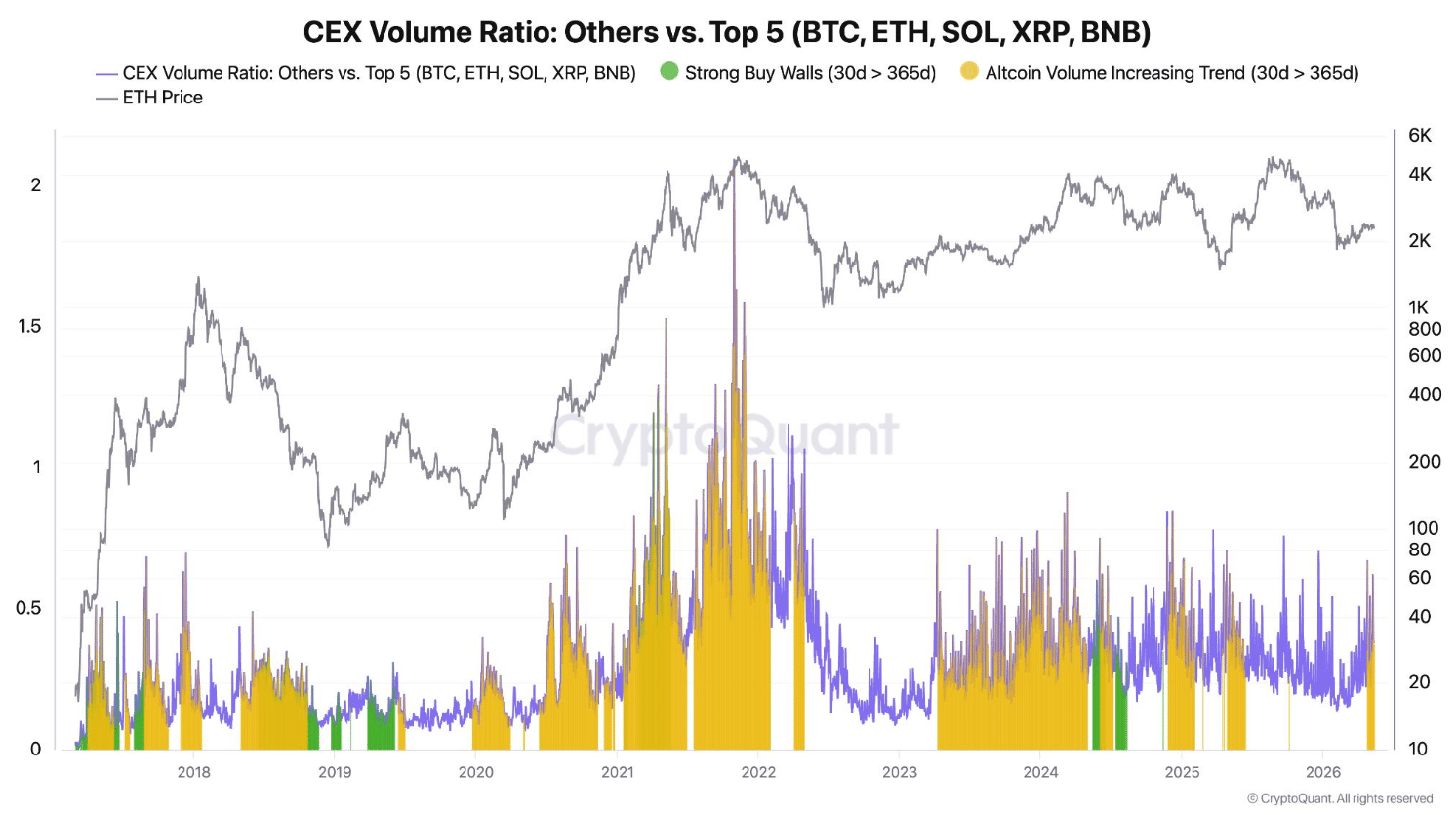
Price can move on thin liquidity, but volume gives the move its backbone. One of the more useful signals now comes from altcoin trading volume on centralized exchanges, excluding the largest coins. The 30-day moving average has reportedly crossed above the 365-day moving average, a setup that can show fresh interest in mid-cap and lower-cap assets.
This matters because altcoins often need fresh liquidity before price momentum becomes durable. Without volume, rallies can fade fast. With volume, dips may attract buyers instead of panic sellers. It is the difference between a crowded room and a room with only background noise.
For traders, this kind of volume shift does not mean every token is ready to run. It means the market is becoming more selective. Stronger projects with active liquidity, real user demand, clear narratives, or improving charts may attract capital first. Weak tokens with poor depth may still struggle, even if the wider market improves.
TOTAL2 Shows Whether Rotation Has Real Weight
Another key indicator is TOTAL2, the market capitalization of crypto assets excluding Bitcoin. TOTAL2 is useful because it gives traders a cleaner view of whether altcoins are gaining value as a group. When TOTAL2 strengthens, it suggests money is not only hiding in Bitcoin but spreading into the rest of the market.
A stronger TOTAL2 structure can support the altcoin season argument, especially if it comes with rising volume and improving market breadth. But the chart still needs follow-through. A clean breakout, higher lows, and sustained buying would make the case stronger. Without that, the market may remain in a transition phase where altcoins bounce but Bitcoin still controls direction.
This is where many traders get caught as they see 1 strong week and assume the cycle has flipped. In reality, crypto rotations often move in stages. Bitcoin usually leads first. Large-cap altcoins follow. Then, if risk appetite keeps building, mid-caps and smaller tokens begin to move. The current setup looks like the market may be entering that middle phase, but confirmation is still pending.
The Altcoin Season Index Is Improving, But Still Cautious
The Altcoin Season Index also points to early improvement, though it remains far from full confirmation. Recent readings show the index near the high 20s, while some market trackers define altcoin season as a period when 75% of the top 100 altcoins outperform Bitcoin over 90 days. A reading near 27 or 28 suggests that Bitcoin still holds the advantage, even as more altcoins begin to catch up.
That gap is important. It shows why the current move should be treated as an early rotation, not a confirmed market-wide breakout. Bitcoin reportedly gained around 17% over the recent 90-day window, while select names such as Zcash, Bittensor, and Morpho stood out among stronger performers.
In plain terms, the market is improving, but it is not yet broad enough to support careless risk-taking. The stronger trade may be in watching which assets hold support after rallies, not chasing every green candle.
Price Analysis: What Traders Should Watch Next
The first key level is the 200-day moving average across more altcoins. If the share of Binance-listed tokens above that level rises from 21% toward 40%, it would show broader improvement. A jump toward 60% would make the altcoin season case much stronger.
The second signal is volume quality. Traders should watch whether the 30-day volume average stays above the 365-day average. If it rolls over quickly, the market may be dealing with a short-term bounce. If it expands while prices hold higher lows, that would suggest real accumulation.
The third signal is Bitcoin dominance. If Bitcoin dominance cools while TOTAL2 rises, the setup would support capital rotation into altcoins. But if Bitcoin dominance rises again, altcoins may lose steam. In past cycles, this handoff has often decided whether smaller crypto assets extend gains or give back early moves.
The fourth signal is sector leadership. A stronger altcoin season usually does not lift every sector at once. Privacy coins, AI-linked tokens, DeFi assets, gaming tokens, and Layer 1 networks often rotate at different speeds. Traders should look for leadership clusters instead of assuming the whole market will move together.
Conclusion
The latest indicators suggest that the altcoin market is no longer asleep, but it is also not fully awake. More Binance-listed altcoins are reclaiming long-term trend levels, exchange volume is improving, and TOTAL2 is showing better structure. Those are constructive signals, especially after a long period where Bitcoin carried most of the market’s confidence.
Even so, the evidence still points to an early-stage rotation rather than a confirmed altcoin season. The next test is simple: more breadth, more volume, and stronger follow-through. If those pieces align, altcoins may have room to extend. If they fail, this could remain another short-lived relief rally.
Frequently Asked Questions
What is altcoin season?
Altcoin season is a market phase where a large share of major altcoins outperform Bitcoin over a set period, often 90 days.
Is altcoin season confirmed now?
No. Current indicators show early improvement, but the Altcoin Season Index remains far below the 75 level usually linked with confirmation.
Why does the 200-day moving average matter?
The 200-day moving average helps traders judge long-term trend strength. When more altcoins trade above it, market breadth is improving.
What is TOTAL2 in crypto?
TOTAL2 measures the total crypto market cap excluding Bitcoin. It helps show whether capital is moving into altcoins as a group.
Which indicators matter most right now?
Market breadth, exchange volume, Bitcoin dominance, TOTAL2 structure, and the Altcoin Season Index are the main indicators to watch.
Glossary of Key Terms
Altcoin: Any cryptocurrency other than Bitcoin.
200-day moving average: A long-term trend line based on the average closing price over 200 days.
TOTAL2: The total crypto market capitalization excluding Bitcoin.
Bitcoin dominance: Bitcoin’s share of the total crypto market cap.
Market breadth: The number of assets taking part in a market move.
Sources
Disclaimer: This article is for informational purposes only and does not provide financial advice. Crypto assets are volatile, and readers should do independent research before making investment decisions.