
Money talks in Washington, and right now it is speaking with a distinctly digital accent. Crypto election spending has climbed to 189 million dollars for the 2026 midterm cycle, according to Federal Election Commission filings compiled by the watchdog group Public Citizen. That figure alone makes the industry the single largest corporate political spender in the country this cycle, and it is not particularly close.
For context, that number beats the 2024 total of 170 million dollars, which was already considered eye-popping at the time. Nearly 20 million dollars more has flowed into campaign coffers this time around, and the pace suggests the industry has no intention of slowing down before November.


Crypto Election Spending Outpaces Every Other Sector
To put this in perspective, crypto election spending is now roughly triple what the artificial intelligence and big tech sector has committed, which sits around 60 million dollars. Sports betting interests landed in third place, trailing well behind both.
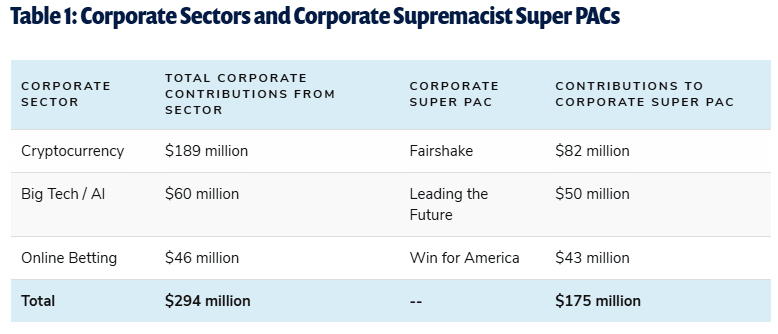
Total corporate political spending across every industry has reached 517.5 million dollars so far this cycle, meaning crypto alone accounts for about 36.5 percent of it. That is more than a third of all corporate money entering the 2026 elections, coming from an industry that barely registered on Capitol Hill’s radar a decade ago.
It is worth pausing on that shift. A sector once dismissed as a fringe experiment for tech enthusiasts and speculators now outspends pharmaceutical giants, defense contractors, and Silicon Valley’s biggest names combined, at least in this particular arena.
Who Is Writing the Biggest Checks
At the company level, venture capital firm a16z leads the pack with 51.65 million dollars committed. Ripple Labs follows close behind at roughly 50 million dollars. Crypto.com and Coinbase round out the top donors with 38 million and 35 million dollars respectively.
Most of that cash has been funneled through Fairshake, a political action committee that has become something of a kingmaker for the industry. The group has concentrated its efforts in a handful of battleground states, including Georgia, Alabama, Nebraska, Kentucky, and Texas, working to unseat candidates seen as hostile to digital assets while backing those willing to play ball.
Coinbase stands apart from the pack in one notable way. While most crypto election spending has gravitated toward Republican candidates, largely because of the party’s warmer posture toward digital assets under President Trump, Coinbase has continued backing Democrats who support crypto-friendly regulation. It is a hedge, of sorts, and a reminder that this fight is not purely partisan even if it often looks that way from the outside.
Not Everyone Is Cheering the Numbers
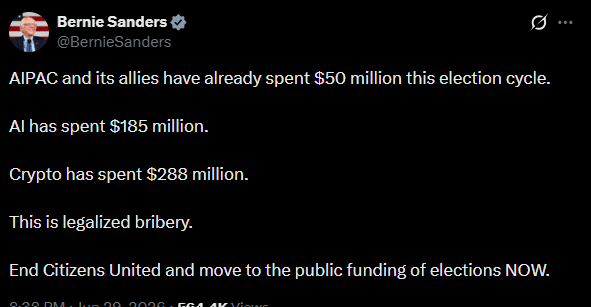
Senator Bernie Sanders has pegged the real total closer to 288 million dollars using his own calculations, and he did not hold back in his assessment, calling the practice legalized bribery. Whether or not one agrees with that characterization, it captures the unease plenty of lawmakers feel watching an industry buy this much influence in such a short window.
What the Industry Is Actually Fighting For
None of this spending happens in a vacuum. Crypto’s lobbying muscle in 2024 helped tilt the election toward Trump, and the payoff has been tangible. Gary Gensler’s SEC, long viewed as an adversary by the industry, was replaced with a friendlier regime.
The GENIUS Act delivered long-awaited clarity on stablecoin rules. Regulators even opened an investigation into crypto debanking practices, and banks have been nudged toward deeper integration with digital asset firms.
The one prize still out of reach is the CLARITY Act, a bill meant to settle broader market structure questions once and for all. It remains stuck behind a packed Senate calendar, and there is a real chance it slips into 2027, leaving its fate to whichever Congress takes office after the midterms.
That uncertainty explains the urgency behind this round of crypto election spending. The industry wants friendly faces in office who can push the bill across the finish line rather than watch existing gains unravel.
Conclusion
The scale of crypto election spending in 2026 signals something bigger than a single legislative fight. It reflects an industry that has matured into a political heavyweight, willing to spend at a level that rivals or exceeds far older, more established sectors.
Whether voters see that as smart advocacy or something closer to Senator Sanders’ description likely depends on which side of the regulatory debate they sit on. Either way, the money is already on the table, and its influence on the next Congress will be hard to ignore.
Frequently Asked Questions
How much has the crypto industry spent on the 2026 midterms?
Roughly 189 million dollars, according to FEC filings tracked by Public Citizen, making it the top corporate spender this cycle.
Which crypto firm has donated the most?
Venture firm a16z leads with 51.65 million dollars, followed by Ripple Labs at around 50 million dollars.
What is the CLARITY Act?
A proposed bill meant to establish clear market structure rules for digital assets in the United States. It has not yet passed the Senate.
Why is Coinbase donating to Democrats while other firms back Republicans?
Coinbase has chosen to support pro-crypto candidates across both parties, rather than aligning exclusively with one side.
Glossary of Key Terms
FEC (Federal Election Commission): The federal agency responsible for tracking and regulating campaign finance in the United States.
PAC (Political Action Committee): An organization that pools donations to support or oppose political candidates.
Stablecoin: A type of cryptocurrency designed to hold a steady value, usually pegged to a currency like the US dollar.
Market structure bill: Proposed legislation that defines how digital assets are classified and regulated, such as the CLARITY Act.
Debanking: The practice of banks refusing service to individuals or businesses, in this case crypto-related firms, often over regulatory concerns.
Sources